Change management after generative AI & automation: ChatGPT, Claude, Copilot, AI agents, adoption & governance
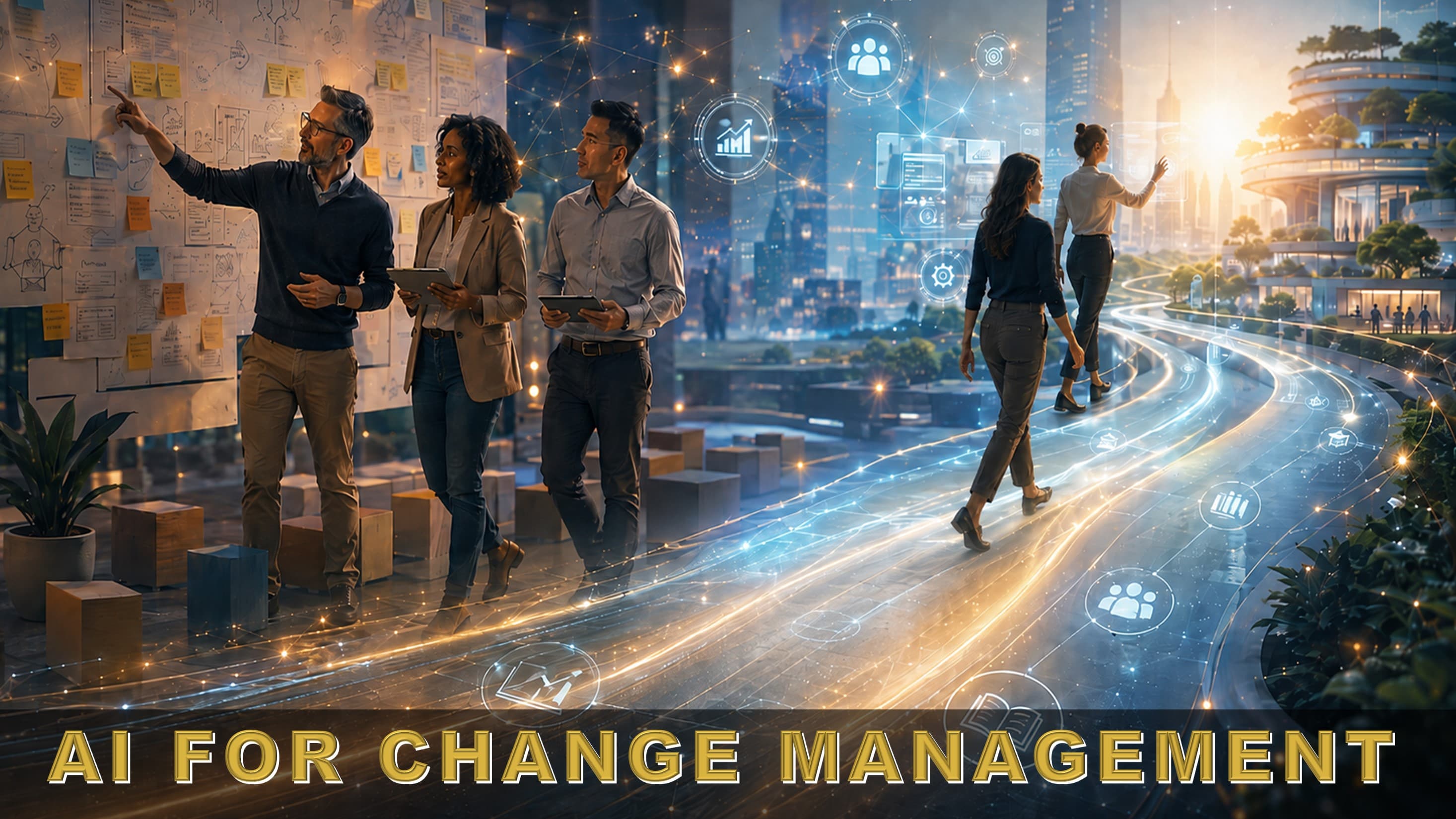
This course contains the use of artificial intelligence. AI tools are used in the production of this course, including AI-assisted speech delivery based on the instructor’s own voice. All content, demonstrations, workbooks, and prompts have been personally designed, reviewed, and verified by the instructor to ensure accuracy and practical value.
Change management is being rewritten. Generative AI and automation have compressed change cycles from quarters into weeks, put AI-generated analysis into everyday decisions, and pushed automation into knowledge work itself. The frameworks most of us trained on — Kotter, Prosci and their peers — were designed for slower, more linear change, and several of their assumptions no longer hold.
This course is a practical, hands-on guide to leading change in an AI-native organisation. You will not just learn about AI — you will use it, on real change work, in every section. No technical background is needed, and no coding is involved.
What you will cover:
You will build a working mental model of the four AI layers that matter — generative AI, predictive and analytical AI, agents and tool use, and enterprise integration — then apply them across the tools your organisation actually uses: ChatGPT, Claude and Microsoft 365 Copilot in Word, Excel, Teams and PowerPoint. You will master a five-part prompt structure that turns AI into a reliable drafting partner for leadership briefings, stakeholder emails, FAQs, change plans, risk logs and training content, and build a reusable prompt library for your team. You will work with agent mode and automated workflows, learning where to place human checkpoints and how to supervise delegated work.
From there, the course walks the full change lifecycle: AI-supported discovery and readiness assessment, change strategy and design, communications, engagement and training, then adoption, reinforcement and measurement. You will look at functional and sector use cases, role-based adoption pathways, and the human side that decides whether change sticks — fear, fatigue, deskilling, trust, transparency and clear human accountability. Finally, you will build the governance to do this responsibly: risk management for agentic workflows, a workable AI governance operating model, and an AI adoption roadmap and capability plan for your own team.
Every section ends with a practical exercise you can run on a live initiative. By the end you will have a repeatable AI-enabled change method, a prompt and template library, and the confidence to lead AI adoption — rather than be led by it. Enrol now and start applying it to your next change programme this week.
Who this course is for:

CEO of AI Awareness Limited | 25+ years in IT training | Helping non-technical professionals go from AI-curious to AI-confident
Grant Gamble has spent over 25 years in IT and technology training, working with businesses across the UK on practical AI adoption. He is CEO of AI Awareness Limited and founder of G Com Solutions Limited, and specialises in helping non-technical professionals move from AI-curious to AI-confident through hands-on, domain-specific training and certification. Grant's view is that AI is not a single tool but a set of capabilities spread across every department, often underused or ungoverned. The organisations making real progress are not the ones running generic awareness programmes; they are the ones mapping specific AI capabilities to specific workflows and giving their people the time and permission to use them. His courses take exactly that approach. His teaching covers practical AI literacy for non-technical professionals, AI skills and workforce readiness, and the governance and responsible use of AI at work. Expect a hands-on style: real business examples, clear explanations of why each technique works, and skills you can apply to your own work straight away.
Professional development requirements vary by profession, country, and regulatory body. Before enrolling, review the course details and confirm that the content, learning format, and any listed credits meet your specific requirements. You are responsible for confirming eligibility with your regulator or professional association and keeping the records required for reporting.
