Practical Strategies for Structural Protection, Ductile Performance, Progressive Collapse Mitigation, and Post-Event Damage Evaluation
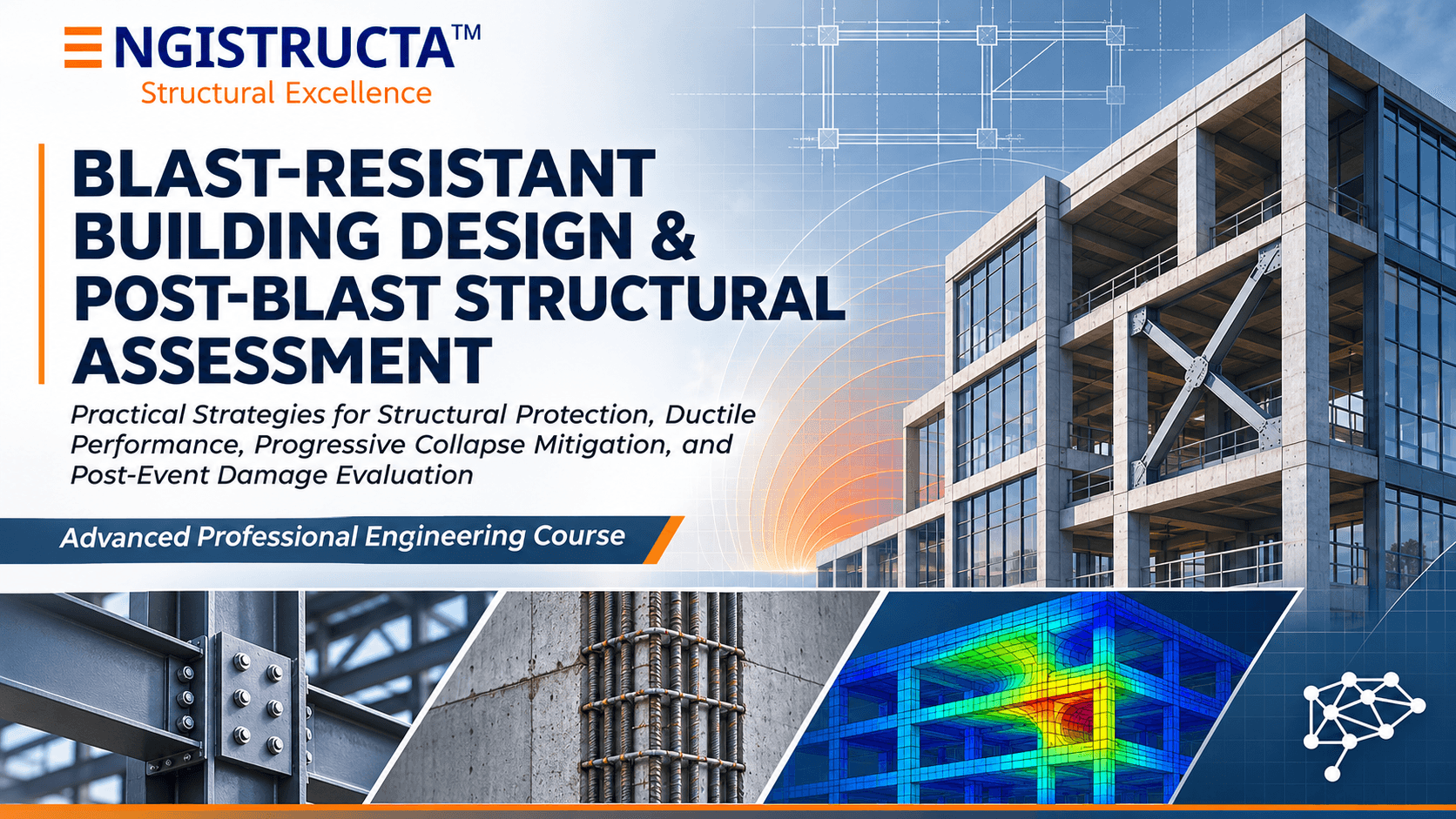
Blast events present complex engineering challenges that extend beyond the immediate resistance of individual structural members. The resulting demands may affect building configuration, load paths, structural connections, protective barriers, and the overall stability of a facility. For practicing structural engineers, addressing these challenges requires a coordinated understanding of protective design strategies, structural behavior under extreme loading, progressive-collapse mitigation, and post-event damage assessment.
Blast-Resistant Building Design & Post-Blast Structural Assessment is a practical, technically focused professional engineering course developed for civil and structural engineers involved in structural design, engineering review, protective construction, and building assessment. Organized into seven chapters, the course examines the engineering principles and practical considerations governing blast-related structural protection and the evaluation of damaged buildings.
The course begins with protective site planning, blast-demand reduction, standoff distances, and protective barrier systems. It then examines building configuration and structural-system selection, followed by the performance of reinforced concrete, ultra-high-performance concrete (UHPC), and concrete-filled steel columns. Particular attention is given to ductile structural behavior, reinforcement detailing, dynamic response, acceptable damage levels, and the mechanisms that influence structural integrity under extreme loading conditions.
Progressive-collapse mitigation is addressed through alternate-load-path concepts, structural continuity, and supplementary cable systems. The course subsequently develops a structured approach to post-event building inspection, damage classification, field documentation, and engineering evaluation. Emphasis is placed on distinguishing observable damage from analytical conclusions and identifying when additional investigation, structural analysis, or specialized testing is necessary.
The final chapter presents an applied reinforced-concrete building case study using three-dimensional SAP2000 V21 modeling and a GSA-based notional column-removal procedure. The assessment examines alternate-load-path behavior, nonlinear dynamic response, structural load redistribution, plastic-hinge development, and damage evaluation. The case study provides an opportunity to examine the application of progressive-collapse assessment procedures within a practical structural-engineering context. It is important to distinguish this assessment from a numerical simulation of an explosive event.
Throughout the course, engineering principles, recognized technical references, structural illustrations, inspection procedures, and applied analytical material are integrated to support informed engineering judgment. The material is intended to strengthen the participant's ability to evaluate protective-design strategies, review structural vulnerabilities, interpret post-event damage, and develop technically defensible preliminary recommendations for further investigation, repair, strengthening, or other appropriate engineering actions.
The course is structured for practicing professionals and assumes familiarity with reinforced-concrete and structural-steel design, structural analysis, load paths, and engineering detailing.
2 activities • 1 chapters • duration: 3 hours

Professor of Reinforced Concrete Structures | Structural & Forensic Engineering Consultant | Wyoming-Licensed P.E. | CPD Course Author
Dr. Ibrahim M. Metwally, Ph.D., P.E., is a Wyoming-licensed Professional Engineer specializing in civil and structural engineering, structural and forensic engineering consultancy, and continuing professional education. He serves as Professor of Reinforced Concrete Structures at the Housing and Building National Research Center (HBRC) in Cairo, Egypt. He is the Founder and Principal Consultant of ENGISTRUCTA™ | Structural Excellence, a structural and forensic engineering consulting practice registered in Wyoming. He is also registered as an independent structural engineering consultant with the Wyoming Department of Transportation (WYDOT) and as a structural consulting engineer with Egypt’s Ministry of Housing, Utilities and Urban Communities. With more than 30 years of academic, research, and professional experience, Dr. Metwally specializes in structural analysis and design, forensic investigation, structural assessment, rehabilitation and strengthening, seismic and wind engineering, performance-based evaluation, and advanced nonlinear finite element analysis. His technical expertise encompasses reinforced concrete, structural steel, prestressed and post-tensioned concrete, deep foundations, structural masonry, bridges, buildings, and infrastructure systems. His professional experience includes the design, review, evaluation, rehabilitation, and failure investigation of major structures across Egypt and the Arabian Gulf region, including projects involving deterioration, structural distress, complex loading conditions, and extreme environmental effects. His academic and research interests include ultra-high-performance concrete (UHPC), fiber-reinforced polymer (FRP) structural systems, large-scale experimental testing, seismic performance, and the behavior of concrete structures under extreme loading. As an author and technical reviewer of continuing professional development (CPD) courses for professional engineers, Dr. Metwally integrates current codes and standards, advanced technical knowledge, worked examples, and practical engineering judgment. His educational materials help practicing engineers strengthen their capabilities in structural design, assessment, rehabilitation, forensic engineering, and code compliance.
Professional development requirements vary by profession, country, and regulatory body. Before enrolling, review the course details and confirm that the content, learning format, and any listed credits meet your specific requirements. You are responsible for confirming eligibility with your regulator or professional association and keeping the records required for reporting.
