A Practical Guide to Applying the ASCE 7-22 Envelope Procedure in Building Wind-Load Design.
COURSE OVERVIEW
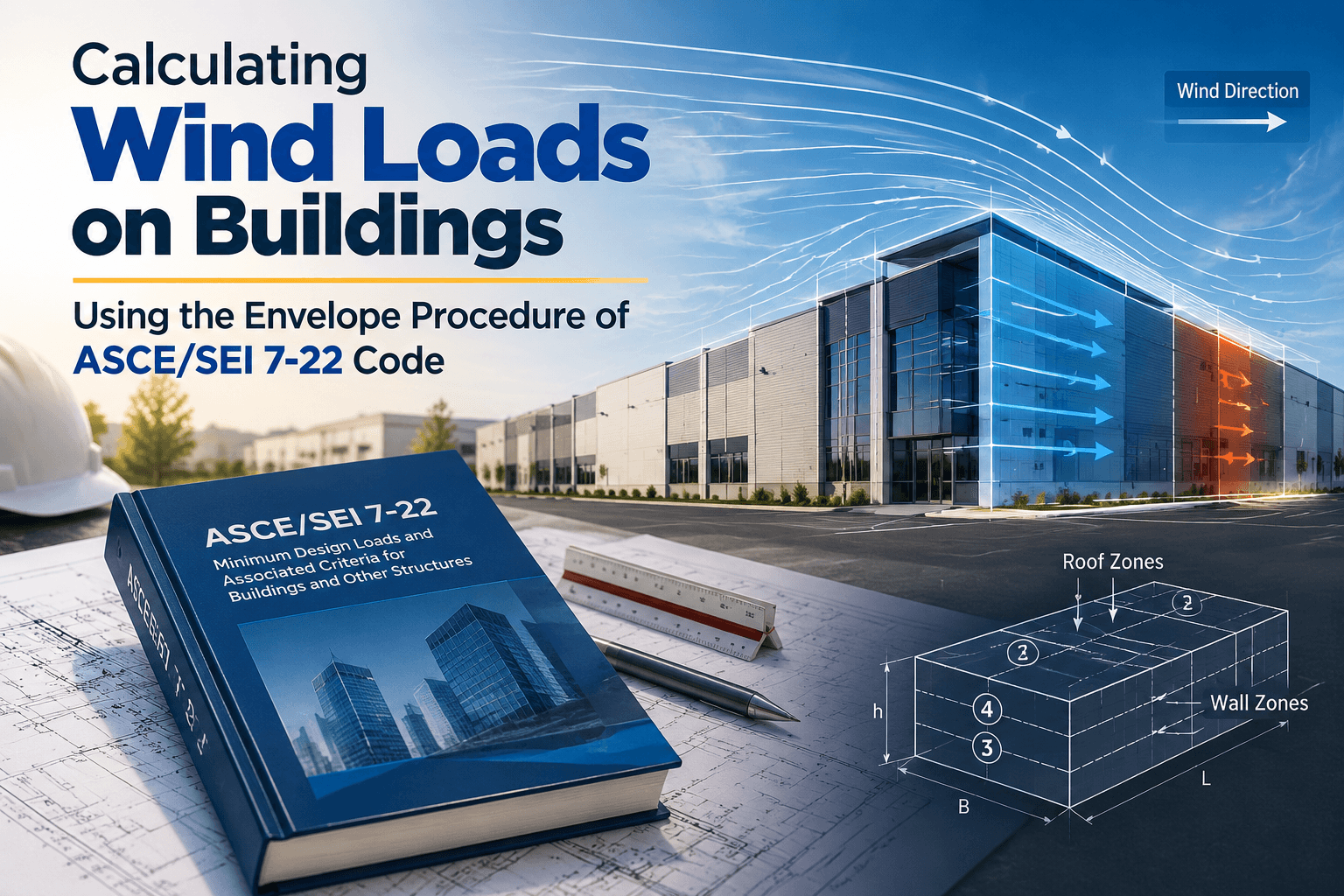
This practical 2-PDH course provides structural engineers with a clear, step-by-step approach to calculating and applying wind loads on low-rise buildings using the Main Wind Force Resisting System Envelope Procedure of ASCE/SEI 7-22.
The course explains when the Envelope Procedure may be used, how it differs from the Directional Procedure, and how to determine the principal wind-design parameters required by the standard. Topics include risk category, basic wind speed, exposure category, topographic effects, ground-elevation effects, enclosure classification, internal pressure coefficients, external pressure coefficients, velocity pressure, design wind pressures, and required load cases.
A detailed worked example demonstrates the complete manual calculation of wind pressures for a low-rise commercial warehouse building. The course also shows how the same building is evaluated using Tekla Tedds software, allowing participants to compare manual code-based calculations with professional software output.
Special attention is given to the correct application of pressures to building surfaces, the treatment of positive and negative internal pressures, roof and wall zones, and the basic and torsional load cases required by ASCE/SEI 7-22.
By completing this course, participants will be better prepared to determine whether the Envelope Procedure is applicable, calculate wind design pressures, apply the required loading patterns, and review software-generated results using sound engineering judgment.
Once you complete your course review, you need to take a multiple-choice quiz consisting of fifteen (15) questions to earn 2 PDH credits. The quiz will be based on the entire file.
LEARNING OBJECTIVES
Upon successful completion of this course, participants will be able to:
Intended Audience
This course is intended for structural engineers, civil engineers, consulting engineers, forensic engineers, licensed professional engineers, building officials, plan reviewers, designers of low-rise buildings, advanced engineering students, and other professionals involved in the analysis, design, review, or assessment of buildings subjected to wind loading.
2 activities • 1 chapters • duration: 2 hours

Professor of Reinforced Concrete Structures | Structural & Forensic Engineering Consultant | Wyoming-Licensed P.E. | CPD Course Author
Dr. Ibrahim M. Metwally, Ph.D., P.E., is a Wyoming-licensed Professional Engineer specializing in civil and structural engineering, structural and forensic engineering consultancy, and continuing professional education. He serves as Professor of Reinforced Concrete Structures at the Housing and Building National Research Center (HBRC) in Cairo, Egypt. He is the Founder and Principal Consultant of ENGISTRUCTA™ | Structural Excellence, a structural and forensic engineering consulting practice registered in Wyoming. He is also registered as an independent structural engineering consultant with the Wyoming Department of Transportation (WYDOT) and as a structural consulting engineer with Egypt’s Ministry of Housing, Utilities and Urban Communities. With more than 30 years of academic, research, and professional experience, Dr. Metwally specializes in structural analysis and design, forensic investigation, structural assessment, rehabilitation and strengthening, seismic and wind engineering, performance-based evaluation, and advanced nonlinear finite element analysis. His technical expertise encompasses reinforced concrete, structural steel, prestressed and post-tensioned concrete, deep foundations, structural masonry, bridges, buildings, and infrastructure systems. His professional experience includes the design, review, evaluation, rehabilitation, and failure investigation of major structures across Egypt and the Arabian Gulf region, including projects involving deterioration, structural distress, complex loading conditions, and extreme environmental effects. His academic and research interests include ultra-high-performance concrete (UHPC), fiber-reinforced polymer (FRP) structural systems, large-scale experimental testing, seismic performance, and the behavior of concrete structures under extreme loading. As an author and technical reviewer of continuing professional development (CPD) courses for professional engineers, Dr. Metwally integrates current codes and standards, advanced technical knowledge, worked examples, and practical engineering judgment. His educational materials help practicing engineers strengthen their capabilities in structural design, assessment, rehabilitation, forensic engineering, and code compliance.
Professional development requirements vary by profession, country, and regulatory body. Before enrolling, review the course details and confirm that the content, learning format, and any listed credits meet your specific requirements. You are responsible for confirming eligibility with your regulator or professional association and keeping the records required for reporting.
