Master inclusive design principles to create safe, empowering, and accessible environments that enhance the quality of life for Canada's growing aging and dementia populations.
Canada’s aging population is reshaping the demands placed on architects, planners, and healthcare designers. As more projects seek to support older adults living with frailty, sensory changes, and dementia, the design of the physical environment has become a critical factor in promoting wellbeing, independence, and quality of life. Thoughtful design decisions can reduce confusion, support daily routines, encourage mobility, and foster meaningful social engagement.
This session explores evidence-based design strategies for aging and dementia-friendly environments, drawing on principles of environmental gerontology and research in long-term care and senior living. Participants will examine how lighting, acoustics, wayfinding, material selection, outdoor access, and spatial organization influence behaviour and experience. With a practical focus on decisions made during planning and design stages, the program provides actionable insights for creating environments that preserve dignity, support autonomy, and enable older adults to remain connected to their communities.
Key Topics Discussed:

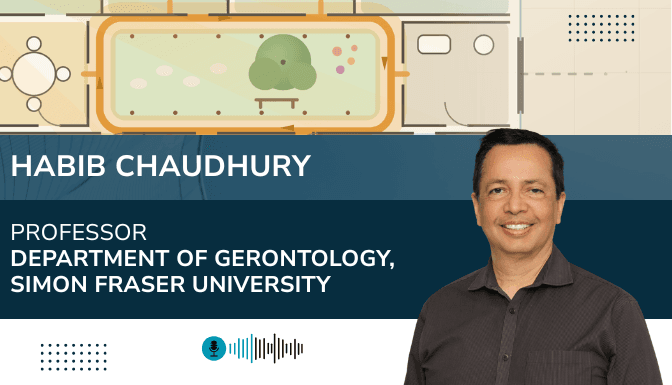
Professor | Department of Gerontology, Simon Fraser University
Dr. Habib Chaudhury, Professor in the Department of Gerontology, has extensive research experience in the field of environmental gerontology. He conducts research and consulting work in the following areas: physical environment for people with dementia in long-term care facilities, dementia-inclusive communities, and community planning and urban design for age-friendly communities. Projects have been funded by the Public Health Agency of Canada (PHAC), Canadian Institute of Health Research (CIHR), Social Science and Humanities Research Council (SSHRC), Canada Mortgage and Housing Corporation (CMHC), CapitalCare Foundation and the Centre for Health Design. Published books include: Environments in an Aging Society: Autobiographical Perspectives in Environmental Gerontology (Annual Review of Gerontology and Geriatrics, Vol 38, 2018; co-edited with F. Oswald), Remembering Home: Rediscovering the Self in Dementia (Johns Hopkins University Press, 2008) and Home and Identity in Later Life: International Perspectives (Springer Publications, 2005; co-edited with G. Rowles). Dr. Chaudhury conducts research consulting with various national and international organizations in the areas of planning and design of seniors housing and long-term care facilities. He is also affiliated with the Centre for Research on Personhood in Dementia at the University of British Columbia, Canada. He serves as Editor-in-Chief of the Journal of Aging and Environment. He currently serves as member on the Ministerial Advisory Board on Dementia for the Government of Canada, and as Chair on the Institute of Aging Advisory Board at the Canadian Institutes of Health Research (CIHR). Dr. Chaudhury received the Environmental Design Research Association’s (EDRA) Career Award in 2022. Dr. Chaudhury received the Excellence in Teaching Award at Simon Fraser University in 2013 and the Research Excellence Award (Milestone) in 2025. He has supervised over fifty graduate students in gerontology and/or social science disciplines. His students have received external support and recognitions that include: SSHRC Graduate Scholarships, SSHRC Post-Doctoral Award, Alzheimer Society of Canada Doctoral Award, Alzheimer Society of Canada Post-Doctoral Award, Michael Smith Foundation Graduate Trainee Award, Best Research Poster Award from the Canadian Association on Gerontology and Best Research Poster Award from the CIHR.
Professional development requirements vary by profession, country, and regulatory body. Before enrolling, review the course details and confirm that the content, learning format, and any listed credits meet your specific requirements. You are responsible for confirming eligibility with your regulator or professional association and keeping the records required for reporting.
