This course includes coverage of basic concepts, calculation procedures and example calculations for flood routing.
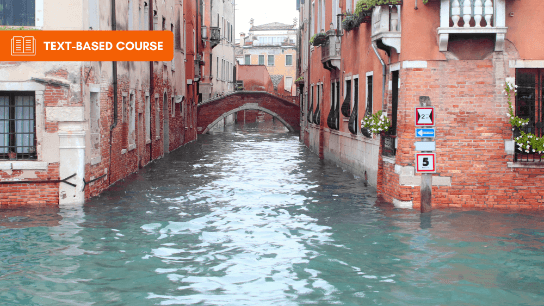
Flood routing is one of the key elements of a watershed hydrological model. Stream channels, floodplains, and reservoirs can have a significant impact on the delivery of water to any location along a stream network. Flood routing can be used to determine the magnitude of the peak discharge, the time of the peak discharge, depth and extent of flooding, and environmental factors such as stream bank erosion, floodplain scour, sediment transport, and deposition. This course includes coverage of basic concepts, calculation procedures and example calculations for flood routing.
Topics: At the conclusion of this course, the student will: Know the differences between hydrologic flood routing methods and hydraulic flood routing methods Know the difference between translation effects and storage effects on flood wave movement down a stream system Be familiar with elevation-storage relationships for reservoirs Be familiar with elevation-discharge relationships for reservoirs Be familiar with elevation-discharge and elevation-storage relationships for channel reaches Be familiar with elevation discharge hydrographs to reservoirs or channel reaches Be able to make reservoir routing and channel routing calculations using the storage-indication routing method Be able to use the continuity equation for reservoir routing and channel routing calculations. Be able to use the Muskingum method for channel routing calculations Be able to use the Muskingum-Cunge method for channel routing calculations Be able to use the Muskingum method for channel routing calculations with meandering streams Be familiar with the effects of baseflow on routed flows Be familiar with the effects of transmission losses on routed flows Be familiar with routing through tide gates and dikes.
Intended Audience: This course is intended for Hydraulic, Stormwater, Geotechnical, Civil, Environmental, Water Resources, and other engineers whose job description may require a general knowledge of flood routing methods and procedures. Publication Source: USDA NRCS

Dr. Harlan Bengtson is an online PDH course provider of continuing education courses for professional engineers. Dr. Bengtson is a graduate of Iowa State University with B.S. and M.S. degrees and of the University of Colorado with a PhD. He is a licensed Professional Engineer in Missouri. Dr. Bengtson has spent 30 years in engineering education in teaching and administrative positions, including six years as Dean of Engineering at Southern Illinois University Edwardsville. Dr. Harlan H. Bengtson, PE 33 Grainey Drive Glen Carbon, IL 62034 Phone: (618) 406-6892 E-mail: hnkbengtson@yahoo.com PROFESSIONAL PROFILE Dr. Bengtson is a graduate of Iowa State University with B.S. and M.S. degrees and of the University of Colorado with a PhD. He is a licensed Professional Engineer in Missouri. He has spent 30 years in engineering education in teaching and administrative positions, including six years as Dean of Engineering at Southern Illinois University Edwardsville. His areas of expertise are environmental engineering, hydrology and hydraulics, engineering science and renewable energy systems. He has done regular consulting work while holding the academic positions. Prior to entering academia, Dr. Bengtson worked for Minnesota Mining & Manufacturing as a Product Development Engineer and for E. I. duPont deNemours as a Process Development Engineer. Dr. Bengtson has authored numerous publications, presentations and technical reports. He is currently active as a freelance technical writer, author of continuing education courses for Professional Engineers, and is the founder of www.engineeringexceltemplates.com and www.EngineeringExcelSpreadsheets.com, sites with the objective of providing inexpensive, easy to use Excel spreadsheets for a variety of engineering calculations.
Professional development requirements vary by profession, country, and regulatory body. Before enrolling, review the course details and confirm that the content, learning format, and any listed credits meet your specific requirements. You are responsible for confirming eligibility with your regulator or professional association and keeping the records required for reporting.
