by learnformula
search
For Business
Team license & compliance management
For Higher Education
Academic partnerships
For Government Agencies
Government training solutions
For Instructors & Course Creators
Teach on our marketplace
Become a Sponsor
Reach professionals where they learn
Log inStart 7-Day Free TrialStart Free TrialStart Free Trial
search
Courses/Litigation, Trial & Dispute Resolution/Trial Practice & Evidence

The Eyewitness Trap: Challenging Memory, Identification and Reliability at Trial

Strategic courtroom techniques to cross-examine witnesses, expose the science of false memory, and defeat unreliable identification evidence.
Created byCurt Carlson
BeginnerUpdated Oct 1, 2026
The Eyewitness Trap: Challenging Memory, Identification and Reliability at Trial

What You'll Learn

check_circleUnderstand the psychological science underlying eyewitness memory and identification
check_circleIdentify common lineup and identification procedure flaws that can increase misidentification risk
check_circleEvaluate factors that affect the reliability of eyewitness testimony
check_circleRecognize the role of bias, suggestion, and confidence inflation in identification evidence
check_circleApply research-based strategies when challenging or presenting eyewitness evidence in court

About This Course

Eyewitness testimony can be highly influential in legal proceedings, but its persuasive impact does not always reflect its reliability. Memory can be affected by stress, suggestion, viewing conditions, post-event information, and investigative procedures, creating risks that attorneys must understand when evaluating identification evidence.

This course examines the psychological science behind eyewitness memory and its practical implications for litigation. Participants will explore how memories are formed and recalled, why misidentifications occur, and how factors such as lineup procedures, witness confidence, bias, and external influence can affect the reliability of testimony. The session provides practical guidance for assessing eyewitness evidence, identifying weaknesses, preparing challenges, and making informed decisions about expert evidence and trial strategy.

Key Topics Discussed:

  • How eyewitness memory is formed and retrieved
  • Memory distortion and post-event information
  • Misidentification and wrongful conviction risk
  • Viewing conditions, stress, and weapon focus
  • Cross-racial identification issues
  • Lineup construction and filler selection
  • Sequential versus simultaneous lineups
  • Blind and double-blind administration
  • Administrator influence and witness instructions
  • Confidence statements and feedback effects
  • Repeated identification procedures
  • Expert testimony on eyewitness memory

Your Instructor

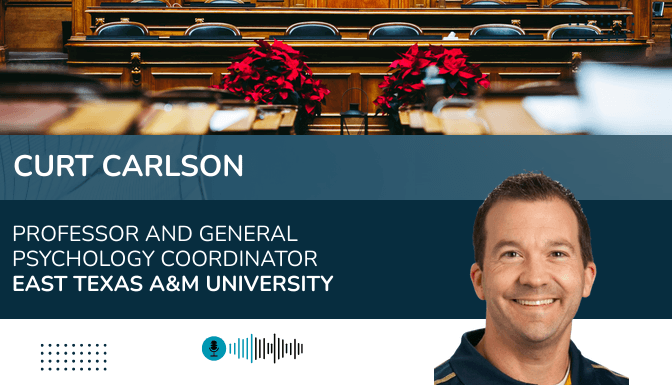
Curt Carlson
Curt Carlson

Professor and General Psychology Coordinator | East Texas A&M University

menu_book1 courses

Curt Carlson earned his PhD from the University of Oklahoma, where he was trained as an experimental psychologist, focusing on recognition memory and face perception. Specifically, he focuses on applying the convergence of these two theoretical fields to eyewitness identification. He works as a professor of experimental psychology at East Texas A&M University where he is director of the CriMe (Cognitive research involving Memory) lab. He publishes regularly in the field of eyewitness memory and his work has been supported by the National Institute of Justice.

Credit Information

Professional development requirements vary by profession, country, and regulatory body. Before enrolling, review the course details and confirm that the content, learning format, and any listed credits meet your specific requirements. You are responsible for confirming eligibility with your regulator or professional association and keeping the records required for reporting.

What Students Are Saying

0.0
Student's Choice
0 reviews

Frequently Asked Questions

We are a registered provider with 300+ associations and regulatory bodies worldwide. We operate across 27 global markets including Canada, the US, Australia, and the UK. Every course page clearly displays its specific accreditations. Upon completion, you receive a professional certificate that can be validated online. Our certificates include all necessary accreditation details, credit hours, and completion dates, and are formatted specifically to meet the submission requirements of most global regulatory bodies.

You May Also Like

Accounting & Tax: Technology for Accountants

Claude Fundamentals for Accountants (2026 Update)

star5.0(579)
2.5 CPD hrs
Ethics: Business Ethics

2026 Ethics and Corporate Compliance

star5.0(494)
2 CPD hrs
Ethics: Ethics for Accountants

4-Hour Ethics for Accountants 2026

star4.9(96)
4 CPD hrs