by learnformula
search
For Business
Team license & compliance management
For Higher Education
Academic partnerships
For Government Agencies
Government training solutions
For Instructors & Course Creators
Teach on our marketplace
Become a Sponsor
Reach professionals where they learn
Log inStart 7-Day Free TrialStart Free TrialStart Free Trial
search
  1. Courses
  2. /Law
  3. /Family Law

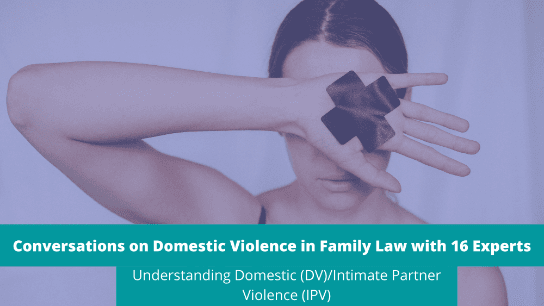
Understanding Domestic (DV)/Intimate Partner Violence (IPV)

The coronavirus pandemic has caused a spike in domestic violence that shelters, domestic violence agencies, law enforcement, and courts are still trying to manage.
Created byBill Eddy
BeginnerUpdated Jan 10, 2025
Understanding Domestic (DV)/Intimate Partner Violence (IPV)

What You'll Learn

  • check_circleUnderstand the distinctions between DV and IPV and their implications for family law professionals.
  • check_circleLearn how to identify signs of DV/IPV and assess the level of danger in family law cases.
  • check_circleGain the ability to identify and address coercive control in DV/IPV situations.
  • check_circleExplore the psychological and emotional effects of DV/IPV on children involved in family law cases.

About This Course

This is the first part of 6-PART VIDEO SERIES on Domestic Violence (DV) / Intimate Partner Violence (IPV) best practices in the family law environment in the United States and Canada.

For decades, Domestic Violence (DV) or Intimate Partner Violence (IPV) has been a challenging and important issue for new and experienced family lawyers, judges, evaluators, mediators, therapists, and DV advocates.

Understanding the impact of DV/IPV on family law issues will help new and seasoned professionals better handle these emotionally charged and dangerous cases.

We created this video series that presents an overview of DV/IPV facing family law professionals. The featured experts offer concrete advice about how to screen for DV/IPV, assess the level of danger, and work towards safe and healthy resolutions for families.

Course Outline:

  • Difference between domestic violence and intimate partner violence
  • Advice for family law professionals in understanding DV/IPV
  • Recognizing coercive controlling dynamics
  • Impact on children of DV/IPV
  • Why each case is unique

Intended Audience: Family lawyers Judges Mediators Evaluators Therapists DV advocates Others who would benefit from learning about Domestic Violence/IPV best practices in the family law environment in the United States and Canada.

Your Instructor

Bill Eddy

Understanding & Managing High Conflict Legal Disputes

menu_book18 courses
star238 reviews

Bill Eddy is a pioneer in high-conflict personality theory and one of the most influential voices in modern conflict resolution. As a lawyer, mediator, therapist, and bestselling author of more than 30 books, he developed widely used tools including The CARS Method®, BIFF Response®, EAR Statements™, and the New Ways® series. His work is used across workplaces, courts, healthcare, government, and human services around the world. Bill’s integrated mental health and legal expertise continues to shape HCI’s research-driven methods for managing all levels of conflict. He also co-hosts the podcast It’s All Your Fault!

Credit Information

Professional development requirements vary by profession, country, and regulatory body. Before enrolling, review the course details and confirm that the content, learning format, and any listed credits meet your specific requirements. You are responsible for confirming eligibility with your regulator or professional association and keeping the records required for reporting.

What Students Are Saying

0.0 out of 5
Student's Choice
0 reviews

Frequently Asked Questions

We are a registered provider with 300+ associations and regulatory bodies worldwide. We operate across 27 global markets including Canada, the US, Australia, and the UK. Every course page clearly displays its specific accreditations. Upon completion, you receive a professional certificate that can be validated online. Our certificates include all necessary accreditation details, credit hours, and completion dates, and are formatted specifically to meet the submission requirements of most global regulatory bodies.

You May Also Like

  • Accounting & Tax: Technology for Accountants

    Claude Fundamentals for Accountants (2026 Update)

    starRated5.0out of 5,(579 reviews)
    2.5 CPD hrs
  • Ethics: Business Ethics

    2026 Ethics and Corporate Compliance

    starRated5.0out of 5,(494 reviews)
    2 CPD hrs
  • Ethics: Ethics for Accountants

    4-Hour Ethics for Accountants 2026

    starRated4.9out of 5,(96 reviews)
    4 CPD hrs