
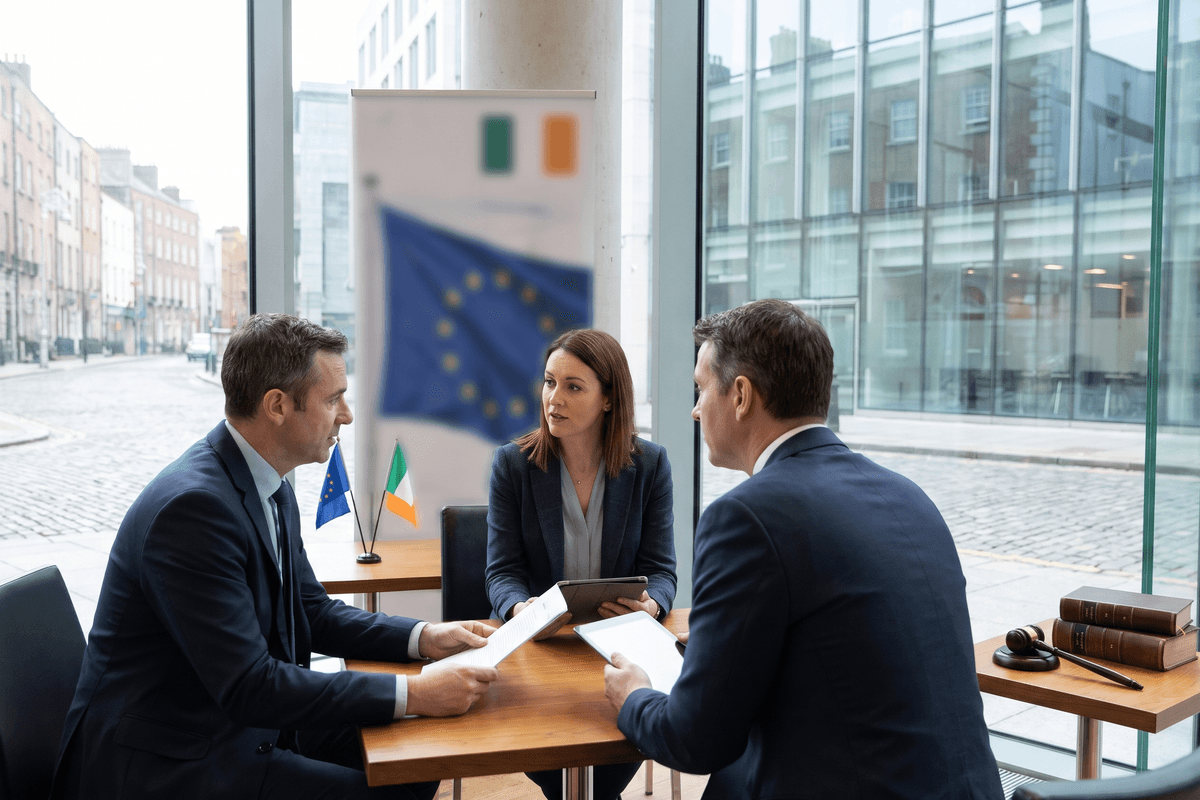

As Ireland approaches its pivotal tenure holding the Presidency of the Council of the European Union, the State’s domestic and European legal architecture is preparing for its most consequential operational test in over a decade. In a major joint initiative reported by Irish Legal News, the Irish Centre for European Law (ICEL) and the Chief State Solicitor’s Office (CSSO) have announced a high-level conference titled Ireland’s Enduring Place in Europe. Headlined by Attorney General Rossa Fanning SC and Chief State Solicitor Maria Browne, the symposium signals a coordinated effort across the State legal apparatus, the Bar, and commercial practice to align domestic legal strategy with Ireland’s upcoming responsibilities at the apex of European policymaking.
Holding the Presidency of the Council of the EU places exceptional technical, diplomatic, and constitutional demands on the member state in the chair. Rather than operating merely as a ceremonial milestone, the Presidency requires hundreds of departmental legal advisers, advisory counsel, and state solicitors to chair Council working parties, mediate contentious trilogue negotiations with the European Parliament and the European Commission, and defend compromise texts under the rigorous scrutiny of EU primary law. For practitioners across both the public and private sectors in Dublin, the conference establishes a vital blueprint for how Irish jurisprudence will interact with European governance over the coming cycle.
The Institutional Machinery: Rossa Fanning SC and Maria Browne
The joint staging of the event by the ICEL and the CSSO brings together two pivotal arms of Ireland's legal ecosystem: independent academic and practitioner scholarship on European law, and the frontline executive arm responsible for litigation, advisory work, and state representation. The keynote addresses from Attorney General Rossa Fanning SC and Chief State Solicitor Maria Browne underscore the administrative gravity of this moment.
As chief legal adviser to the Government, the Attorney General occupies a constitutional role that bridges domestic statutory drafting, constitutional propriety, and international treaty obligations. Under Fanning’s stewardship, the Office of the Attorney General (AGO) has navigated complex cross-border litigation, state liability questions, and the post-Brexit recalibration of common law within the Union. Addressing the CSSO and wider legal community, his appearance reflects the state’s drive to ensure institutional cohesion before the legislative spotlight turns squarely on Ireland.
"The Council Presidency demands not merely political direction, but forensic legal precision. It falls upon the State's legal officers and advisers to craft texts that survive judicial challenge in Luxembourg while advancing the collective European interest."
Parallel to the AGO’s advisory mandate, Maria Browne’s Chief State Solicitor’s Office bears the operational brunt of executing State legal policy across administrative, regulatory, and European proceedings. From managing preliminary references before the Court of Justice of the European Union (CJEU) to ensuring domestic transposition deadlines are met without infraction proceedings, Browne’s leadership within the CSSO has emphasized professional modernization, digital transition, and operational resilience—qualities essential for managing the surging volume of EU dossiers anticipated during the Presidency.
The Strategic Realities of the 2026 Council Presidency
Ireland’s upcoming Presidency occurs within a profoundly altered geopolitical and institutional landscape. As the premier English-speaking common law jurisdiction remaining within the European Union, Ireland occupies a rare structural nexus. It must navigate civil law traditions across the majority of Member States while simultaneously translating nuanced legal concepts into workable legislative acts.
Practitioners participating in Council working groups and committee scrutiny will encounter heavy legislative files spanning artificial intelligence governance, corporate sustainability due diligence, anti-money laundering frameworks, and border management. The table below outlines the core legal vectors dominating the preparatory agenda:
| Priority Sector | Key Legislative & Legal Drivers | Practical Implications for Irish Practitioners |
|---|---|---|
| Digital & Tech Governance | AI Act enforcement, Data Governance Act, cross-border GDPR procedural harmonisation | Advising multinational clients on regulatory interface; drafting Council compromise texts on technical compliance. |
| Rule of Law & CJEU Review | Article 7 TEU oversight, judicial independence benchmarks, preliminary reference efficacy | Managing state litigation, assessing mutual recognition in European Arrest Warrants, and public law challenges. |
| Sustainable Finance & ESG | CS3D implementation, Deforestation Regulation, Green Claims Directive | Navigating director liability, supply-chain due diligence audits, and administrative sanctions risk. |
| Financial Crime & AML | AML Authority (AMLA) operationalisation, 6th AML Directive, sanctions scrutiny | Elevated scrutiny on transaction structuring, cross-border investigations, and statutory reporting duties. |
Practical Imperatives for the Irish Legal Profession
While the CSSO and the AGO serve as the tip of the spear for state affairs, the broader Irish legal profession—from the Four Courts to corporate boardrooms—faces immediate practical consequences stemming from the EU Presidency agenda:
- Capacity Building in EU Legislative Procedure: Council working parties require lawyers who understand informal trilogue mechanics, Coreper coordination, and multilingual text drafting. Familiarity with the EU Treaties must extend beyond general principles into hyper-specialized sub-regulations.
- Rise in Luxembourg Referrals: As Ireland steers pivotal regulatory files, domestic courts will continue to play an outsized role in referring complex preliminary questions under Article 267 TFEU, particularly in data protection, environmental permitting, and asylum law.
- Surge in Cross-Border Advisory Work: Commercial law firms will see heightened demand from domestic and international entities seeking to interpret Ireland’s negotiating postures on key economic directives, creating opportunities for regulatory dispute teams.
- Talent Deployment and Secondments: The surge in institutional workload will drive increased movement of legal personnel between private practice, government departments, and Ireland's Permanent Representation to the EU (PermRep) in Brussels.
The Role of the Irish Centre for European Law
The co-hosting role of the Irish Centre for European Law highlights the vital interface between high-level scholarship and practical statecraft. Founded to advance the study and practice of European law across Ireland and Northern Ireland, ICEL has consistently acted as an intellectual crucible for exploring the intersection of Irish constitutional doctrine and European treaties.
By partnering directly with the CSSO, ICEL provides a neutral platform where commercial litigators, in-house counsel, judges, and government advisers can dissect technical questions without the constraints of an active courtroom dispute. The presence of both Rossa Fanning SC and Maria Browne confirms that the State views this symposium not merely as an academic forum, but as an essential element of administrative readiness.
Forward-Looking Conclusion: Cementing Ireland’s European Identity
The ICEL and CSSO EU Presidency Conference arrives at an inflection point. As Europe grapples with geopolitical tension, regulatory shifts, and economic transitions, Ireland’s stewardship of the Council represents an opportunity to demonstrate the strength, adaptability, and sophistication of its legal traditions.
For Irish legal professionals, the message is unequivocal: engagement with European law can no longer be treated as a specialized niche or an ancillary department within a firm. Whether litigating before the domestic courts, navigating complex cross-border mergers, or defending the State against statutory challenges, the European legal order forms the bedrock of modern Irish practice. By convening this summit, the CSSO, the Attorney General, and the ICEL have set an ambitious benchmark—ensuring that when Ireland takes the helm in Europe, its legal machinery is fully prepared to lead.