
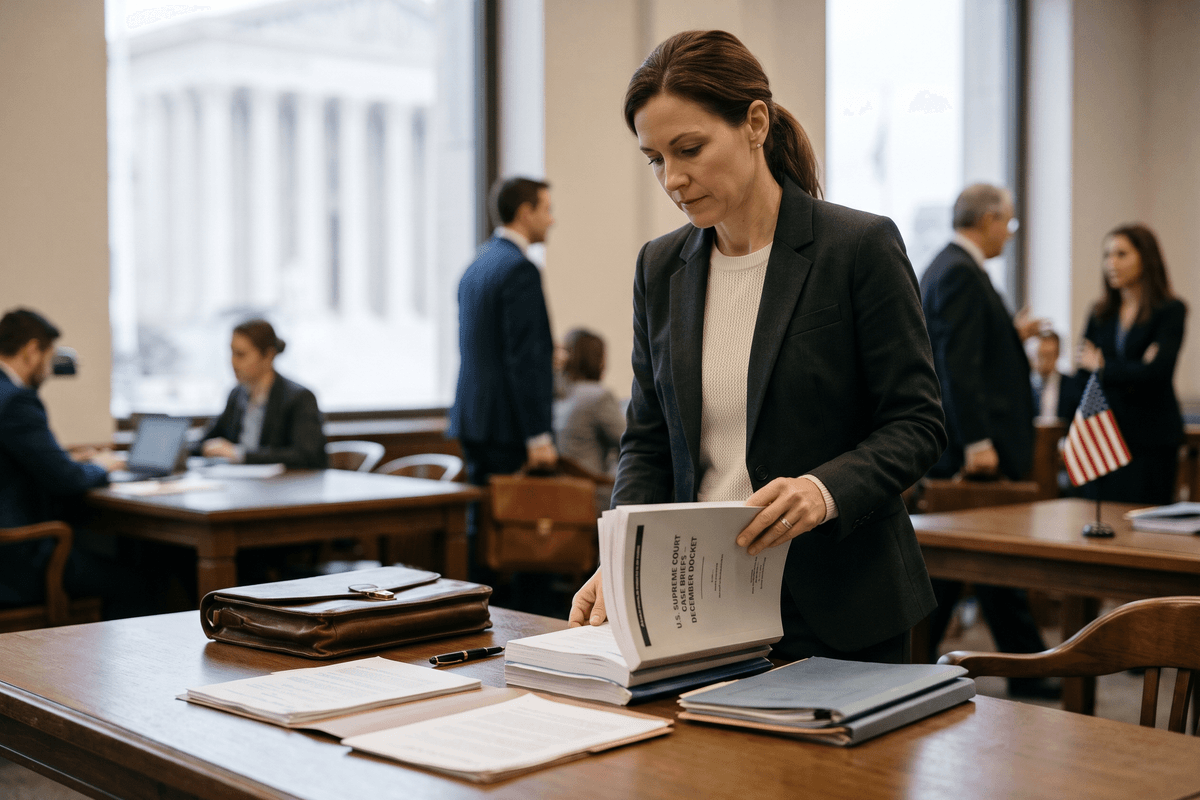

The Supreme Court is heading into its Thanksgiving break with a full December argument calendar, and the court's own signals matter as much as the cases themselves. In its November 25 preview, SCOTUSblog reported that the December session opens Monday, November 30, with eight oral arguments. The lineup covers the Second Amendment, deportations to “third-party countries,” and the forfeiture of an airplane over the transport of beer. For practitioners, the session is a reminder that the court is still working through a wide range of federal and state questions while the year closes.
The December Argument Calendar
The court has scheduled the following arguments in the first week of the session:
- Monday, November 30: Crowther v. Board of Regents of the University System of Georgia, on whether Title IX allows school employees to sue over alleged sex discrimination, and Wassily v. Blanche, on whether immigrants whose asylum protections have been terminated remain eligible to become lawful permanent residents.
- Tuesday, December 1: Jouppi v. Alaska, an Alaskan bush pilot's challenge to the forfeiture of his $95,000 airplane over the transport of beer into a dry village.
- Wednesday, December 2: Khaya v. Cook County, on the constitutionality of bans on AR-15 and similar semiautomatic rifles, beginning at 10:00 a.m. EST.
The Title IX question in Crowther will matter to university counsel and employment lawyers because it turns on who can bring a sex discrimination claim under the statute. The asylum-to-green-card question in Wassily sits at the intersection of immigration status and humanitarian protection, an area where the consequences of a ruling can reach well beyond the named parties.
Khaya v. Cook County: The Mootness Question Comes First
The gun case has already taken an unusual procedural path. On Monday, the court dismissed the lead plaintiff, Cutberto Viramontes, from the case formerly known as Viramontes v. Cook County. It did not act on Cook County's request to dismiss the case as moot. On Tuesday, the court deferred that request until after argument, as SCOTUSblog reported, and the case is now captioned Khaya v. Cook County.
For lawyers, the sequence is a useful one to study. A mootness argument asks whether a live controversy still exists. By deferring the question, the court has effectively asked both sides to address the merits and the mootness issue in the same hour. Advocates arguing the appeal should expect questions about whether the dispute remains live after the change in parties, and should be prepared to address the merits in case the court reaches them.
Immigration and Asylum Threads
Several immigration matters are moving at once. Beyond Wassily, the court has granted review in Mullin v. Refugee and Immigrant Center for Education and Legal Services, which concerns President Donald Trump's suspension of asylum at the U.S.-Mexico border, according to a SCOTUSblog contributor column on that case.
The news of the week also includes the end of a long-running case. Reuters reported that Kilmar Abrego Garcia left the United States for Spain on Tuesday. His case began when, according to the report, authorities sent him to a megaprison in El Salvador in March 2025 despite a prior court order barring his return there. The Supreme Court ultimately ordered the government to facilitate his return. After he came back in June 2025, he faced human smuggling charges and a renewed deportation effort. His voluntary departure closes that chapter, but the procedural history remains a reference point for counsel handling removal cases where a prior order is in tension with executive action.
Religion, Parental Rights, and State Programs
Two petitions in the morning reads show the court being asked to revisit established doctrine. A group of Catholic schools has asked the justices to address Maine rules that bar schools from participating in a state voucher-style program if their admissions policies prefer students of a certain religion, allow religious discrimination, or do not follow the state's views on gender ideology. The Washington Examiner reported that the schools want the court to consider overruling Employment Division v. Smith, the 1990 decision on whether the free exercise clause protects religious conduct that violates a valid and neutral law. The petition builds on Carson v. Makin, the 2022 ruling that Maine could not exclude religious schools from the program.
Separately, Emily Bickford, a Maine mother, has appealed to the Supreme Court over a custody order that bars her from taking her 13-year-old daughter to church and gives the father sole authority over the child's involvement with Calvary Chapel Church. Her petition frames the issue as one of parental rights and religious liberty. Family law practitioners should note how often custody orders now carry religious-participation terms, and how these disputes are being framed as constitutional questions rather than purely domestic ones.
Tariffs and the Rebuilt Trade Regime
The Wall Street Journal reported that the administration is preparing new tariffs on China and dozens of other countries. The Supreme Court held in February that the president lacked authority under the International Emergency Economic Powers Act to impose tariffs. Since then, the administration has used other statutes to rebuild its tariff regime. The new levies will likely join a separate action unveiled in July that targeted nations over forced-labor trade, and that July action has already drawn a new lawsuit. Trade counsel should track which statutory authority each action relies on, because the February ruling has made the choice of statute the central legal question.
State Law Stakes: Ten Commandments and the Hush Money Appeal
In Texas, the state's incoming attorney general, Democrat Nathan Johnson, has said he will not defend the state's Ten Commandments classroom law. He said:
“My jurisprudential opinion is that the law is unconstitutional,” Johnson said.
He added that the state's position will not be the one the state previously took. The Dallas Morning News reported that outgoing Attorney General Ken Paxton cited Johnson's unwillingness to defend the law in the state's brief opposing Supreme Court review, filed November 10. If the justices decline to hear the case, a federal appeals court ruling upholding the displays would stay in place, preserving a win for Paxton after he leaves office in January. For state solicitors' offices, this is a live lesson in how a change in administration can reshape the defense of a statute at the highest level.
In New York, a 2nd Circuit panel sided with Trump on Monday in his effort to move his hush money conviction into federal court, ruling that the district court did not properly consider his argument that he may raise the issue as a federal defense. The Hill reported that the decision halts his ongoing state appeal and shifts the case to federal court, where he will keep pressing the removal argument. Trump's push cites the Supreme Court's presidential immunity ruling.
Beyond the Court: AI Vendors Start Circling Legal Work
Artificial Lawyer reported that OpenAI held talks with an AI-native “new model” law firm with the intention of acquiring at least some of its team. The firm, one of around 15 or more now in the market that work with startups, turned the offer down and chose to pursue its own growth. The publication said the approach appears to have come from executives outside OpenAI's legal vertical, Astra for Legal, which is led by Jason Boehmig. Artificial Lawyer also noted that Anthropic, Google, and Microsoft have launched legal-specific channels, and that Palantir is working closely with Kirkland.
The report is not a court story, but it bears on the same firms that follow the Supreme Court. It suggests that large model providers see legal as a high-value, text-heavy market, a view the publication framed by describing legal as a $1 trillion sector. Firms weighing AI vendors and any staffing or acquisition conversations should treat these approaches as a signal that the competitive field is widening.
What to Watch
- The Khaya ruling on mootness: Whether the court reaches the Second Amendment merits or disposes of the case on threshold grounds.
- The Monday and Tuesday arguments: How the justices approach Title IX standing in Crowther and asylum-based green card eligibility in Wassily.
- The Maine petitions: Whether the court agrees to revisit Employment Division v. Smith or to take up the Bickford custody appeal.
- The tariff lawsuits: Which statutes the administration relies on for the new China and multi-country tariffs, and how courts respond.
- Texas and New York: Whether the Ten Commandments petition is granted or denied, and how the removal fight in the hush money appeal proceeds in federal court.