
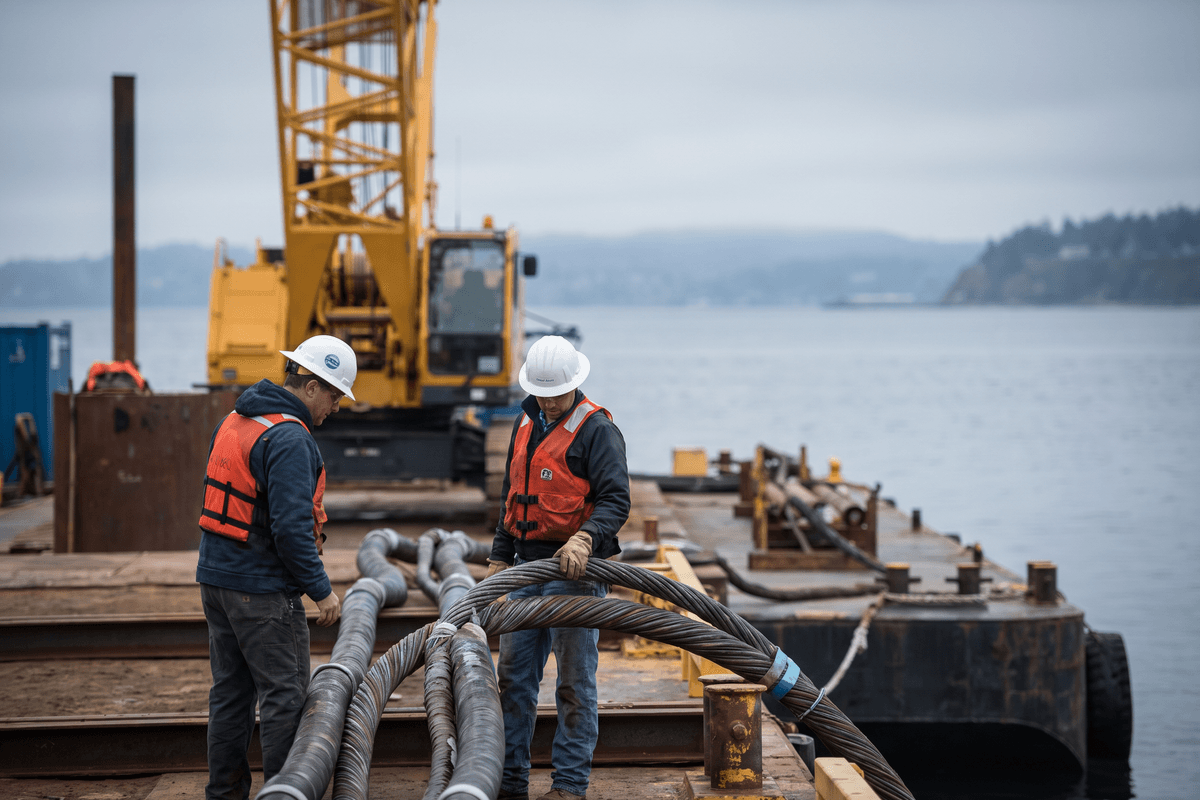



Prince Edward Island’s energy security is, quite literally, anchored to the ocean floor. Separated from the mainland by the notoriously turbulent Northumberland Strait, the island province relies on subsea transmission cables to import roughly 60 percent of its electricity. But as electrification accelerates and the province pushes toward ambitious net-zero targets, the existing interties are approaching their operational and thermal limits. Enter a critical lifeline for both the province and the Canadian engineering sector: the recent $5.9 million investment by the Government of Canada to advance the Prince Edward Island–New Brunswick Interconnection Expansion Project.
While multi-billion-dollar construction announcements typically dominate the headlines, seasoned infrastructure professionals know that the true trajectory of a mega-project is forged in the Front-End Engineering Design (FEED) phase. This $5.9 million injection isn't for pouring concrete or laying copper; it is dedicated entirely to the complex engineering studies, environmental assessments, and preliminary transmission route designs required to make the project viable.
For Canadian electrical, civil, and marine engineers, this project represents a masterclass in cross-disciplinary problem solving. Upgrading a subsea intertie is not merely a matter of dropping a thicker cable into the water—it requires navigating punishing marine environments, synchronizing distinct provincial grids, and mitigating deep-rooted environmental risks.
The Marine Geotechnical Gauntlet
The Northumberland Strait is a uniquely hostile environment for subsea infrastructure. Unlike deep-ocean cable laying, which contends primarily with pressure and distance, the Strait presents a shallow-water gauntlet defined by aggressive tidal currents, shifting bathymetry, and—most critically—ice scour.
During the winter months, the Strait freezes over. As tides and winds shift the ice pack, massive ice keels can scrape along the seabed, gouging deep trenches. Any subsea cable laid in this corridor must be buried deep enough to avoid catastrophic severing by ice, yet shallow enough to dissipate the immense heat generated by high-voltage power transmission.
"Subsea transmission engineering in the Canadian Maritimes is a constant negotiation between mechanical protection and thermal performance. If you bury a cable too deep to avoid ice scour, you risk thermal bottlenecking that derates the entire line's capacity."
Key Engineering Deliverables for the Routing Phase
The federal funding will directly support the specialized geomatics and geotechnical engineering required to map the optimal route. This involves several critical steps:
- High-Resolution Bathymetric and Geophysical Surveys: Utilizing multibeam echosounders and sub-bottom profilers to map the seabed topography and identify bedrock outcrops or existing unexploded ordnance (UXO).
- Thermal Resistivity Testing: Core sampling the seabed to determine how well the marine sediments conduct heat. This data is vital for sizing the copper or aluminum conductors.
- Hydrodynamic Modeling: Simulating tidal forces to calculate potential sediment mobility, ensuring the cable trench won't be naturally uncovered over its 40-to-50-year design life.
Synchronizing the Grid: Electrical Systems Design
Beyond the physical routing, the engineering studies funded by this initiative must address the complex electrical dynamics of connecting two distinct provincial grids. New Brunswick Power and Maritime Electric (PEI) operate highly integrated but fundamentally different systems.
The expansion project will likely require an evaluation of High-Voltage Alternating Current (HVAC) versus High-Voltage Direct Current (HVDC) technologies. While the relatively short span of the Northumberland Strait (approximately 13 to 17 kilometers depending on the final route) typically favors HVAC due to lower terminal station costs, the increasing capacity demands and the need for precise power flow control might bring Voltage Source Converter (VSC) HVDC technology into the conversation.
Engineers tasked with the system studies will need to model multiple scenarios:
| Engineering Study Focus | Objective | Impact on Final Design |
|---|---|---|
| Load Flow Analysis | Determine voltage profiles and equipment loading under peak winter demand. | Dictates the required ampacity of the subsea cables and overland transmission lines. |
| Transient Stability | Assess system recovery following a fault (e.g., a lightning strike on the NB side). | Informs the need for static VAR compensators or synchronous condensers on the PEI grid. |
| Harmonic Resonance | Ensure the capacitance of the new subsea cables doesn't amplify grid distortions. | Drives the design of harmonic filters at the terminal substations. |
The Strategic Value of Early-Stage Funding
In the infrastructure sector, the "valley of death" occurs between a project's conceptualization and its final investment decision (FID). Without robust, bankable engineering data, governments and private utilities cannot commit the hundreds of millions of dollars required for construction.
By injecting $5.9 million into the preliminary design phase, the federal government is effectively de-risking the PEI-NB Interconnection Expansion. This funding model is becoming increasingly common as Canada looks to modernize its national grid. It allows Engineering, Procurement, and Construction Management (EPCM) firms to deploy specialized teams early, identifying fatal flaws in routing or system design before procurement contracts are signed.
A Blueprint for the Atlantic Loop
The PEI-NB interconnection is not happening in a vacuum. It is a microcosm of the broader, much-discussed "Atlantic Loop" concept—a proposed multi-billion-dollar transmission network designed to move clean hydroelectricity from Quebec and Newfoundland through New Brunswick and Nova Scotia.
The engineering methodologies, regulatory pathways, and inter-provincial cooperation models developed during this PEI-NB expansion will serve as a template for larger regional projects. The firms that secure the contracts for these preliminary studies will gain an invaluable first-mover advantage, developing proprietary data and institutional knowledge regarding Maritime grid integration.
As the project transitions from concept to preliminary design over the coming months, the Canadian engineering community will be watching closely. The challenges of the Northumberland Strait are formidable, but they offer a unique canvas for innovation in subsea transmission. Ultimately, the lines drawn on CAD screens and the data pulled from the ocean floor today will secure the energy resilience of an entire province tomorrow.