
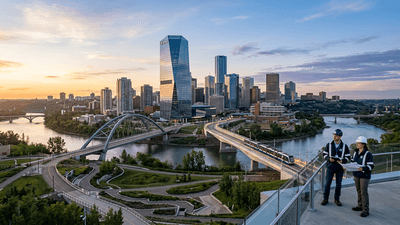



Alberta’s engineering sector has long been the undisputed heavyweight champion of Canada's resource economy, characterized by massive extraction projects and heavy industrial infrastructure. But beneath the surface of the province's traditional reputation, a quiet, profound evolution is taking place. The definition of a "flagship project" in Western Canada is shifting rapidly from pure resource extraction to complex, multi-disciplinary initiatives focused on energy transition, climate resilience, and sustainable community development. For engineering professionals looking to future-proof their careers and firms aiming to capture market share, understanding this shift is no longer optional—it is the new baseline.
This paradigm shift was placed front and center at the recent Consulting Engineers of Alberta (CEA) Showcase Awards Gala, where global professional services firm GHD was recognized for four distinct projects. Spanning community infrastructure, energy transition, and sustainable design, these awards serve as a vital bellwether. They are not merely vanity metrics; they are blueprints illuminating where capital, regulatory favor, and public demand are flowing in 2026.
Decoding the Winning Portfolio: The Three Pillars of Modern Consulting
When an industry association like the CEA highlights specific projects, it sends a clear signal to the market about what constitutes engineering excellence today. GHD’s recognized projects share a common DNA that reflects the broader pressures facing Canadian municipalities and industrial clients. We can categorize these pressures into three distinct pillars.
1. The Energy Transition Reality
Alberta is uniquely positioned in the global energy transition. It possesses both the legacy infrastructure of a fossil-fuel powerhouse and the renewable potential (particularly in wind, solar, and hydrogen) to become a clean energy leader. The engineering challenge is not simply building greenfield renewable projects; it is integrating these new energy sources into existing grids, retrofitting legacy assets, and managing the complex thermodynamics and fluid mechanics of new fuels like hydrogen.
"The projects winning awards today are no longer siloed structural or mechanical feats. They are complex ecosystems that require engineers to balance capital efficiency with carbon accounting, regulatory compliance, and long-term climate resilience."
For consulting engineers, the energy transition means moving beyond theoretical feasibility studies into hard, practical execution. This requires a deep understanding of evolving regulatory frameworks, such as the federal government's investment tax credits (ITCs) for clean technology, and how they impact project economics.
2. Resilient Community Infrastructure
Canada is experiencing unprecedented population growth, heavily concentrated in urban and suburban centers. This demographic boom is placing immense strain on aging municipal infrastructure—from water treatment facilities to transit corridors. Simultaneously, the increasing frequency of severe weather events demands that new infrastructure be designed not just for capacity, but for resilience.
Award-winning community infrastructure projects in 2026 are characterized by their ability to solve multiple problems simultaneously. A stormwater management project, for example, is no longer just about flood mitigation; it must also serve as a public green space, improve local biodiversity, and utilize low-carbon materials in its construction.
3. Sustainable Design as a Baseline, Not an Add-on
Historically, "sustainable design" was often treated as a premium add-on—a nice-to-have feature if the budget allowed. Today, as evidenced by the CEA Showcase criteria, it is the foundational metric of project success. Clients are increasingly demanding lifecycle carbon assessments, circular economy principles in material selection, and nature-based solutions.
The Evolving Competency Matrix for Canadian Engineers
The transition highlighted by the CEA awards necessitates a fundamental shift in the skill sets required by engineering professionals. The traditional "T-shaped" professional (deep expertise in one discipline, broad understanding of others) is giving way to the "M-shaped" professional, who possesses multiple areas of deep expertise, often bridging traditional engineering with environmental science or data analytics.
Here is a breakdown of how project demands are reshaping engineering competencies:
| Project Pillar | Traditional Engineering Focus | Modern/Transitional Focus (2026+) |
|---|---|---|
| Energy Infrastructure | Capacity, throughput, and capital cost optimization. | Grid integration, lifecycle carbon intensity, and multi-fuel adaptability. |
| Community Infrastructure | Meeting baseline municipal codes and immediate capacity needs. | Climate resilience, demographic scalability, and nature-based integration. |
| Sustainable Design | Post-design environmental impact mitigation. | Upfront lifecycle assessment (LCA) and circular material sourcing. |
Practical Implications for Firms and Professionals
What does this mean for the boots on the ground—the project managers, the principal engineers, and the managing partners of Canadian consulting firms? The lessons from GHD's success at the CEA awards offer actionable insights for the broader industry.
- Break Down Internal Silos: The complexity of modern projects means that structural, civil, environmental, and electrical engineers can no longer work in isolation. Firms must adopt integrated project delivery (IPD) models internally, fostering collaboration from the conceptual design phase through to commissioning.
- Invest in Carbon Literacy: Carbon accounting is becoming as critical as financial accounting in project management. Engineers must become fluent in calculating embodied carbon in materials and operational carbon over a project's lifecycle. Upskilling teams in LCA software and methodologies is a critical competitive advantage.
- Pivot from Order-Takers to Strategic Advisors: Clients are navigating unprecedented regulatory and environmental uncertainty. Engineering consultants must step into the role of trusted advisors, helping clients understand how to leverage government funding for green initiatives, navigate complex permitting processes, and future-proof their assets against climate risks.
- Embrace Nature-Based Solutions: Particularly in community infrastructure, integrating natural systems (like constructed wetlands for water treatment or bio-swales for runoff) is proving more cost-effective and resilient than traditional "grey" concrete infrastructure. Familiarity with ecological engineering is highly sought after.
Looking Ahead: The New Standard of Excellence
The projects celebrated at the 2026 Consulting Engineers of Alberta Showcase Awards Gala are not anomalies; they are the vanguard. As Canada pushes toward its net-zero targets and grapples with the realities of a changing climate and a growing population, the demands on the engineering profession will only intensify.
Firms that view sustainability, resilience, and energy transition as passing trends or niche markets will find themselves increasingly marginalized in competitive bidding processes. Conversely, those that follow the blueprint laid out by recent award-winners—integrating deep technical expertise with holistic, forward-thinking design—will not only capture the lion's share of the market but will be the architects of Canada's future economy. The baseline has been raised; now, the industry must rise to meet it.