



Break Even Analysis
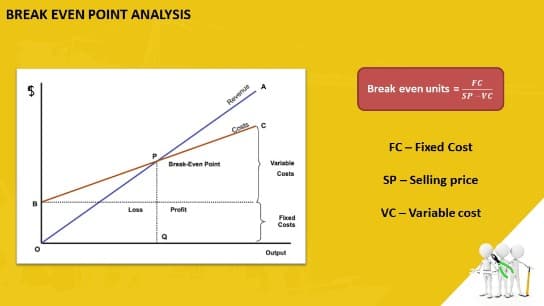
The Break-even Analysis is the technique used by management to calculate their monthly or annual sale or returns, to cover their costs. The break-even point is that point at which gains equal losses. It is the point where the total costs equal total revenues. The break-even point helps calculate the minimum profit for a business when setting margins. It helps determine after what point a business will earn a profit. The break-even point analysis is often mistaken for the Payback Period which is the time taken to recover an investment.
Break Even Units = Fixed Cost/(Selling Price - Variable Cost)
Costs
A number or costs must be taken into account when performing a break-even analysis. A brief description of the types of costs is given below. The total production costs are categorized into fixed variable and mixed costs.
- Fixed Costs: Fixed costs are costs that must be incurred irrespective of the quantity of produce. This implies that whether it’s a single product or bulk production, the fixed costs still remain the same. Some examples of fixed costs are research and development costs, rent, insurance, administration, marketing costs, etc.
- Variable Costs: Variable costs are those costs that depend directly or indirectly on the quantity of produce. Some of these variable costs like raw materials, machinery, and labor costs are direct costs while costs such as maintenance of machinery, and depreciation are examples of indirect variable costs.
- Mixed Expenses: Certain expenses are mixed in nature i.e. a portion of it is fixed, while a portion is variable. These expenses are called mixed expenses or semi-variable expenses. These kinds of expenses are very common and can be used by adding its fixed component to the total fixed expenses and its variable component to the total variable expenses.
Limitations of Break-Even Analysis
Any past or future losses cannot be made up for with a current break-even. It is sometimes difficult to gather the information required for break-even analysis, especially the variable expenses. It is even more difficult to classify expenses into fixed or variable. Break-even analysis can best analyze one product at a time.
This calculation also assumes that the number of products produced and sold remains the same. It also assumes that all the products will be sold at the same price. Based on the response to a product, the company may have to increase or decrease its price.
Join my curated course on Production Planning & Control by CLICKING HERE