
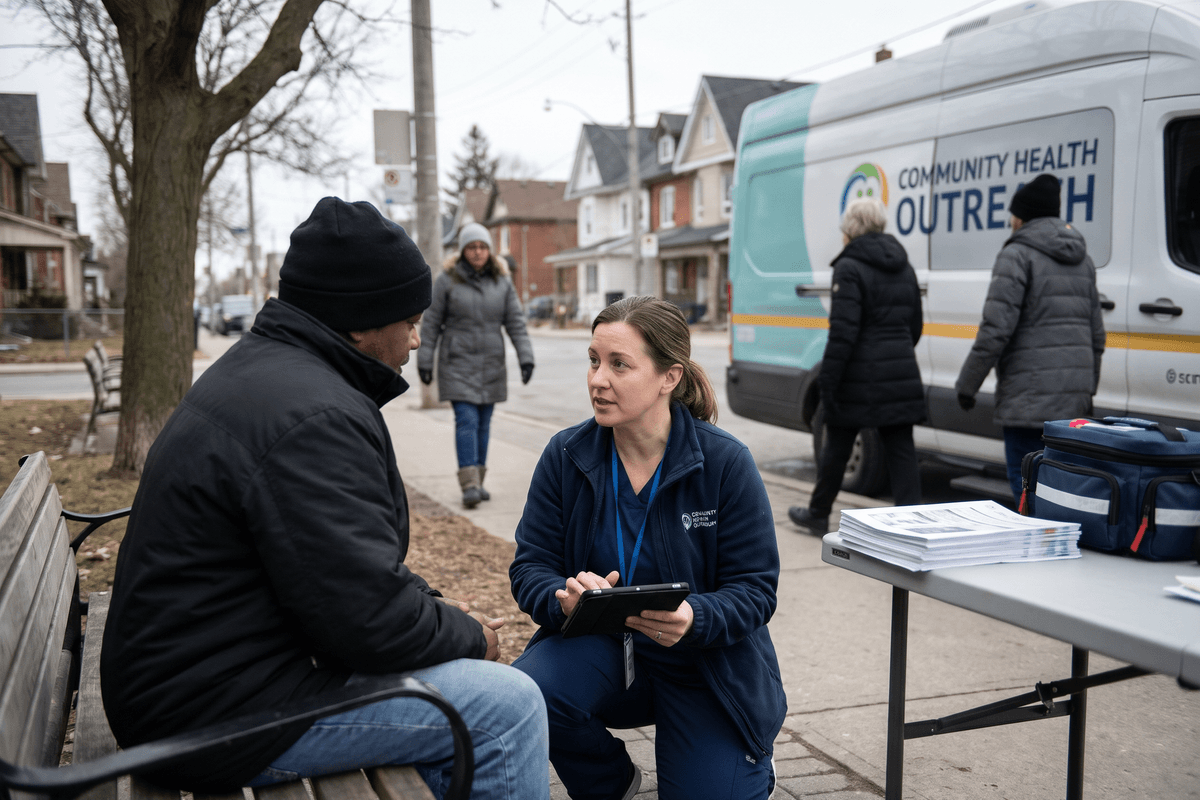

Most nursing students learn to assess a patient in a bright, well-equipped hospital bay. A growing number of Ontario students are learning the same skills on sidewalks, in shelters, and beside encampments, where the patient may not have a stable address, a family doctor, or a reliable way to refill a prescription. A community nursing outreach initiative that has expanded its presence across Ontario is demonstrating that this kind of placement can serve two purposes at once. It delivers frontline care to people who are often excluded from the health system, and it gives students supervised experience that few conventional rotations can match.
A Placement Model Built Around Who Is Missing From Care
The initiative's core premise is straightforward: people experiencing homelessness are among the least likely to reach primary care, and when they do reach emergency departments, they are often discharged back to the conditions that made them sick. Outreach nursing meets patients where they are. For students, that means practising assessment, wound care, harm reduction, and health teaching in unstructured environments where the usual cues and equipment are absent.
The model pairs frontline care for unhoused individuals with clinical experience for nursing students, turning an access gap into a training ground.
This dual design matters for a profession that has spent years debating how to prepare nurses for practice that reflects Canada's social realities. Programs have responded in various ways, from curricular reform to cultural safety training. Outreach-based clinicals add something different: direct exposure to social determinants of health in the setting where they operate.
What the Model Offers Each Stakeholder
| Stakeholder | Primary Benefit | Key Consideration |
|---|---|---|
| Unhoused patients | Continuity and access to care without requiring a fixed address | Trust must be built slowly and sustained over time |
| Nursing students | Autonomous assessment and advocacy in complex, unpredictable settings | Supervision and debriefing are essential to prevent moral distress |
| Partner health services | Reduced pressure on emergency departments from preventable visits | Funding and staffing must be stable for placements to be reliable |
| Nursing education programs | Diversified clinical sites and stronger social-justice competencies | Placement capacity must be negotiated with each community partner |
Practical Implications for Canadian Nurses
For practising nurses, the expansion of outreach-based education offers lessons that extend well beyond the classroom. Whether you are a preceptor, a charge nurse, or a staff nurse who regularly receives students, these are the areas where the model has the most to teach:
- Preceptorship in unfamiliar settings. Students learning in outreach environments need preceptors who can model flexible assessment and explain decisions made without a full set of resources.
- Harm reduction as clinical competence. Outreach work normalizes harm reduction as part of nursing practice rather than a specialty add-on, which aligns with broader calls for non-judgmental, evidence-based care.
- Documentation and privacy. Care delivered without a fixed address raises questions about consent, record-keeping, and information sharing across agencies. Nurses should know their regulator's standards for these scenarios.
- Moral resilience. Students and staff working closely with people in crisis need structured debriefing and peer support to sustain their practice.
The Wider Frontline: Other Stories Shaping Nursing Work
The outreach initiative is one piece of a broader picture in which nurses are navigating workforce pressure, shifting roles, and questions about accountability. Several recent developments illustrate the pressures on the frontline.
Labour Tensions on the Prairies
Hundreds of nurses rallied outside the Saskatchewan Legislative Building as the Saskatchewan Union of Nurses announced an upcoming job action vote. The union cited stalled contract talks, nurse-to-patient ratio concerns, and underfunding. Students in outreach programs will eventually enter workplaces shaped by these disputes.
Discharge Timing and Patient Safety
In Alberta, the United Nurses of Alberta raised concerns about Alberta Health Services benchmarking an 11 a.m. discharge target. Nurses warned that rigid scheduling could compromise patient safety. The debate echoes the outreach model's central lesson: discharge planning must account for a patient's real circumstances, including whether they have a safe place to go.
Military Nursing in Crisis
Fifteen Canadian Armed Forces nurses were deployed to Edmonton and Calgary hospitals to relieve civilian burn unit nurses caring for critically injured soldiers after a training ground fire. The deployment shows how quickly specialized capacity can be stretched and how interdependent military and civilian nursing systems are.
Recruitment and Community Health Roles
Federal job notices advertising registered nurse positions in community health with Indigenous Services Canada, with pay of up to $136,000 a year or $40 an hour, target specialized shortages in Alberta. Community-facing roles like these are where outreach-trained graduates may find their first employment.
Scope of Practice and Accountability
Two stories raise questions about the boundaries of nursing work. In British Columbia, an appeal hearing concerning a dismissed nurse examined professional regulatory limits, workplace conduct guidelines, and legal interpretations of sex-based rights. Separately, a union has filed a grievance at Group Health after newly created patient care assistant roles were assigned duties traditionally held by licensed practical nurses. The grievance raises concerns about scope-of-practice dilution, a risk that deserves close attention as health systems create new roles to fill gaps.
What Comes Next for Nursing Education and Practice
The expansion of outreach-based nursing education points toward a more integrated future, one in which students learn to care for people where they live and nurses are equipped to advocate for them within systems under strain. Yet the model's long-term success depends on decisions made far from the sidewalk: stable funding for community partners, clear supervision standards, and workforce planning that does not treat students as a substitute for staff.
Nurses should watch three developments closely in the months ahead. First, whether placement models like this one receive durable provincial or federal support rather than short-term grants. Second, how regulators respond to new care roles that overlap with existing scopes of practice. Third, whether the lessons of community-based care, especially around discharge planning and continuity, shape hospital policy. The students learning on the street today will be the nurses setting those standards tomorrow.