
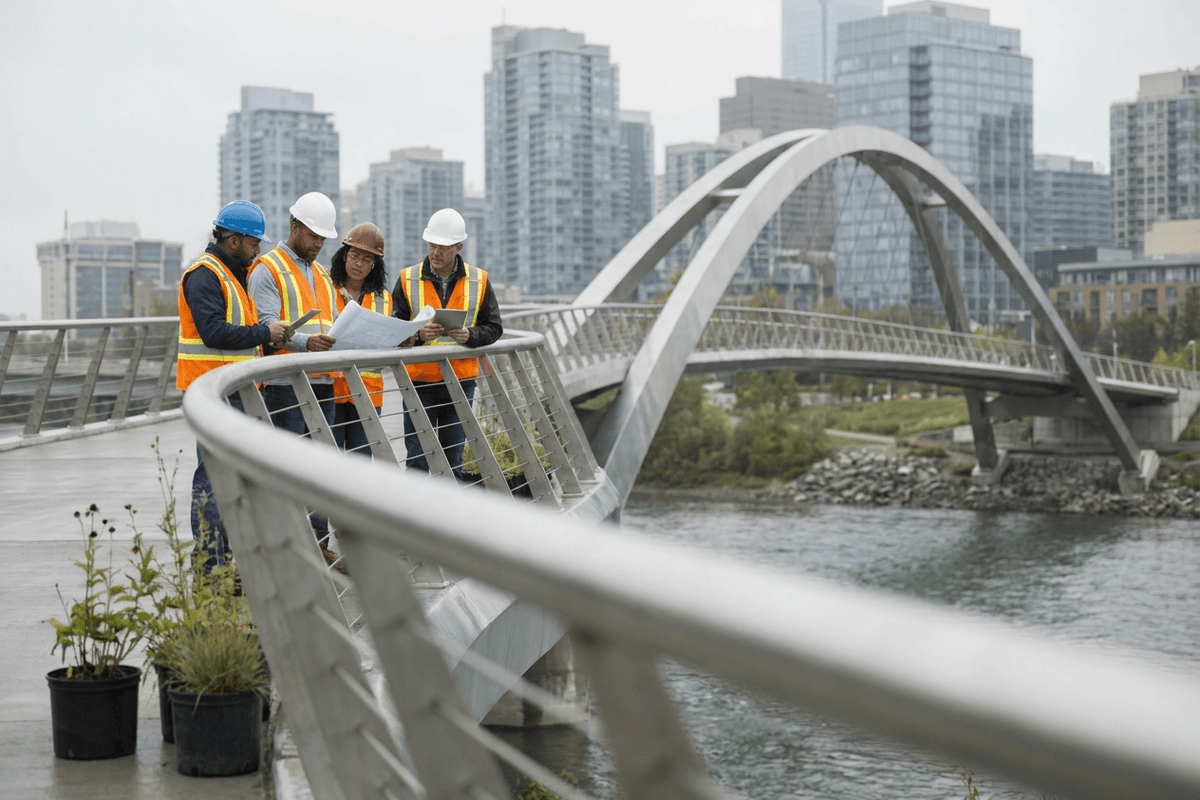

When the first structural steel plates were cut for Toronto’s Keating Channel pedestrian crossing, it marked more than another milestone in the decadal transformation of the city's Port Lands. It signaled a rigorous test of Canadian structural fabrication, non-linear geometric modeling, and multi-disciplinary urban integration. As announced by Waterfront Toronto, fabrication has officially commenced on the Equinox Bridge, an ambitious S-shaped suspended-arch structure designed in close collaboration with global engineering consultancy Arup and fabricated by Dartmouth, Nova Scotia-based Cherubini Bridges and Structures. Connecting downtown Toronto directly with Ookwemin Minising—the brand-new island forged by the $1.3-billion Port Lands Flood Protection Project—the bridge exemplifies the sheer technical complexity facing contemporary Canadian infrastructure.
Yet advanced engineering in Canada does not live solely within the realm of sweeping structural steel arches. Concurrently, the national profession’s highest governing body has cast a spotlight on chemical and process engineering innovation. Calgary-based clean technology firm Well Resources recently celebrated the induction of its president, Warren Chung, as a 2026 Fellow of Engineers Canada (FEC). Together, these milestones reveal two complementary engines driving Canadian engineering: the execution of hyper-complex structural envelopes tailored to urban climate resilience, and proprietary process technologies engineering the decarbonization of resource sectors.
The Geometry of Equinox: Engineering an S-Curved Suspended Arch
Designing and erecting a standard pedestrian bridge over an active urban waterway presents manageable engineering challenges. Constructing a continuous S-shaped, suspended-arch bridge across the mouth of the Don River’s Keating Channel, however, introduces non-linear structural dynamics that push conventional computational design to its limits.
Named the Equinox Bridge to align with solar alignments and celebrate Indigenous cultural connections to the natural world, the structure links the burgeoning East Bayfront with Ookwemin Minising. Designed by an international and Indigenous-led consortium featuring Arup, Grimshaw Architects, and Two Row Architect, the crossing must perform under stringent structural, hydraulic, and environmental performance metrics:
- Curvilinear Load Pathing and Torsional Moments: Unlike linear arch bridges where primary loads resolve through symmetrical vertical planes, an S-curved deck creates asymmetric torsional shear across its entire span. Every pedestrian movement, thermal shift, and aerodynamic excitation induces combined bending and twisting moments within the hollow structural section (HSS) ribs and deck girders.
- Suspension Hanger Kinematics: The cable-stayed and suspended network relies on tensioned stainless-steel or structural strand hangers configured at varying, non-orthogonal angles. Engineers at Arup had to deploy sophisticated non-linear finite element modeling (FEM) to simulate varying tension states across distinct seasonal temperature differentials spanning from -30°C to +35°C.
- Hydraulic and Flood Clearance: Positioned at the throat of the newly naturalized Don River outlet, the bridge must maintain specified freeboard requirements above 100-year and regulatory flood levels, preventing debris damming while managing tight aesthetic approach grades for universal accessibility under the Accessibility for Ontarians with Disabilities Act (AODA).
"Curved arch bridges transform every dead and live load into a coupled structural problem. You cannot decouple vertical deflection from torsional rotation—the geometry demands that fabrication and erection tolerances match the millimeter-scale precision of your digital twin."
Fabrication Rigor at Cherubini: Translating Computational FEM into Heavy Steel
The transition from Arup’s computational models to physical steel plate occurs inside Cherubini Bridges and Structures’ fabrication facilities in Nova Scotia. Cherubini, which previously fabricated the iconic curved bridge structures for the Port Lands (including the Cherry Street and Commissioning Street bridges), must execute compound-curve box girders and bespoke cast-steel cable nodes.
In compound-curved arch bridges, plate rolling and induction bending must account for springback, weld shrinkage, and residual stresses. Sub-assembly trial fits are essential; fabricators must employ 3D laser scanning to verify that as-fabricated geometries correspond perfectly to the structural digital twin before segments are coated, barged, and positioned over the Keating Channel.
| Structural Component | Primary Engineering Challenge | Fabrication / Execution Solution |
|---|---|---|
| Compound-Curved Arch Ribs | Bi-axial bending and out-of-plane torsion under unbalanced live loads. | Precision-rolled high-strength weather-resistant structural plate with internal diaphragms and continuous submerged arc welding (SAW). |
| Suspension Hangers & Pin Connectors | Fatigue stress cycling from wind-induced vortex shedding and pedestrian-induced resonance. | Custom cast-steel anchor nodes engineered for multi-axis cable departure, fitted with tuned mass damping criteria. |
| Marine Substructure & Abutments | Lateral soil thrust, differential settlement, and corrosive brackish water immersion. | Deep foundation concrete caissons anchored into Toronto shale bedrock with cathodic protection and high-durability marine concrete mixes. |
The Process Engineering Frontier: Decarbonization and Technical Leadership
While Waterfront Toronto’s civil works show how infrastructure reshapes cityscapes, process engineering defines how Canadian industrial operators remain viable in an increasingly decarbonized global economy. The announcement of Warren Chung’s election as a 2026 Fellow of Engineers Canada underscores the vital role played by process engineers who translate laboratory chemistry into commercially deployable industrial facilities.
As president of Calgary’s Well Resources, Chung has directed the commercialization and licensing of novel clean separation technologies, most notably solvent deasphalting (SELEX-P) and low-emission heavy oil upgrading pathways. In sectors often dominated by high-temperature, capital-intensive thermal cracking, these non-destructive, solvent-based separation processes reduce parasitic energy consumption, eliminate coke formation, and curtail direct Scope 1 greenhouse gas emissions.
What the Fellowship Distinction Means for Professional Practice
The Engineers Canada Fellowship (FEC) is not merely an honorary accolade; it reflects sustained, peer-reviewed contributions to the engineering profession and public safety. For mid-career and senior practitioners across Canada, Chung’s recognition highlights key evolutionary trends in industrial practice:
- Intellectual Property as an Export Engine: Canadian engineering firms are increasingly shifting from transactional fee-for-service consulting to developing and licensing proprietary, patented technology platforms globally.
- Process Intensification: Reducing the thermodynamic footprint of industrial separations—whether in bitumen processing, critical mineral extraction, or industrial wastewater management—is now a primary design metric rather than a secondary efficiency gain.
- Regulatory and Ethical Governance: As process systems interface with complex environmental frameworks and public expectations, licensed Professional Engineers (P.Eng.) bear direct legal and ethical accountability for system safety, plant reliability, and environmental stewardship.
Strategic Implications for Canadian Engineering Teams
Examining the Equinox Bridge fabrication and the recognition of national engineering fellowship reveals clear operational imperatives for engineering firms operating in Canada today.
1. The Convergence of Fabrication and Erection Engineering
On bespoke infrastructure projects, the boundary between permanent-works design and temporary-works/erection engineering has dissolved. Consulting firms must collaborate with fabricators and specialty marine contractors during early design phases. Complex geometries cannot be safely hoisted across watercourses using conventional crane picks without comprehensive staging analyses that model stress redistributions at every increment of cable tensioning.
2. Indigenous Co-Design as a Core Competency
The Equinox Bridge’s integration of Indigenous storytelling, environmental observation, and structural form reflects a permanent shift in Canadian civil practice. Multi-disciplinary teams that embed Indigenous knowledge systems and cultural architects from project inception create public assets with deeper social license, streamlined approvals, and award-winning architectural distinction.
3. Cross-Discipline Cross-Pollination
Whether calculating dynamic pedestrian vibration damping for an S-shaped deck or modeling mass-transfer kinetics inside a chemical separation column, the underlying tools of modern engineering—multiphysics simulations, parametric design, and life-cycle carbon accounting—are unifying the profession. Engineers who understand both heavy mechanical-structural systems and chemical-material performance are uniquely positioned to lead complex transitional projects.
Looking Ahead: The Built Environment of 2026 and Beyond
As Cherubini’s crews shape curved structural steel in Dartmouth and Well Resources scales proprietary process units across Western Canada and international markets, the Canadian engineering profession continues to prove its adaptability. The Equinox Bridge will ultimately be barged into the Keating Channel and hoisted into place, forming a visible civic symbol of flood resilience, urban design, and complex structural fabrication. Meanwhile, chemical and process innovators ensure the underlying economic engine of Canadian industry continues its pragmatic path toward decarbonization.
For Canadian engineers, these projects deliver a clear message: technical excellence, mastery of digital modeling, and uncompromising professional leadership remain the bedrock of a resilient built and industrial environment.