
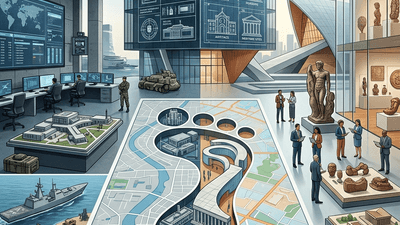



In the shifting sands of Canada’s 2026 architectural economy, the public sector remains the ultimate patron—but the nature of its patronage is demanding an increasingly polarized set of skills from design professionals. On one end of the spectrum lies the quiet, highly secure, and heavily engineered world of national defense; on the other sits the hyper-visible, culturally sensitive realm of ecological and heritage landmarks. For Canadian architectural practices looking to secure long-term stability, understanding the distinct procurement languages of these two federal arenas is no longer optional. It is the baseline for survival and growth.
Recent major project announcements highlight this stark duality. The strategies required to win a multi-million-dollar military infrastructure contract are vastly different from those needed to design a national park visitor centre, yet both represent the pinnacle of federal investment. By examining these recent awards, firm leaders can glean critical insights into how to position their studios for the next wave of government procurement.
The $270 Million Mandate: Defense and the Premium on Scale
When it comes to national security and defense infrastructure, the federal government’s primary currency is risk mitigation. This reality was underscored recently when AECOM was selected for the top-ranked position on Defence Construction Canada's (DCC) National Architecture & Engineering Source List. This multi-year program, valued at up to $270 million CAD, is a cornerstone of Canada’s defense infrastructure strategy.
The AECOM win is instructive for the broader industry. DCC projects often involve complex requirements—from high-security clearance protocols and climate-resilient engineering to rapid deployment capabilities across remote Canadian geographies, including the Arctic.
"Securing top-tier defense contracts in 2026 requires an architectural approach that is inextricably linked with heavy engineering, cybersecurity, and supply chain resilience. It is design as an act of national security."
What the DCC Contract Means for the Industry
- Multi-Disciplinary Dominance: Firms that can offer integrated architecture, engineering, and environmental consulting under one roof have a distinct advantage in defense procurement. The sheer administrative burden of managing multiple sub-consultants often pushes DCC toward massive, integrated entities.
- Long-Term Revenue Stability: Source lists and standing offers provide a buffer against private-sector market volatility. While the barrier to entry is exceptionally high, the multi-year nature of these contracts ensures sustained studio revenue.
- Sub-Consultant Opportunities: For boutique and mid-sized Canadian firms, the path to defense work often lies in partnering with mega-firms like AECOM, offering niche expertise in local building codes, regional climate adaptations, or specialized sustainability targets.
The Banff Paradigm: Global Vision Meets Local Sensibility
In stark contrast to the utilitarian demands of defense infrastructure, federal cultural and ecological projects are highly public expressions of Canadian identity. Here, procurement favors poetic design, environmental stewardship, and deep cultural resonance.
This approach was vividly demonstrated in the recent announcement that Kengo Kuma & Associates and Paul Raff Studio have been selected to design the new Banff National Park Visitor Centre. Organized by Parks Canada in partnership with the Royal Architectural Institute of Canada (RAIC), this project represents a masterclass in modern cultural procurement.
The selection of a globally renowned Japanese firm (Kengo Kuma) partnering with an acclaimed Toronto-based practice (Paul Raff Studio) signals a continuing trend: the federal government’s desire for international "starchitect" cachet, grounded by domestic expertise and contextual sensitivity. The project demands an architecture that defers to its majestic Rocky Mountain setting while accommodating millions of annual visitors and adhering to stringent ecological guidelines.
The Anatomy of a Winning Cultural Bid
- Strategic Joint Ventures (JVs): The Kuma-Raff partnership proves that combining international design prestige with deep local knowledge (including Indigenous consultation frameworks and Canadian environmental standards) is a winning formula for high-profile federal design competitions.
- Integration with the Natural Realm: Parks Canada projects are heavily scrutinized for their ecological footprint. Winning designs in 2026 must move beyond basic LEED certification, integrating biophilic design, circular material economies, and passive climate strategies.
- Navigating Public Scrutiny: Unlike defense projects, which are shielded from public view, cultural landmarks are subject to intense public and media critique. Firms must excel not only in design, but in public relations, stakeholder engagement, and transparent storytelling.
The Domestic Vanguard: Holding Ground on the Global Stage
While massive global firms dominate defense, and international JVs capture landmark cultural projects, domestic practices are far from sidelined. Canadian firms continue to refine their competitive edge, proving that domestic talent can operate at the highest levels of design excellence.
This enduring domestic strength is highlighted by Vancouver’s Henriquez Partners Architects, recently recognized as one of the top ten studios in Architizer's 2026 list of the 30 Best Architecture & Design Firms in Canada. Henriquez Partners exemplifies the successful Canadian mid-to-large-sized practice: deeply rooted in complex civic and mixed-use projects, capable of navigating dense urban politics, and consistently delivering world-class design without relying on international partnerships.
For firms of this profile, the strategy is less about chasing $270 million defense contracts, and more about dominating the complex, multi-stakeholder civic and private developments that shape Canada's rapidly densifying urban centers. Their inclusion in global rankings reinforces that Canadian architectural branding—characterized by social equity, sustainability, and urban integration—remains highly exportable and deeply respected.
Contrasting Procurement Pathways: A Strategic Overview
To successfully navigate the 2026 landscape, firm leadership must clearly define which institutional pathway aligns with their studio’s operational capacity and design ethos. The table below outlines the divergent requirements of these two major federal procurement streams:
| Procurement Factor | Defense & Infrastructure (e.g., DCC) | Cultural & Ecological (e.g., Parks Canada) |
|---|---|---|
| Primary Client Driver | Risk mitigation, security, rapid deployment. | Public engagement, cultural narrative, ecology. |
| Ideal Firm Profile | Massive, multi-disciplinary, highly integrated. | Design-forward JVs (International + Domestic). |
| Key Deliverables | Resilient engineering, strict compliance, scale. | Biophilic design, Indigenous consultation, aesthetics. |
| Barrier to Entry | High security clearances, massive administrative capacity. | Intense design competition, public scrutiny. |
Looking Ahead: The Architecture of Public Trust
As we move deeper into 2026, the Canadian architectural profession is being asked to serve two very different masters within the public sector. The monumental scale of AECOM’s defense mandate reminds us that architecture is fundamentally a matter of shelter, security, and national resilience. Meanwhile, the delicate, landscape-driven vision of the Banff Visitor Centre by Kengo Kuma and Paul Raff Studio reminds us that public works must also elevate the human spirit and honor the land.
For Canadian architects, the lesson is clear: success in the public sphere requires extreme clarity of purpose. Whether your firm is building the secure facilities that protect the nation, or the cultural landmarks that define it, the future belongs to those who can master the rigid complexities of institutional procurement without losing their fundamental commitment to design excellence.