
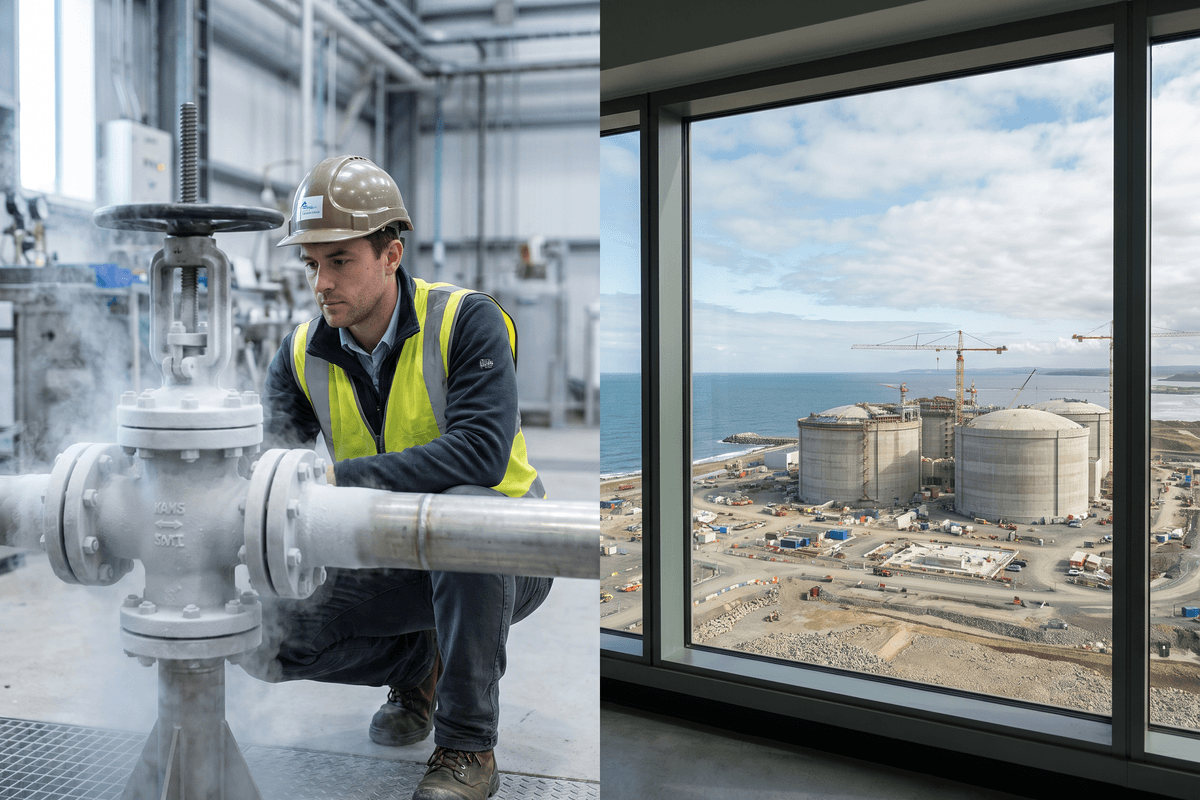

From the precision thermodynamics of orbital propulsion testing in Southwestern Ontario to the massive cryogenic trains rising along the Pacific Rim in northern British Columbia, Canadian engineering is operating at unprecedented technical extremes. While industrial and aerospace sectors are often viewed through separate lenses, their simultaneous acceleration reveals a unified truth: domestic consulting engineers, EPCMs, and specialty technical firms are being tasked with solving complex fluid dynamic, metallurgical, and structural challenges under the most demanding operating envelopes in history.
Two major project announcements—the unveiling of Canada Rocket Company’s C$30 million aerospace propulsion test facility at London International Airport and the confirmation that Shell and the LNG Canada joint venture have reached a Final Investment Decision (FID) for Phase 2 in Kitimat—exemplify how extreme-temperature engineering and sovereign infrastructure are reshaping the national engineering landscape.
Sovereign Aerospace Ground Infrastructure: The London Rocket Test Facility
For decades, Canadian space engineering distinguished itself globally through satellite instrumentation, robotics, and Earth observation payloads. However, sovereign launch vehicle testing and domestic propulsion static-firing capabilities remained largely inaccessible within Canadian borders. Canada Rocket Company’s C$30 million investment to establish the nation’s first commercial large launcher test facility at London International Airport marks a decisive pivot toward end-to-end aerospace development.
Structural and Blast-Containment Engineering
Developing a commercial static-fire test stand for liquid-propellant rocket engines introduces unique civil, structural, and mechanical design constraints:
- Dynamic Thrust Load Attenuation: Test stands must withstand continuous and transient thrust vectors exceeding tens of kilonewtons while maintaining micro-deflection tolerances to prevent inaccurate telemetry data.
- Acoustic and Thermal Deflection: Flame trenches and water-deluge suppression systems require specialized refractory concrete mixes and hydrodynamic cooling channels designed to survive localized exhaust temperatures surpassing 3,000°C.
- Cryogenic Fluid Management: On-site bulk storage, vacuum-jacketed transfer piping, and automated purge systems for liquid oxygen (LOX), liquid methane, and refined kerosene demand strict compliance with CSA B51 and ASME B31.3 process piping standards.
"Establishing a dedicated large launcher testing footprint in Southwestern Ontario provides Canadian aerospace engineers with immediate, sovereign access to propulsion qualification workflows, significantly shortening R&D feedback loops for orbital architectures."
Beyond structural testing, the London facility represents a hub for high-frequency instrumentation engineering. Static firing requires multi-channel data acquisition (DAQ) systems sampling pressure transducers, accelerometers, and optical pyrometers at rates exceeding 100 kHz. Engineering teams must integrate real-time autonomous abort logic with SIL-3 (Safety Integrity Level 3) rated emergency shutdown valves to safeguard airfield operations.
Cryogenic Scale on the Pacific Rim: LNG Canada Phase 2 Unlocks Megaproject Capacity
While London establishes a beachhead for aerospace propulsion, northern British Columbia is seeing an extraordinary mobilization of heavy process and civil engineering. The final investment decision to proceed with LNG Canada Phase 2 in Kitimat effectively doubles the facility’s nameplate export capacity from 14 to 28 million tonnes per annum (MTPA), commissioning two additional world-scale liquefaction trains.
| Engineering Dimension | Canada Rocket Co. Test Stand (London, ON) | LNG Canada Phase 2 (Kitimat, BC) |
|---|---|---|
| Primary Technical Challenge | Acoustic damping, high-pressure LOX/methane static fire, rapid-transient DAQ | World-scale cryogenic liquefaction (-162°C), e-drive electrification, modular EPC |
| Capital Scope | C$30 Million | Multi-Billion Dollar Capital Buildout |
| Key Engineering Disciplines | Aerospace, Structural Dynamics, Instrumentation, Cryogenics | Chemical/Process, Heavy Civil, Marine Geotechnical, Electrical HV |
| Operational Life Cycle | High-frequency R&D, rapid test-and-iterate cycles | 40+ year continuous industrial baseload export |
Electrification and Process Decarbonization
Phase 2 incorporates critical engineering modifications over Phase 1, most notably a pathway toward electric-drive (e-drive) compressor architectures powered by BC Hydro’s renewable grid. This design shift introduces substantial high-voltage electrical engineering requirements:
- Grid Intertie & Substation Engineering: Managing massive localized electrical loads without destabilizing regional 500 kV transmission lines requires sophisticated static VAR compensators and harmonic filter designs.
- Cryogenic Heat Exchange Optimization: Main Cryogenic Heat Exchangers (MCHEs) operating at -162°C require advanced metallurgy—primarily 9% nickel steels and specialized aluminum alloys—to prevent brittle fracture during continuous thermodynamic cycling.
- Modular Offsite Fabrication: Transporting multi-thousand-tonne pre-assembled process modules (PARMs) via marine heavy-lift vessels requires complex marine geotechnical wharf engineering at the Douglas Channel marine terminal.
The Cross-Disciplinary Nexus: Shared Technical Frontiers
Although an aerospace propulsion test cell and an industrial LNG train serve different commercial markets, the core engineering disciplines driving both projects are remarkably aligned. The convergence centers around three core engineering competencies:
1. Cryogenic Metallurgy and Leak Containment
Handling liquefied gases—whether liquid oxygen at -183°C for rocket oxidizers or liquefied natural gas at -162°C—demands identical rigor in material selection. Engineers must calculate thermal contraction coefficients, prevent thermal shock during pre-cooling sequences, and deploy advanced non-destructive examination (NDE) methods including phased-array ultrasonic testing (PAUT) on all critical welded joints.
2. Advanced Computational Fluid Dynamics (CFD)
Both London’s test cell designers and Kitimat’s process engineers rely heavily on multi-phase CFD simulations. For the launch facility, CFD models predict plume expansion, thermal radiation envelopes, and acoustic reflection off concrete blast walls. For LNG Canada Phase 2, CFD governs gas dispersion safety models, flare stack radiation sizing, and cryogenic boil-off gas (BOG) re-liquefaction loops.
3. Rigorous Process Safety Management (PSM)
Hazard and Operability (HAZOP) studies and Layer of Protection Analysis (LOPA) are foundational across both domains. The catastrophic risk of fuel-oxidizer mixing or large-scale vapor cloud explosions mandates double-containment barriers, automated emergency depressurization (blowdown) systems, and real-time optical flame detection matrices.
Strategic Outlook for Canadian Consulting and EPCM Practices
The progression of these projects signals a vibrant chapter for Canadian engineering firms, providing diverse opportunities across consulting, detailed design, commissioning, and environmental monitoring:
- High-Value EPC & Specialty Consulting: London’s test stand buildout demonstrates that specialized infrastructure can thrive outside conventional tech clusters, drawing upon Ontario’s advanced manufacturing and precision tooling supply chains.
- Long-Duration Execution Pipelines: LNG Canada Phase 2 secures multi-year procurement, quality assurance, and site construction supervision work packages for domestic consulting firms operating across British Columbia and Alberta.
- Workforce Up-Skilling: Transitioning engineering talent from conventional process systems to cryogenic e-drive facilities and sovereign aerospace propulsion platforms ensures Canada maintains a highly competitive, future-ready technical workforce.
As construction begins in London and major procurement mobilizes for Kitimat, Canadian engineers find themselves at the center of critical national transformations. By mastering the dual challenges of extreme-temperature physics and large-scale project execution, the profession continues to demonstrate its vital role in anchoring Canada's sovereign technological and industrial future.