
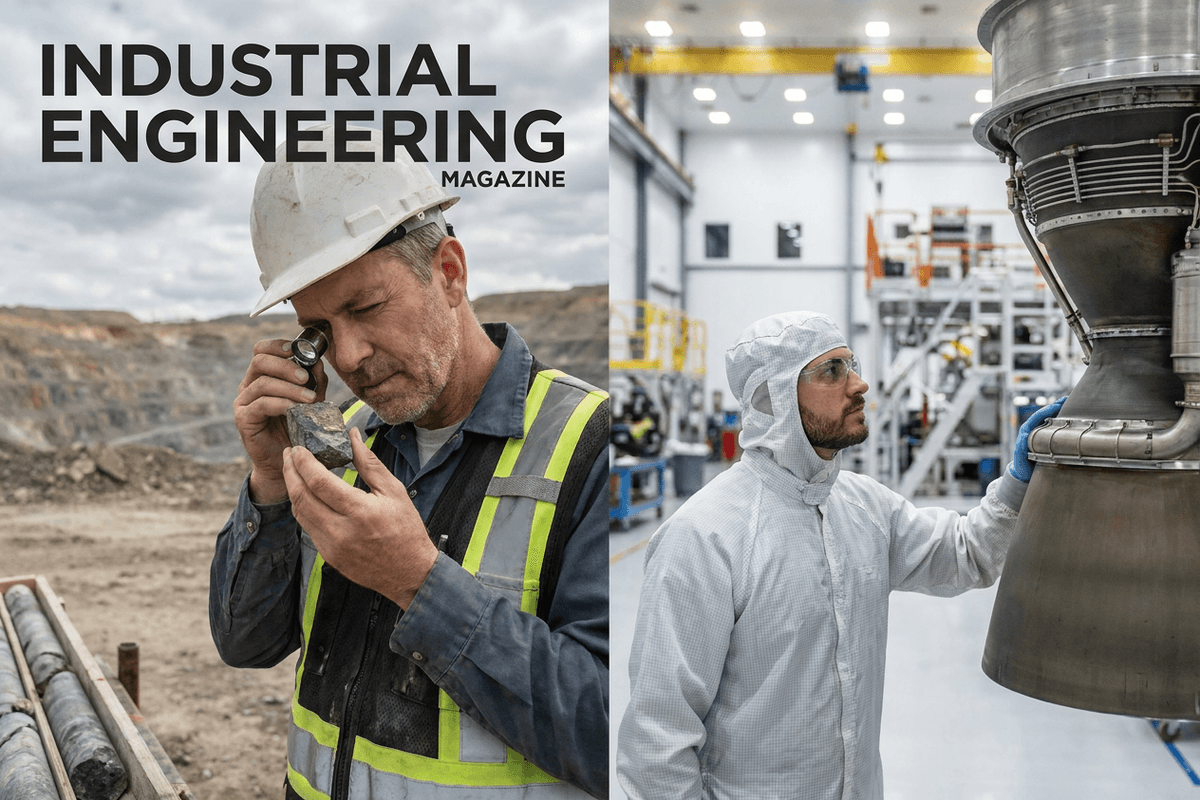

For decades, the fragility of the Western industrial base was treated as an abstract macroeconomic risk: foreign-controlled mineral extraction on one side of the globe, high-spec aerospace and defense assembly on the other, connected by tenuous maritime supply lines. That era of passive risk management has officially collapsed. Today, American engineering delivery is undergoing a radical, structural realignment—one that directly couples upstream resource extraction in frontier markets with high-precision mission-critical facility delivery across the domestic manufacturing footprint.
At the tip of this geopolitical spear is engineering and construction powerhouse Fluor Corporation. As reported by Business Insider Africa, Fluor has entered the race to develop Kenya’s $62 billion Mrima Hill critical minerals site following the sudden withdrawal of two Chinese state-linked firms. The deposit represents one of the world's most lucrative untapped sources of niobium and rare earth elements (REEs)—materials that are fundamental to modern aerospace superalloys, rocket motor casings, and next-generation defense systems. Simultaneously, domestic facility execution is undergoing parallel hardening: the U.S. Army Corps of Engineers (USACE) Mobile District is executing more than $150 million in complex facility infrastructure modernizations for NASA, while specialty contractors like U.S. Engineering are re-engineering chilled-water thermal baselines to keep high-tolerance aerospace manufacturing lines operational.
The Upstream Offensive: Fluor, Mrima Hill, and the Niobium Imperative
The geopolitical significance of Kenya’s Mrima Hill deposit cannot be overstated. Located in Kwale County, the geological formation holds an estimated asset valuation surpassing $62 billion, rich in both light and heavy rare earths, and crucially, immense reserves of niobium. Niobium is an irreplaceable metallurgical additive: when micro-alloyed into nickel and steel, it yields superalloys capable of retaining structural rigidity, creep resistance, and oxidation resistance at temperatures exceeding 1,200°C—the exact thermal thresholds found in hypersonic combustion chambers, rocket thrusters, and commercial jet turbine discs.
For American engineering procurement and construction (EPC) conglomerates like Fluor, stepping into the void left by Chinese departures represents a deliberate alignment with allied critical mineral security initiatives. Developing Mrima Hill is not a standard open-pit civil earthwork; it is an ultra-complex chemical and metallurgical engineering challenge:
- Complex Metallurgical Extraction: Weathered carbonatite deposits like Mrima Hill typically contain refractory ores that require high-temperature hydrometallurgical cracking, continuous solvent extraction, and acid-leach circuits to separate high-purity niobium oxide from co-mingled thorium and radioisotopes.
- Remote Logistical Infrastructure: Delivering heavy modular chemical refining skids to rural East Africa requires heavy-haul civil route engineering, power island installations, and closed-loop process water management designed to withstand sensitive regional environmental scrutiny.
- Allied Supply Chain Integration: Rather than shipping unrefined ore concentrates overseas for processing, Fluor’s technical engagement opens the door to creating an integrated, Western-aligned flow from pithead to flight hardware.
"The strategic project aims to expand Western supply lines for niobium and rare earths used in advanced aerospace and defense manufacturing... filling a critical vacuum as alternative foreign operators step back."
— Industry Analysis, Business Insider Africa
The Domestic Crucible: Executing $150M in Complex Aerospace Upgrades Under Live Production
Extracting high-performance elements at the front end of the supply chain is meaningless if domestic assembly facilities lack the physical infrastructure to convert raw superalloys into flight hardware. This reality is on vivid display across the Gulf Coast, where the USACE Mobile District is steering an intensive capital delivery program exceeding $150 million across NASA’s aerospace facilities.
The operational crown jewel of this effort is the historic Michoud Assembly Facility in New Orleans, Louisiana—the primary manufacturing hub for NASA’s Space Launch System (SLS) rocket core stages and Orion spacecraft structures. At Michoud, USACE civil and structural teams are tackling an engineering feat that borders on surgical: a continuous, 43-acre reroofing program spanning one of the largest continuous industrial footprints in the world.
Engineering Beneath the 43-Acre Canopy
The engineering complexity of the Michoud reroofing project is defined not merely by square footage, but by the continuous manufacturing cadence taking place directly beneath the structural decking. At no point can flight-hardware manufacturing halt:
- Zero-Tolerance Particulate Controls: Michoud houses multi-axis friction-stir welding towers, automated composite fiber placement machines, and thermal protection system application chambers. A single grain of structural debris, abrasive dust, or roofing sealant dropped from overhead could compromise the metallographic purity of an SLS cryogenic fuel tank weld.
- Continuous Hydrostatic Protection: Operating in Louisiana’s high-precipitation subtropical corridor, the phased removal of existing roof membranes requires real-time meteorological monitoring, rapid-deployment temporary weather barriers, and zoned negative-pressure drainage systems to prevent water ingress.
- Vibrational Isolation: Heavy structural rigging and fastening on the roof deck must be dynamically isolated to avoid propagating harmonic vibrations down structural steel columns into laser metrology systems and optical alignment jigs calibrated to thousandths of an inch.
Downstream Thermal Precision: The Micro-Environment of Modern Machining
While USACE fortifies the structural envelopes of aerospace megaprojects, specialty trade engineers are grappling with micro-environmental constraints inside the facilities themselves. In its latest technical review, specialty contractor U.S. Engineering outlined the increasingly exacting mechanical tolerances required by aerospace clients, spotlighting custom process chilled-water redesigns engineered to maintain flawless thermal stability across manufacturing lines.
When high-purity superalloys—such as the niobium-enhanced nickel alloys sourced from sites like Mrima Hill—are machined into turbine blisks or rocket engine fuel injectors, tool wear, cutting shear heat, and coolant temperature fluctuations dictate final part tolerances. If process chilled water varies by more than 0.5°C across a 24-hour cycle, thermal expansion within multi-million-dollar 5-axis CNC machining centers can drive finished parts outside critical defense tolerances.
Comparison: The Engineering Continuum of the Defense-Aerospace Supply Chain
| Lifecycle Tier | Representative Anchor | Primary Engineering Discipline | Critical Operational Threshold |
|---|---|---|---|
| Upstream Extraction | Mrima Hill Project (Fluor Corp) | Chemical, Metallurgical & Heavy Civil EPC | Efficient solvent-extraction separation of refractory niobium from radioactive tailings. |
| Facility Structural Envelope | Michoud Assembly Facility (USACE Mobile) | Structural, Building Envelope & Programmatic Civil | Continuous water-tightness and particulate isolation across 43 acres over live rocket fabrication lines. |
| Precision Process Cooling | Aerospace Machining Redesigns (U.S. Engineering) | Mechanical, Hydronic & Controls Engineering | Sub-degree process chilled-water loop stability to eliminate thermal drift in CNC machining. |
The Labor and Technical Pipeline: Engineering the Next Generation
Every link in this supply chain—from Fluor’s geotechnical engineers in Kwale to the mechanical estimators and pipefitters at U.S. Engineering—is constrained by a single systemic bottleneck: skilled human capital. Advanced process piping, complex envelope construction, and hydronic balancing cannot be automated through commercial software alone.
To counteract the severe talent shortfall facing industrial MEP (mechanical, electrical, and plumbing) disciplines, U.S. Engineering has deepened its direct pipeline initiatives, engaging regional youth robotics programs, trade academies, and engineering universities. This proactive talent capture mirrors what leading defense contractors are pursuing across the country: treating the engineering workforce pipeline not as a downstream human resources function, but as an essential piece of front-end infrastructure.
"Strengthening the skilled trade and engineering workforce pipeline is no longer optional. The gap between theoretical digital modeling and field excellence in complex mechanical environments must be closed through direct, early intervention."
— Field Operations Briefing, U.S. Engineering
Strategic Implications for U.S. Project Leaders
For executives, project managers, and lead engineers across the United States, the convergence of Fluor’s critical mineral offensive, USACE’s defense facility recapitalization, and specialized mechanical redesigns signals a fundamental change in how capital delivery must be structured:
- Design for Geopolitical Redundancy: Process and materials engineers must design specifications that can quickly pivot between newly secured allied mineral outputs (e.g., Kenyan or domestic REE processing) rather than locking systems into single-source adversarial supply streams.
- Master Live-Facility Phasing: Greenfield projects are becoming rare luxuries. Capital efficiency increasingly demands executing radical structural and MEP overhauls inside operational, high-security facilities where production downtime costs millions of dollars an hour.
- Integrate Mechanical Micro-Tolerances with Civil Scale: Heavy industrial project teams must communicate seamlessly with MEP and process engineers early in the conceptual design phase. Thermal stability, vibration suppression, and localized process cooling can no longer be treated as secondary fit-out tasks.
The Path Forward
The industrial dominance of the 21st century will not be decided solely in digital software suites or boardrooms. It will be decided in the physical, hard-hat trenches of global engineering execution. By capturing the upstream chemical and mineral extraction points at Mrima Hill, maintaining the integrity of our national space assembly facilities at Michoud, and engineering precision mechanical baselines on the factory floor, the U.S. engineering ecosystem is proving that national security is, at its core, a discipline of relentless capital delivery.