
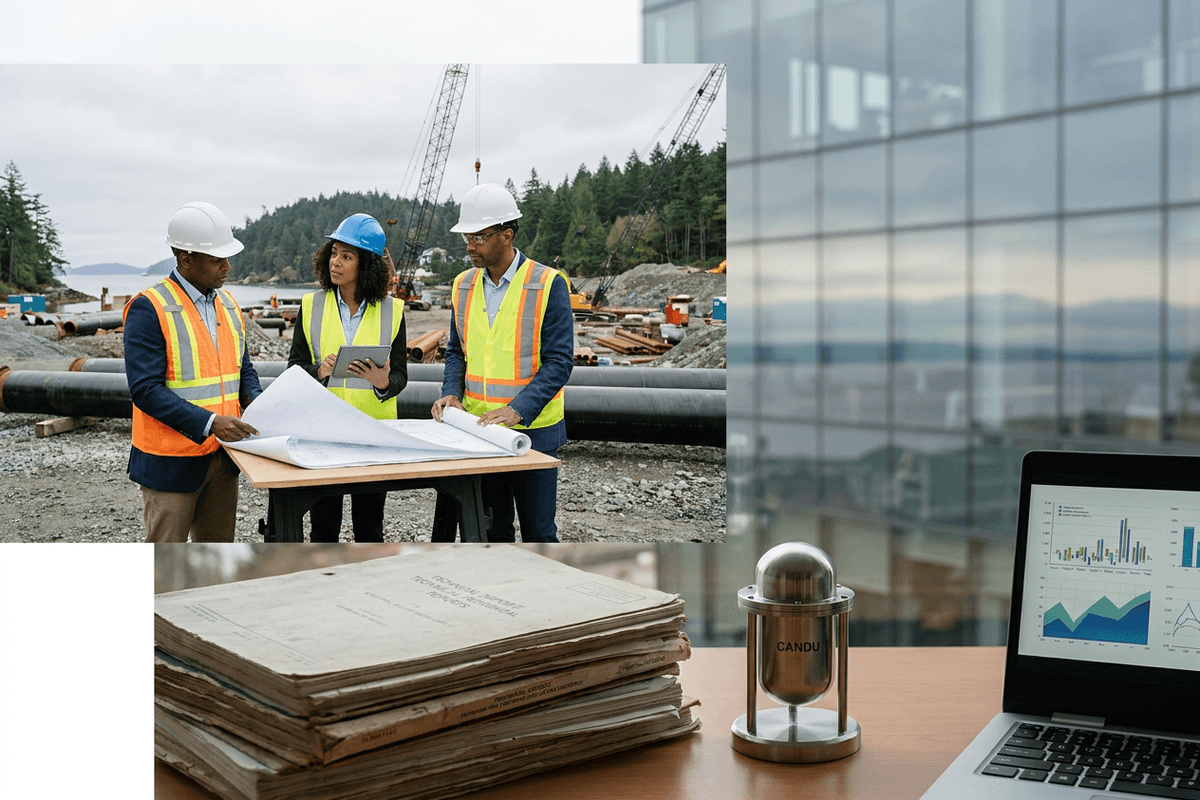



Canada’s heavy engineering sector is experiencing an unprecedented convergence of megaproject execution, cross-border nuclear export ambition, and digital transformation. As energy transition demands accelerate capital deployment, major engineering firms are securing critical mandates that span complex natural gas logistics in British Columbia, baseload nuclear development in the United States, and AI-enabled asset management across domestic transport and utility corridors. At the centre of this operational momentum is LNG Canada’s decision to award TR Canada E&C an EPCM contract valued at over €200 million for Phase 2 of British Columbia's Coastal GasLink expansion, underscoring how pipeline hydraulics, compression engineering, and multi-billion-dollar project delivery are evolving across Western Canada.
Coastal GasLink Phase 2: Mastering Compression and Hydraulic Scale
The Coastal GasLink pipeline system represents the critical energy artery connecting the prolific Montney gas basin in northeastern British Columbia to the LNG Canada export terminal in Kitimat. While Phase 1 established the baseline 670-kilometre conduit, Phase 2 is designed to double throughput capacity to approximately 5.0 billion cubic feet per day (Bcf/d) without laying additional mainline pipe. Instead, the expansion relies entirely on midstream compression engineering.
Under the newly awarded €200-million-plus engineering, procurement, and construction management (EPCM) mandate, TR Canada E&C (the Canadian subsidiary of Técnicas Reunidas) will oversee the complete lifecycle execution for five new compressor stations along the right-of-way. For Canadian process and mechanical engineers, this project presents distinct technical hurdles:
- High-Efficiency Turbine-Compressor Integration: Configuring heavy-duty industrial gas turbines and centrifugal compressor trains engineered to operate reliably across mountainous terrain and severe sub-zero winter temperatures.
- Emissions Abatement and Waste Heat Recovery: Implementing dry low-NOx combustion systems and waste heat recovery units (WHRUs) to reduce the carbon intensity of midstream compression operations.
- SCADA and Dynamic Pipeline Simulation: Integrating real-time transient hydraulic modeling to coordinate multi-station pressure optimization, mitigate slugging, and maintain stable feed pressure to Kitimat's cryogenic liquefaction trains.
- Constructability in Remote Geographies: Managing complex modular fabrication, heavy-haul logistics over forestry service roads, and geotechnical stabilization across sensitive river valleys and seismic zones.
"Phase 2 expansion demonstrates the operational power of hydraulic optimization. By deploying five strategically located compressor stations, the Coastal GasLink corridor doubles its delivery capacity while minimizing incremental ground disturbance across complex British Columbia terrain."
The Nuclear Export Frontier: AtkinsRéalis and the 6.0 GW Indiana CANDU Evaluation
While domestic midstream infrastructure scales in the West, Canadian nuclear engineering is establishing a historic foothold in the American Midwest. Montreal-headquartered engineering leader AtkinsRéalis entered into a memorandum of understanding with the State of Indiana and Hoosier Energy to evaluate building up to eight CANDU nuclear reactors producing 6.0 GW of clean baseload power. This initiative highlights the global re-emergence of Canadian heavy-water reactor technology as industrial grids seek continuous, non-emitting energy to support manufacturing reshoring and hyperscale artificial intelligence data centres.
For Canadian nuclear engineers and supply-chain partners, the Indiana agreement signals a profound expansion of technical scope beyond domestic life-extension projects at Darlington, Bruce Power, and Pickering:
- Standardized Fleet Deployment: Evaluating the construction of up to eight Monark-class or enhanced CANDU units provides long-term engineering predictability, moving away from customized single-unit construction toward programmatic manufacturing and modular assembly.
- Natural Uranium and Fuel Flexibility: Leveraging the CANDU platform's heavy-water moderation capability, which allows operation on natural uranium and alternative fuel cycles without dependence on enriched uranium supply bottlenecks.
- Cross-Border Regulatory Harmonization: Bridging Canadian Nuclear Safety Commission (CNSC) operational baselines with U.S. Nuclear Regulatory Commission (NRC) design certification and licensing frameworks.
| Project / Strategic Initiative | Lead Organization | Primary Technical Focus | Capacity / Value Scope |
|---|---|---|---|
| Coastal GasLink Phase 2 EPCM | TR Canada E&C / LNG Canada | 5 Compressor Stations, Hydraulic Modeling, Modular EPCM | €200M+ EPCM (5.0 Bcf/d Total Throughput) |
| Indiana Clean Energy Deployment | AtkinsRéalis / Hoosier Energy | CANDU Nuclear Technology, Fleet Baseload Generation | Up to 8 Reactors (6.0 GW Total Capacity) |
| GCM Corpo Acquisition | WSP Global | Industrial Decarbonization, Mining, & Energy Engineering | Expanded Heavy Industrial Capability |
| ConeLabs Platform Integration | Consor North America | AI-Driven 3D Computer Vision, Civil Inspection | Bridge & Structural Condition Assessment |
Strategic Consolidation and Advanced Structural Intelligence
Alongside major project awards, the corporate and technological architecture of Canadian engineering is undergoing rapid realignment. Market dynamics reflect an aggressive pursuit of industrial decarbonization expertise and advanced digital inspection platforms.
Heavy Industrial Expansion: WSP and GCM Corpo
In Montreal, engineering services powerhouse WSP Global signed an agreement to acquire industrial engineering specialist GCM Corpo. This transaction directly addresses the growing demand for specialized process engineering, brownfield plant retrofitting, and energy transition solutions across Canada’s heavy manufacturing, chemical, and mineral processing corridors. By absorbing GCM Corpo's bench of industrial specialists, WSP bolsters its capacity to deliver complex EPCM mandates for facilities undergoing structural electrification and carbon capture integration.
Digital Infrastructure Integrity: Consor Acquires ConeLabs
Asset management is simultaneously shifting from manual, reactive inspection cycles to predictive, automated spatial computing. Illustrating this transition, Consor North America acquired Ontario-based technology startup ConeLabs, integrating its proprietary artificial intelligence and 3D modeling platform into civil infrastructure inspections.
For municipal, bridge, and highway engineers, the integration of ConeLabs’ computer vision algorithms directly into standard field practice allows structural defects—such as concrete spalling, sub-millimetre cracking, and rebar corrosion—to be tracked across multi-temporal digital twins. This eliminates human variability in visual inspections, provides defensible asset decay curves, and streamlines capital allocation for aging civil infrastructure across North America.
Setting the Benchmark: Recognition at the 2026 Canadian Consulting Engineering Awards
The operational maturity of Canadian firms was formally celebrated on the national stage, showcasing how technical precision and governance frameworks are elevating industry standards.
Highlighting the necessity of institutional governance in emerging technology, J.L. Richards & Associates Limited earned an Award of Excellence at the 2026 Canadian Consulting Engineering Awards for establishing an organization-wide responsible AI foundation. Rather than treating machine learning as an ad-hoc drafting tool, JLR built a comprehensive enterprise framework that enforces data provenance, algorithmic validation, cybersecurity, and professional engineering accountability across all automated design and calculation tools.
Meanwhile, Canadian multidisciplinary firm CIMA+ received three Awards of Excellence at the 2026 Canadian Consulting Engineering Awards, demonstrating elite execution across three vital engineering disciplines:
- High-Voltage Cross-Border Transmission: Delivering complex electrical engineering and environmental routing for the Hertel-New York power transmission interconnection, enabling clean hydropower exports into the northeastern United States.
- Urban Transit Modernization: Providing structural, civil, and systems integration expertise on Montreal's Réseau express métropolitain (REM) automated light rail network.
- Environmental & Ecological Engineering: Pioneering multi-parameter ecological diagnostics for lake remediation and watershed preservation.
What This Means for Canadian Engineering Practice
The convergence of the Coastal GasLink Phase 2 EPCM award, AtkinsRéalis’ multi-gigawatt CANDU memorandum, and rapid digital integration across consulting firms presents clear operational takeaways for engineers across Canada:
- Interdisciplinary Integration is Mandatory: Modern megaprojects are no longer siloed civil or mechanical tasks. As evidenced by Coastal GasLink’s compressor stations and high-voltage transmission lines like Hertel-New York, projects require tight synchronization between hydraulic simulation, grid interconnection, environmental monitoring, and automated control systems.
- Responsible Digital Adoption: The award-winning frameworks established by J.L. Richards and the acquisition of computer-vision platforms like ConeLabs prove that AI is transitioning from an exploratory phase to a regulated, professional engineering standard. Firms must establish verifiable QA/QC protocols for all computational design outputs.
- Exportable Technical Competency: From heavy-water nuclear engineering in the U.S. Midwest to specialized EPCM delivery in remote alpine corridors, Canadian consulting and construction engineering expertise remains in high demand globally. Maintaining leadership will require sustained investment in midstream modularization, nuclear supply chains, and digital asset lifecycle management.
As capital continues to mobilize into complex energy infrastructure and transit megaprojects, Canadian engineers are uniquely positioned to define the execution standards for North America's industrial future.