
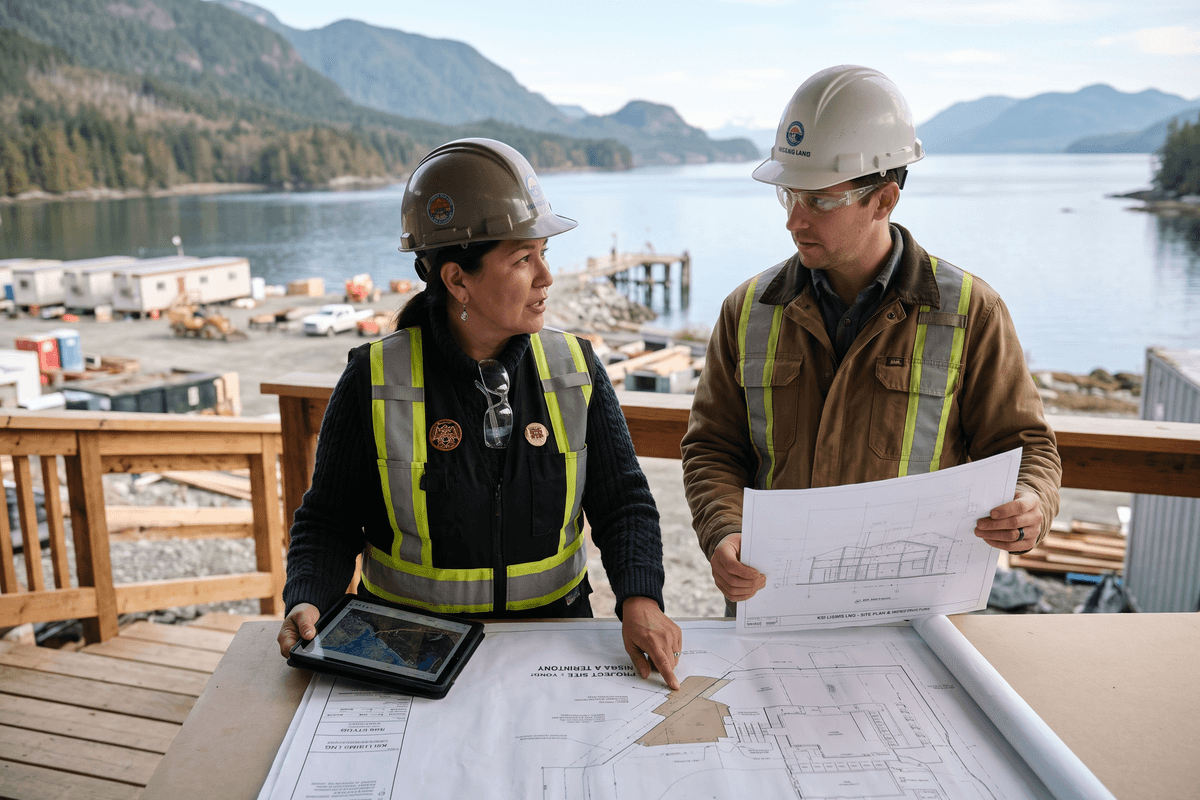

Ksi Lisims LNG, a proposed floating liquefied natural gas export project in British Columbia, has moved a step closer to a commercial outlet. Santos, the Australian oil and gas company listed as the project owner, has signed a nonbinding heads of agreement with Western LNG to acquire about one million tonnes of LNG a year from Ksi Lisims for up to 20 years, starting from about 2031, according to Engineering News. The project is still early in its life, but the offtake signal matters to engineers because it shows how a remote Canadian export project is being shaped around a buyer, a power source and Indigenous land rights before construction decisions are made.
What Happened
Engineering News describes Ksi Lisims as a proposed 12-million tonne-a-year floating LNG export project. It is designed to supply Pacific Basin and Asian markets and uses hydroelectric power for liquefaction, which the source links to a lower-emissions production profile. The project sits on land owned by the Nisga'a Nation in British Columbia, and the Nisga'a Nation, Western LNG and Rockies LNG are named as the primary project developers.
The nonbinding nature of the Santos agreement is important. A heads of agreement sets out intentions and commercial terms in principle, but it does not commit either party to a final contract. For engineers, that means the offtake volume and start window should be treated as planning assumptions rather than firm commitments.
Project Snapshot
The table below lists the figures the source provides and flags those it does not.
| Item | Position in source |
|---|---|
| Proposed capacity | 12-million tonne-a-year floating LNG export project |
| Santos offtake (nonbinding) | About one million tonnes of LNG a year |
| Offtake duration | Up to 20 years |
| Offtake start | About 2031 |
| Capital expenditure | Not stated |
| Potential job creation | Not stated |
| Planned start/end date | Not confirmed |
The gaps are as informative as the figures. With no published capital cost, job estimate or confirmed schedule, anyone assessing the project's workload or labour demand has to rely on the developers' future disclosures.
Why the Power Source Matters to Engineers
Using hydroelectric power for liquefaction is the feature that most directly affects engineering design. Liquefaction is energy-intensive, and a project that draws on hydro rather than fossil-fuel generation changes the power supply and electrical infrastructure questions that engineers must answer. In my view, the electrical scope, grid connection and power reliability will be among the earliest and most consequential design decisions, and they will need to be resolved alongside the floating facility's marine and process engineering.
Indigenous Land and Equity as Project Infrastructure
Ksi Lisims is sited on Nisga'a land, and the developer group includes the Nisga'a Nation. That places Indigenous participation at the centre of project structure rather than at the margins. A parallel story from Canada's energy sector illustrates the trend. The Globe and Mail reported that Enbridge is in talks with a consortium of Indigenous communities to sell a 6% stake in its Line 3 crude oil pipeline for roughly C$1.5-billion, a deal that Reuters reported on 26 November 2026. The deal is expected to be announced in early 2027, but nothing has been finalized.
Reuters placed that transaction in a wider context:
Canada's First Nations are increasingly buying stakes in energy projects to secure economic benefits from developments on their land, while companies seek capital and Indigenous backing that can be critical to winning regulatory approval.
Enbridge's own response to the report pointed in the same direction. The company said it is currently exploring financial partnerships across numerous assets where the economics are favourable for the Indigenous partners and our business. Enbridge declined to comment on specific Line 3 investments, so the Reuters account remains a report of talks rather than a confirmed deal.
For engineers, the practical consequence is that ownership structures, consultation records and benefit arrangements can shape project timelines as much as technical readiness. Teams working on energy projects with Indigenous partners should expect those governance questions to appear in project schedules, scope definitions and risk registers from the start.
What Engineers Should Do Now
- Track the contract status. A nonbinding heads of agreement is not a final sales contract. Note when and whether Santos and Western LNG move to binding terms.
- Watch for the first cost and labour disclosures. The source states that capital expenditure and job creation are not yet given, so any future figures will be the first real basis for workforce planning.
- Plan for the power interface early. Hydroelectric supply for liquefaction makes the grid and power engineering scope a front-end question, not a later detail.
- Factor Indigenous partnership into schedules. The Enbridge Line 3 talks show that equity arrangements with First Nations and Métis communities are becoming a standard part of major energy projects.
What to Watch for Next
The next signals are the conversion of the Santos and Western LNG heads of agreement into binding terms, any confirmed project schedule, and the first published capital and employment estimates. On the Indigenous equity side, the Enbridge Line 3 transaction, expected to be announced in early 2027, will show whether the model of First Nations and Métis co-ownership of major Canadian energy assets is gaining momentum. Until those disclosures arrive, the most useful planning posture is to prepare for a hydro-powered export project whose scale is clear but whose timing and cost are not.