
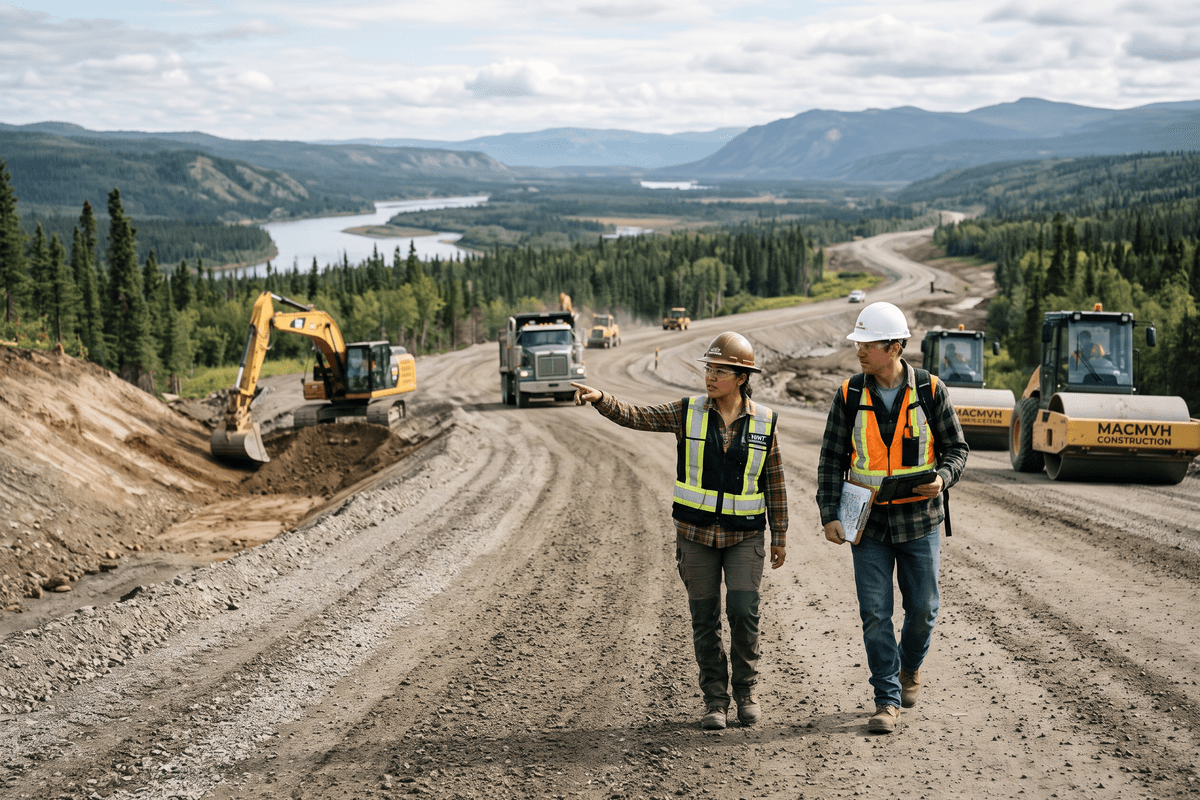

Ottawa has listed the proposed 800-kilometre Mackenzie Valley Highway as a project of national interest under the Building Canada Act, the first such listing in Canada's North. The designation is meant to streamline federal approvals and speed up a road that has been studied and proposed in different forms for nearly 70 years. For engineers, the listing matters less as a political milestone than as a change in how federal reviews, delivery capacity and Indigenous governance will shape the design and procurement work ahead. The Prime Minister's News Release sets out the government's plan.
What the Listing Changes
The listing places the highway under the Building Canada Act, which allows the Major Projects Office (MPO) to coordinate federal regulatory requirements during the environmental assessment. The government says this will bring federal departments together to align decisions and reduce duplication. The highway was first referred to the MPO in March 2026, so the file has moved from referral to listing in about eight months.
The listing does not replace the northern assessment process. The government states that it respects Aboriginal and Treaty rights and the treaty-based assessment process under the Mackenzie Valley Resource Management Act, and the project is undergoing an impact assessment by the Mackenzie Valley Environmental Impact Review Board. In practical terms, the environmental file and the federal coordination run in parallel, and consultants will need to keep both moving.
A New Delivery Entity
Ottawa also plans a new major projects management entity to provide specialised expertise in engineering, project management and procurement. It will start with the Mackenzie Valley Highway. The federal government is committing to fully fund construction and certain maintenance costs, including through Budget 2026 and the Arctic Infrastructure Fund.
In my view, this is the most consequential detail for the profession. A road of this length in a remote region depends on whether public owners can define scope, procure packages and manage interfaces with several governments and Indigenous partners. If the new entity is staffed with real technical depth, it could become a template for how Canada runs large northern infrastructure. If it is slow to form, the schedule risk will fall on the consultants and contractors who depend on clear direction.
The Five-Factor Test and What Engineers Will Need to Show
The government assesses whether a project is in the national interest against five factors set out in the Building Canada Act. For a northern road, each one translates into evidence that engineering teams will likely be asked to produce or support:
- Autonomy, resilience and security: whether the project strengthens Canada's autonomy, resilience and security. For this highway, the government points to better movement of Canadian Armed Forces personnel and supplies and support for defence infrastructure.
- Economic or other benefits: including the 3,000 jobs projected at peak construction and new trade, tourism and resource activity.
- Likelihood of successful execution: the factor most directly tied to scope definition, cost estimating and delivery capacity.
- Advancing Indigenous interests: tied to the governance arrangements described below.
- Clean growth and climate objectives: a factor that will require transparent emissions and resilience reasoning in the design basis.
The government also considered a sixth factor for this project: its terrestrial and aquatic environmental impacts. That addition signals that the environmental record for a gravel highway crossing this terrain will be scrutinised closely, and that design choices around watercourses, habitat and access will carry weight in the review.
Governance Is Part of the Design Brief
On November 25, 2026, Sahtu Secretariat Incorporated, the Gwich'in Tribal Council, Pehdzéh Kı̨́ First Nation, the Government of the Northwest Territories and the Government of Canada signed a Leadership Governance Understanding. It sets out a collaborative framework for governance, planning and long-term direction. The government says it will help keep the project on schedule and on budget.
Indigenous leaders framed the agreement in strong terms. As Chief Jesse Nekenyia-Moses of Pehdzéh Kı̨ First Nation put it, "National interest and Indigenous rights must move forward together." Charles McNeely, Chairman of Sahtu Secretariat Incorporated, said, "The highway will benefit us. It will be built with us."
For engineers, this means that community input is not a late-stage consultation step. Route refinement, construction staging and maintenance planning will all involve partners who hold formal roles in governance. Teams that treat these partners as decision-makers from the start will avoid the rework that comes from redesigning after the fact.
The Scale of the Project
The figures below are drawn from the government's announcement and its quick facts.
| Item | Figure in announcement |
|---|---|
| Proposed highway length | 800 km, all-season gravel |
| Yellowknife to Inuvik travel time | About 38 hours reduced to about 23 hours |
| Road distance saved, Yellowknife to Inuvik | About 1,300 km |
| Peak construction jobs | 3,000 |
| People with improved transport access | More than 10,000 |
| Sahtu residents gaining first all-season connection | About 1,900 |
| Arctic Infrastructure Fund, Arctic Economic and Security Corridor | More than $120 million |
A Corridor Logic Beyond the Highway
The announcement also linked the highway to a second project. The Prime Minister announced more than $120 million from the Arctic Infrastructure Fund to advance the Arctic Economic and Security Corridor, led by the Tłı̨chǫ Government and the Yellowknives Dene First Nation with the Government of the Northwest Territories. That corridor would run from Yellowknife to the Nunavut border and, once connected to the Grays Bay Road and Port, would provide access to a deepwater port on the Arctic Ocean. The funding covers route selection, environmental studies, engineering and regulatory work, with the aim of making the project shovel-ready by 2029.
Engineers working in the North should read the two projects together. The highway would link communities and defence sites inland, while the corridor would connect the network to a coastal port and critical minerals. Route and environmental decisions made on one project will affect the options available for the other.
A Useful Comparison: Pipeline Capacity Planning
A parallel development this week shows a different side of federal major projects. According to Reuters, reported by BOE Report, Trans Mountain expects to launch an open season by early January to gauge shipper interest in a capacity expansion of about 210,000 barrels per day. The Mainline Optimization Project would involve about 30 km of new pipe in British Columbia and 11 new pump stations. The operator is targeting an April 2027 final investment decision and late 2028 construction completion.
The contrast is useful. The pipeline expansion is built around a commercial test of demand before design is locked in. The highway is built around a government listing and funding commitment. Both depend on firm scope, credible schedules and staff who can carry the work. For practitioners, the lesson is that the tighter the schedule, the more the early design and evidence work matters.
What to Watch Next
- The MPO's coordination model: how federal departments align their decisions on the highway, and whether the timelines hold.
- The new management entity: who staffs it, and what engineering, project management and procurement capacity it brings.
- The Mackenzie Valley Environmental Impact Review Board assessment: the environmental findings on terrestrial and aquatic impacts will shape the design basis.
- The Community Readiness Strategy: the Government of the Northwest Territories is developing it with Indigenous governments, organisations and communities to address adverse effects and opportunities.
- The Arctic Economic and Security Corridor: route selection and environmental studies, with a shovel-ready target of 2029.