
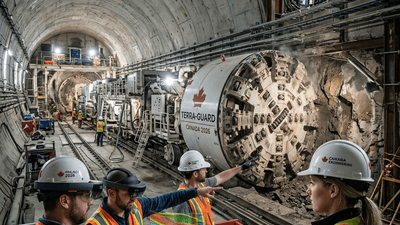



The most transformative engineering projects shaping Canada's future share a distinct commonality: they are largely invisible to the public eye. Whether they are advancing deep beneath our urban centers or simulating catastrophic scenarios in remote resource environments, the vanguard of Canadian engineering is currently defined by our mastery of the earth itself. As we look toward the remainder of 2026, two major developments—one an international congress in Montreal, the other a critical environmental study in northern Quebec—highlight the dual mandate facing today's engineering professionals: pushing the boundaries of subterranean infrastructure while rigorously safeguarding against environmental risk.
This year, the international spotlight is turning toward Canada's geotechnical and civil engineering sectors. With the upcoming World Tunnel Congress (WTC) 2026 in Montréal drawing global heavyweights like Amberg Engineering, and domestic giants like WSP leading high-stakes risk assessments for the critical minerals sector, the message to Canadian professionals is clear. The future belongs to those who can navigate complex geological realities and deliver uncompromising safety models.
The Subterranean Renaissance: Montreal Takes the Global Stage
Canada is currently in the midst of a subterranean infrastructure boom. From the intricate expansions of Montreal's Réseau express métropolitain (REM) to Toronto's massive Ontario Line and Vancouver's Broadway Subway project, billions of capital dollars are flowing underground. It is no coincidence that Montréal was selected to host the World Tunnel Congress (WTC) in 2026.
The event is already attracting global innovators. Swiss-based Amberg Engineering, a leader in underground infrastructure and tunnelling solutions, is preparing to showcase its expertise at the congress, signaling strong international interest in the Canadian market. For local engineering firms, the influx of global players presents both a competitive challenge and a collaborative opportunity.
What WTC 2026 Means for Canadian Professionals
The presence of international tunnelling experts in Montreal highlights a shift in how underground projects are being executed in Canada. We are moving away from traditional drill-and-blast methodologies toward highly digitized, data-driven tunneling operations. The key areas of focus for professionals attending or following WTC 2026 include:
- Advanced TBM (Tunnel Boring Machine) Analytics: Utilizing real-time sensor data to adjust to unpredictable glacial till and bedrock formations common in Canadian geology.
- Digital Twin Integration: Creating comprehensive 3D models of underground spaces before a single cubic meter of earth is excavated, allowing for proactive clash detection with existing municipal infrastructure.
- Sustainable Excavation: Developing new methodologies for the recycling and repurposing of excavated materials (spoil) to reduce the carbon footprint of megaprojects.
For Canadian engineering professionals, the message is clear: the ability to navigate complex geological realities—whether beneath a bustling metropolis or at a remote mining site—is the defining technical challenge of this decade.
Surface Safeguards: WSP and the Lac Knife Dam Break Study
While urban centers focus on building downward, Canada's resource sector is focused on preemptive risk management above ground. The transition to a green economy is driving unprecedented demand for critical minerals, but extracting these resources requires rigorous environmental safeguards. A prime example is the recent move by Focus Graphite, which has initiated a dam break study led by WSP Canada Inc. for its Lac Knife flake graphite project in Quebec.
Graphite is a critical component in electric vehicle (EV) batteries, and the Lac Knife project is vital to establishing a localized North American supply chain. However, advancing such projects to the permitting stage requires proving that the infrastructure can withstand worst-case scenarios. WSP's mandate to conduct a dam break study is not merely a regulatory checkbox; it is a highly complex feat of hydrodynamic engineering.
The Mechanics of Extreme Risk Modeling
Dam break studies are among the most demanding tasks in geotechnical and hydrological engineering. They require professionals to model the unimaginable: the catastrophic failure of a tailings facility or water retention structure. The WSP-led study will involve:
- Hydrodynamic Simulation: Using advanced software to model the flow of water and tailings over complex digital elevation models (DEMs) of the surrounding topography.
- Rheological Analysis: Understanding the specific flow characteristics of the tailings material, which behaves differently than pure water, often acting as a non-Newtonian fluid under stress.
- Consequence Classification: Mapping the potential inundation zones to assess risks to local ecosystems, downstream communities, and vital infrastructure.
The Convergence of Geotechnical and Risk Engineering
At first glance, an international tunneling congress in Montreal and a dam break study at a remote graphite mine might seem worlds apart. Yet, they represent two sides of the same geotechnical coin. Both require an intimate understanding of soil mechanics, groundwater interaction, and structural integrity under immense pressure.
To understand the current landscape, it is helpful to compare the engineering demands of these two distinct environments:
| Engineering Domain | Primary Objective | Key Technical Challenges | Tools & Technologies |
|---|---|---|---|
| Urban Tunnelling (e.g., WTC 2026 focus) | Space creation and transit optimization beneath existing infrastructure. | Ground settlement, clash detection with utilities, variable urban geology. | TBM telemetry, BIM/Digital Twins, Ground Penetrating Radar (GPR). |
| Resource Risk Modeling (e.g., Lac Knife) | Environmental protection and worst-case scenario mitigation. | Non-Newtonian fluid modeling, extreme weather resilience, remote data collection. | Hydrodynamic modeling software, LiDAR topography, Rheological testing. |
Whether an engineer is designing a concrete liner for a subway tunnel or a retention embankment for a tailings pond, the fundamental requirement is the same: absolute certainty in the face of geological unpredictability. The tools are evolving, with artificial intelligence and machine learning increasingly being used to interpret borehole data and simulate fluid dynamics, but the core engineering judgment remains irreplicable.
Strategic Implications for the Canadian Engineer
As we navigate 2026, the convergence of global expertise on Canadian soil and the rigorous demands of our domestic resource projects offer several strategic takeaways for the profession:
- Cross-Pollination of Skills: Geotechnical engineers should look to broaden their skill sets. The data modeling techniques used to predict ground settlement in tunneling can often inform the topographical simulations used in hydrological risk assessments.
- Embrace Global Standards: With international firms like Amberg Engineering bringing their proprietary technologies to Canada, domestic firms must ensure their teams are trained on global best practices, particularly in digital twin integration and sustainable excavation.
- The Premium on Risk Communication: As seen with the WSP dam break study, executing the technical work is only half the battle. Engineers must increasingly act as communicators, translating complex hydrodynamic risks into clear, actionable insights for stakeholders, regulators, and the public.
Looking Ahead: Building Resilience from the Ground Down
The Canadian engineering narrative of 2026 is being written in the earth. As Montreal prepares to host the world's leading tunneling minds at WTC 2026, and as firms like WSP continue to set the standard for environmental safety in the critical minerals sector, the profession is demonstrating its immense versatility. We are proving that we can build the subterranean arteries necessary for urban growth, while simultaneously engineering the robust safeguards required to protect our natural landscapes.
For the professionals driving these projects, the future requires a delicate balance of bold innovation and meticulous risk management. By mastering the complex interplay of earth, water, and infrastructure, Canadian engineers are not just building for the next decade—they are laying the resilient, invisible foundations for the next century.