


When practitioners first learn ontology engineering, it is easy to treat an ontology as a static taxonomy—a neat hierarchy of classes and properties that describes what exists in a domain. While structural modeling is essential, real-world organizations and intelligent systems rarely operate on static snapshots alone. Work moves through sequences, decisions, events, states, and handoffs.
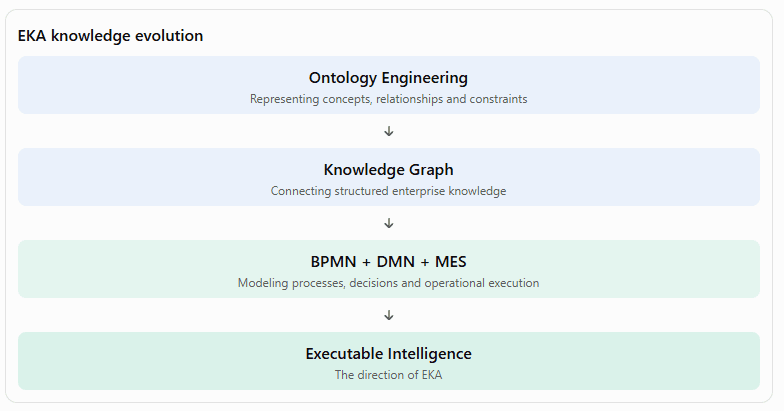
That realization is what drives the evolution toward Executable Knowledge Architecture (EKA) and why process modeling represents such a pivotal new learning step. Rather than viewing conceptual modeling and process modeling as two disconnected disciplines, we can understand them as a progressive four-step arc of thinking—with process modeling serving as the critical bridge in the third step that turns descriptive knowledge into operational behavior.
The Four-Step Arc of Executable Knowledge Thinking
To build systems that are both semantically clear and operationally useful, it helps to trace how our modeling mindset matures across four stages:
-
Step 1: Structural & Conceptual Foundations (What Things Are)
We begin by defining classes, individuals, hierarchies, and core relationships so terms have unambiguous meaning. At this stage, the focus is clarity of vocabulary, domain boundaries, and clean separation of concepts.
-
Step 2: Axioms, Constraints & Logical Reasoning (What Must Be True)
Next, we introduce formal constraints—such as class disjointness, property domains and ranges, and logical rules—so a reasoner can check consistency and infer implicit facts. This catches contradictions early and enforces semantic discipline.
-
Step 3: Process & Behavioral Modeling (How Things Happen and Flow)
Once we know what concepts exist and what rules constrain them, we model how work unfolds over time: workflows, decision logic, event triggers, state transitions, simulations, and data/execution pipelines. This is where static knowledge meets dynamic action—and where new practical learning opens up.
-
Step 4: Executable Intelligence & Knowledge Graphs (How Knowledge Drives Action)
Finally, structured semantics and behavioral models converge into queryable knowledge graphs, decision/orchestration engines, and AI-ready systems where models are not merely documented, but actively interpreted, validated, and executed.
Why Process Modeling Is the Crucial Third Step
Many teams hit a wall between having a clean conceptual model and building something that runs reliably in practice. A taxonomy tells you what a "Workflow," "Decision," "Approval," or "Pipeline" is, or how tools and standards relate to one another—but process modeling forces you to answer operational questions:
-
Sequencing & Orchestration: Which steps happen in order, in parallel, or conditionally? (e.g., deterministic flows vs. event-driven case handling)
-
Decision Separation: Which choices should be evaluated declaratively through rules or decision tables rather than buried inside diagrams?
-
Execution vs. Diagramming vs. Simulation: Is a model meant purely for shared understanding and documentation, for discrete-event/system-dynamics simulation to spot bottlenecks, for log-based process discovery, or for direct runtime execution?
-
Alignment Across Layers: How do business workflows connect to data pipelines, manufacturing/operational execution, and enterprise/systems architecture?
By treating process modeling as a structured discipline rather than ad-hoc flowcharting, practitioners avoid a common pitfall: drawing diagrams that look clear on paper but lack semantic precision or clear execution intent.
Practical CPD Takeaways for Your Own Practice
If you are expanding your skills from foundational ontology engineering into process modeling, apply these four habits in your next modeling exercise:
-
Classify Standards by Purpose, Not Habit: Before drawing, identify whether the problem calls for sequential workflow orchestration, rule-based decisions, case management, state/activity behavior, simulation, dataflow DAGs, or process discovery from event logs.
-
Separate Capability from Notation: A notation defines how a process or rule is expressed; execution capability defines whether a tool supports diagramming, simulation, process mining, or runtime execution. Keeping those distinct prevents over-engineering simple documentation tasks—or under-specifying executable ones.
-
Enforce Disjointness When Modeling Meta-Concepts: When building a meta-model or catalog of tools, standards, and capabilities, explicitly declare disjoint classes and domain/range constraints so logical contradictions surface immediately during reasoning.
-
Model Change Over Time: Process ecosystems and business workflows evolve constantly. Designing explicit relationships for evolution, dependencies, and state changes keeps your models accurate as real-world systems shift.
Where to Focus Your Next Study Session
As you move into this third step of the journey, pick one real workflow or tool ecosystem you already know well and model it from two angles: first structurally (what entities, capabilities, rules, and relationships exist), and second behaviorally (how inputs, decisions, transitions, and outcomes move through the system). Comparing what is easy to capture structurally versus what requires process semantics will sharpen your architectural judgment immediately.