
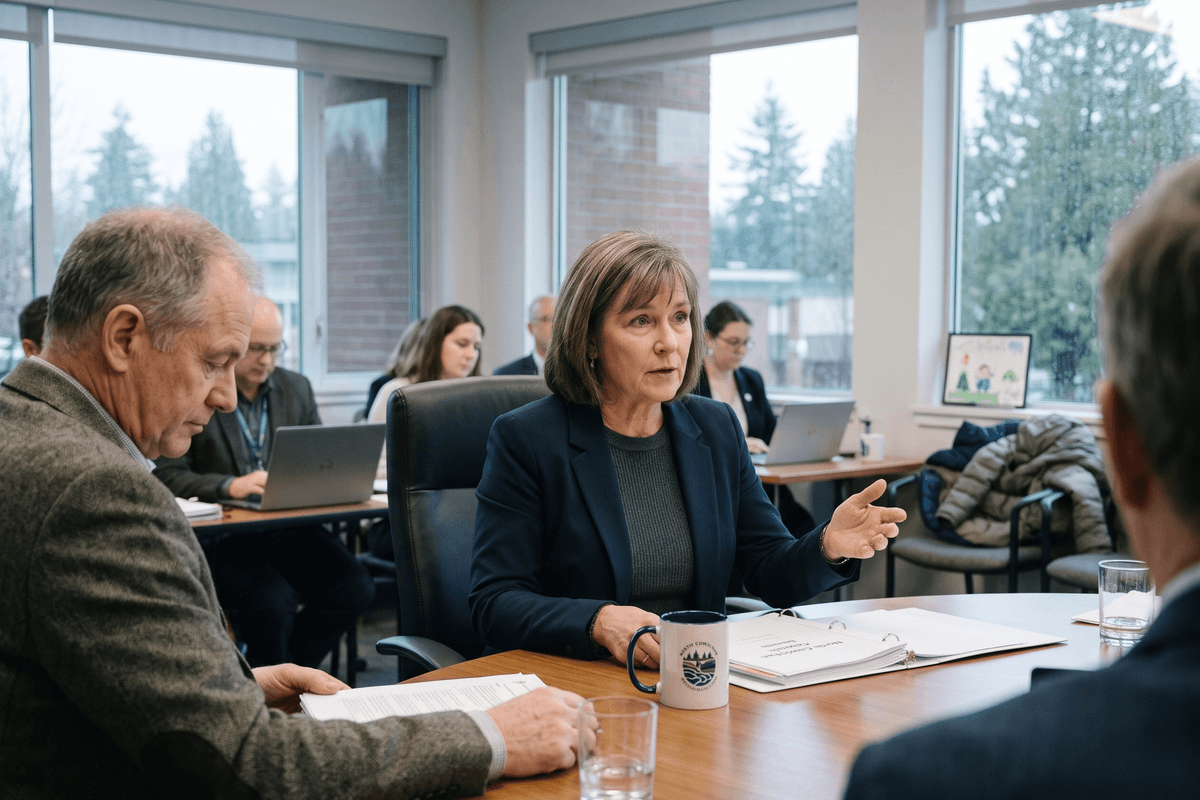

North Cowichan council used its November 18, 2026 Regular Council meeting, which ran just over two hours, to clear a wide range of items. The most consequential was approval of two temporary use permits for winter shelters in Chemainus and on James Street, both tied to funding that has not yet been confirmed. The session also moved two childcare sites forward, awarded a three-year traffic control contract, and sent the 2027 climate grant recommendations to budget discussions. For municipal staff, the meeting is a useful case study in how a small council manages social services, land use and procurement when several decisions depend on other levels of government.
Two Shelters, One Funding Condition
The headline item was the shelter approvals. Council authorized a 10-person extreme weather response shelter at 9806 Willow Street in Chemainus. Cowichan Neighbourhood House will support it, and Lookout Housing Society will operate it. Extreme weather response shelters provide overnight space when temperatures drop or heavy rain or snow arrives, and this one runs until April 30.
The second approval is larger. A 25-bed temporary winter shelter at 2652 James Street will occupy the annex at the rear of the former Cowichan Secondary School site. It will operate 24/7 until May 14, with extra overnight space during extreme weather events. It replaces a winter shelter that had run for two years at the former Ramada Inn location.
Both approvals are conditional. The shelters will be run by a local not-for-profit and professionally managed by an experienced operator, subject to confirmation of funding from BC Housing. That condition matters. A municipality can approve the land use and still be left without an operating model if the provincial money does not arrive, so staff should expect the funding confirmation to be the critical path before either site opens.
Policing and Mental Health Response
North Cowichan/Duncan RCMP Acting Officer-in-Charge Ken Beard presented the detachment's quarterly report for July to September 2026. Two items stand out for council's broader public safety agenda. The first is a mental health liaison program that pairs a police officer with an Island Health nurse to respond to people in mental health or wellness-related crises. According to the report, it was implemented by adjusting existing RCMP budgets rather than through new funding.
The quarter also included a substantial drug and firearms seizure that led to three arrests, and increased foot and bicycle patrols in areas with elevated property crime. The detachment recapped the third annual Community Safety Expo held in September.
For municipal professionals, the mental health liaison model is worth noting because it is achieved through reallocation rather than an added line item. That approach can be replicated, but it also means the program competes with other priorities inside the same envelope.
Childcare Sites and Land-Use Decisions
Council introduced two bylaws to close and remove highway dedication from unused road portions, clearing the way for two new childcare sites: one at Kingsview/Donnay Drive in Maple Bay and one at Berridge Street in Crofton. Consideration of adoption will come at a later meeting. Road closures of this kind are routine on paper, but they require the notice and sequencing steps that often determine whether a project stays on schedule.
Council also gave first reading to a bylaw permitting office use for youth-support services in an existing residential building at 3046 Gibbins Road. Other land-use decisions included a development variance permit for accessory building height and front yard fence height at Lot A, Moose Road, a zoning amendment permitting a detached accessory dwelling unit at 2350 Calais Road, and a zoning amendment allowing residential use alongside church use at 2852 and 2858 Mill Street.
Grants: Some Deferred, Some Advanced
The Community Climate Action Grants, awarded since 2014 to non-profit climate adaptation projects, were not approved outright. Council referred the recommendations for 2027 to budget discussions. The recommended amounts are below.
| Recipient | Project | Recommended amount |
|---|---|---|
| Cowichan Estuary Restoration and Conservation Association | Estuary restoration and heat-adapted swallow nesting | $7,500 |
| Synergy Foundation | Small and medium-sized business energy efficiency | $15,000 |
| Cowichan Green Community | Passive solar greenhouse | $41,828 |
| Vancouver Island Providence Community Association | Solar energy installation | $62,000 |
Council also authorized support for two outside funding applications. The first is a $100,000 request to the Community Emergency Preparedness Fund's Foundations of Disaster Risk Reduction program for a hazard lands development permit guideline modernization project. The second backs the Cowichan Valley Regional District's applications to the UBCM Community Emergency Preparedness Fund for grants totalling up to $150,000 for emergency support services training, equipment, and emergency operations centre training and equipment.
Separately, the Somenos Marsh Wildlife Society presented its annual North Cowichan service agreement report, covering water quality monitoring, invasive plant control, and partnerships with Cowichan Tribes and secondary school students. Council endorsed the society's five-year service plan renewal and workplan through the end of 2031.
Contracts and Governance
Council awarded a three-year agreement for traffic control services to Universal Group Traffic Ltd., at an estimated cost of $1,273,614. The contract covers traffic control personnel, traffic planning, and devices and signage for work on roads or utilities. Because it is a multi-year commitment with an estimated rather than fixed value, staff should track actual draws against the estimate as road and utility work proceeds.
On governance, council asked staff to prepare a policy on disclosure of sensitive meetings and donations involving development-related interests. The item does not yet have a draft or timeline in the summary, but it signals that council wants a formal framework rather than case-by-case handling. Council also supported an advocacy letter to the federal government seeking a long-term solution so that Indigenous families living off reserve in subsidized rentals under the Urban Native Housing Program can keep access to safe and affordable housing.
Election Turnout and Next Steps
Chief Election Officer Tricia Mayea presented the results of the 2026 General Local Election. A total of 9,928 people voted, or 35.63% of eligible voters. Staff preparing for the next cycle may want to review how the turnout figure compares with prior elections, though the summary itself offers no comparison.
Finally, Harvest House Society reported a 25% increase in service, providing food to more than 8,500 households through foodbank distribution, hamper deliveries and school pop-ups. The society will request $35,000 through the grant-in-aid program at the December 2 council meeting.
What to Watch Next
The next Regular Council meeting is scheduled for December 2 at 5 p.m. Three items will show how the November decisions are progressing. First, whether BC Housing funding is confirmed for the Willow Street and James Street shelters before the winter period begins. Second, the Harvest House grant request of $35,000. Third, the adoption of the two childcare-site road closure bylaws and the Gibbins Road office bylaw, which were introduced but not yet adopted. The climate grant recommendations and the disclosure policy will also need to move through budget and staff processes in the coming months.