
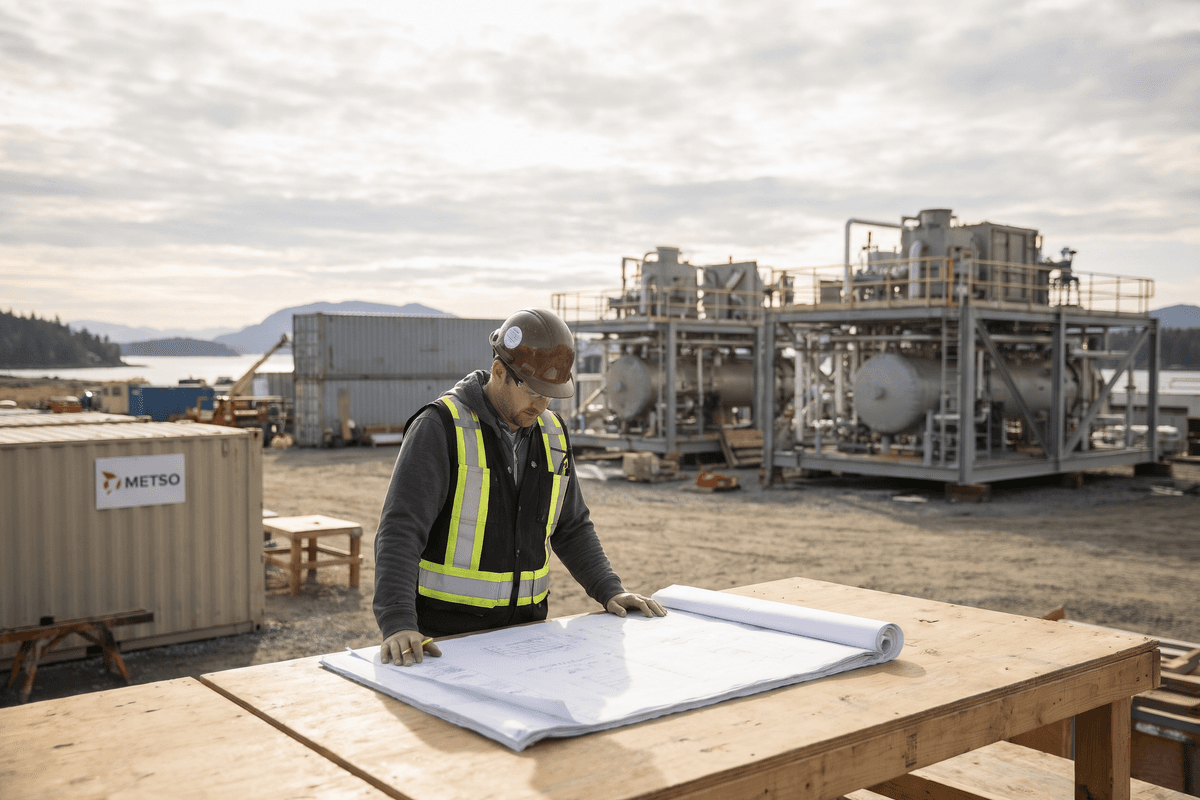

Mining and energy projects in Canada are increasingly being built from fewer, larger packages. Instead of stitching together dozens of separate equipment contracts, owners are asking a single supplier to take responsibility for process design, equipment, and engineering across a plant. That trend became concrete this month with two announcements: Metso's contract to deliver a comprehensive mineral processing and engineering package for the Troilus copper-gold open-pit project in Quebec, and a CAN$200 million federal investment in the Woodfibre LNG project in British Columbia. Together they offer a useful case study in how packaged delivery and public capital are reshaping the work that Canadian engineers are asked to do.
What Metso Is Delivering at Troilus
According to the published summary, Metso has secured a contract to deliver a comprehensive mineral processing and engineering package for the Troilus project. The project is an open-pit copper-gold development in Quebec. The key word is "comprehensive." A package of this kind typically spans process design, equipment selection, and the engineering that connects equipment into a working circuit, rather than the supply of individual machines alone.
Why scope definition matters
When a supplier takes on a full processing package, the boundary between "equipment" and "engineering" becomes the critical question. Crushing, grinding, flotation, and dewatering circuits all depend on assumptions about ore hardness, throughput, and water balance. Those assumptions must be carried through to foundations, structural steel, power, and controls. An owner who buys a package gains a single point of accountability, but also accepts a dependency on that supplier's design basis.
The contract is for a comprehensive mineral processing and engineering package, not simply a set of discrete machines. That distinction determines who owns the interfaces, and interfaces are where most mining projects lose time and money.
Why Package Delivery Changes the Engineering Interface
Traditional mine construction has relied on an owner's engineer or EPCM team to coordinate many vendors. Packaged delivery shifts some of that coordination upstream. The table below summarizes the general trade-offs engineers should weigh when evaluating either model. These are general patterns in project delivery, not findings specific to the Troilus contract.
| Factor | Multi-vendor delivery | Integrated package delivery |
|---|---|---|
| Interface ownership | Owner or EPCM team manages most boundaries | Supplier owns internal equipment interfaces |
| Schedule risk | Spread across many contracts, harder to trace | Concentrated in one contract, easier to track |
| Design flexibility | Higher; owner can substitute vendors | Lower; design basis is largely fixed by supplier |
| Engineering skills needed by owner | Strong integration and coordination capability | Strong review, verification, and performance-testing capability |
| Commercial exposure | Distributed claims and change orders | Concentrated; scope definition errors become large variations |
For engineers working on the owner side, the skill set shifts from coordinating many deliverables to reviewing a supplier's design basis critically. That includes checking metallurgical assumptions, verifying equipment sizing against the mine plan, and confirming that civil, electrical, and process interfaces are defined in writing before the package is frozen.
Woodfibre LNG and the Federal Capital Signal
The second announcement comes from a different part of the energy sector. The Government of Canada has announced CAN$200 million for the Woodfibre LNG project in British Columbia. The investment is described as supporting facility engineering, operational optimization, and low-carbon infrastructure advancements.
What the funding is meant to accelerate
The stated objectives map onto three distinct kinds of engineering work:
- Facility engineering: detailed design and engineering activities that move an LNG facility toward construction and commissioning.
- Operational optimization: process and energy efficiency work that improves how the facility runs once operating.
- Low-carbon infrastructure: emissions reduction measures, which in LNG typically centre on power supply, compression, and heat recovery design.
Public capital at this stage matters because it can de-risk engineering spend that would otherwise wait for final investment decisions. For consultants and contractors, funding aimed at engineering and optimization is often an earlier and more accessible market than construction itself.
The common thread: process engineering under decarbonization pressure
Troilus and Woodfibre operate in different markets, but both are process-intensive. Each requires engineers to balance throughput, energy use, and emissions from the start of design. In mining, that means grinding circuits and power draw. In LNG, it means liquefaction and compression. In both cases, energy efficiency is now a design-stage requirement, not a retrofit consideration.
Practical Implications for Canadian Engineering Professionals
These announcements carry several implications for practice:
- Review capability is becoming a core offering. Owners buying packages need independent engineers who can test a supplier's assumptions rather than duplicate them.
- Interface management still matters. Civil foundations, structural supports, power distribution, and controls remain the owner's or EPCM's responsibility unless the contract says otherwise. Read the scope boundaries closely.
- Decarbonization is embedded in front-end design. Energy and emissions assumptions should be tested in feasibility and FEED stages, when changes are cheapest.
- Public funding creates early engineering demand. Firms positioned for facility engineering and optimization work may see opportunities before construction contracts are awarded.
- Remote and regional capacity is a constraint. Quebec mining and British Columbia LNG both draw on specialized talent that is often in short supply, so resourcing plans should be established early.
What to Watch Next
Several questions will determine how much these announcements change practice. Engineers should track how the Troilus package defines its interfaces, how the Woodfibre funding is disbursed against specific engineering milestones, and whether federal support for low-carbon infrastructure extends to other process-heavy sectors. Each will show whether packaged delivery and public engineering capital become a durable model or remain project-specific arrangements.
For Canadian engineers, the direction is clear enough to act on now. Build the capacity to review and verify integrated designs, define interfaces early and in writing, and treat energy and emissions performance as core engineering scope. The projects that succeed under this model will be those where the engineering owner, not just the supplier, understands the design well enough to defend it.