
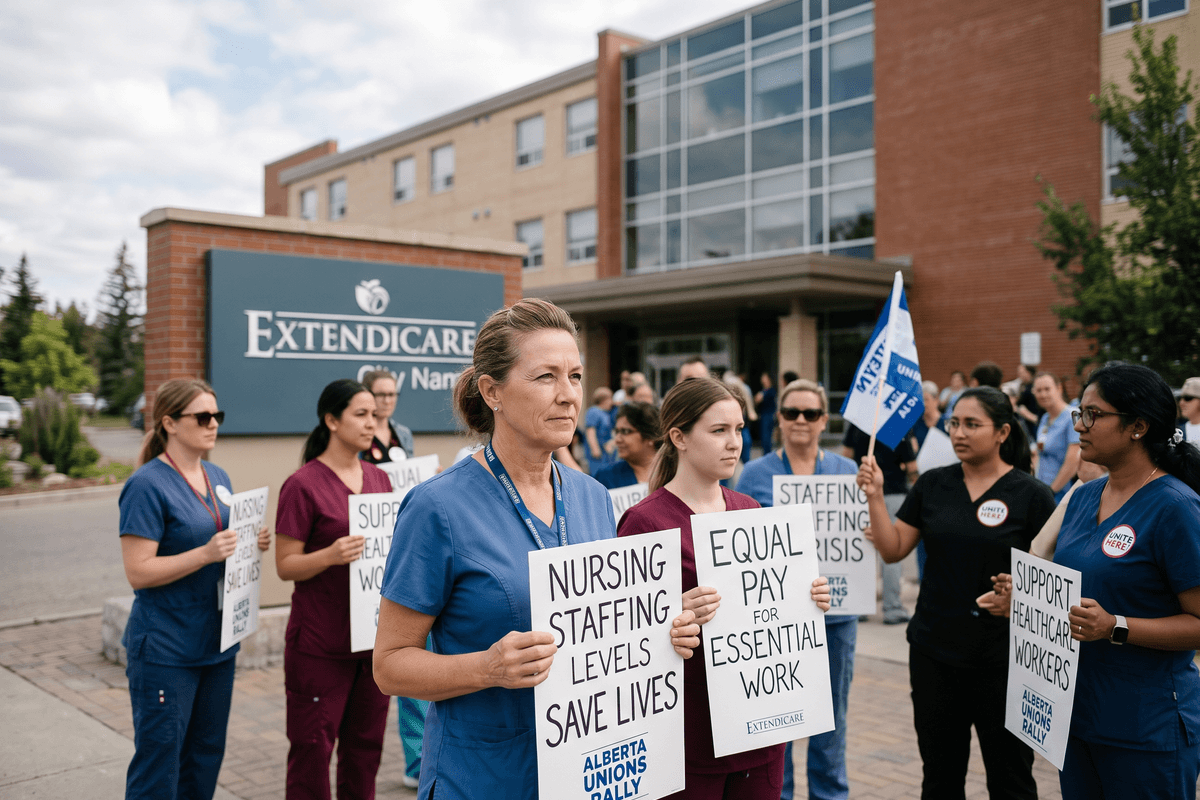

On Thursday, members of three of Alberta’s largest health care unions rallied at Extendicare worksites across the province, including the Michener Hill location in Red Deer. The Alberta Union of Provincial Employees (AUPE), the Canadian Union of Public Employees (CUPE) and the United Nurses of Alberta (UNA) are pressing for collective agreements that deliver equal pay for equal work and increased staffing levels. For nursing professionals working in continuing care, the dispute is a clear test of whether pay parity with the public system can be won through bargaining rather than left to chance.
What happened
The rallies were held at several Extendicare sites on the same day, according to rdNEWSnow’s report on the Red Deer rally. The unions argue that Extendicare has the financial capacity to meet their demands. They claim the company’s profits were in the ballpark of $100 million in 2025.
AUPE President Sandra Azocar framed the action as the culmination of a long fight:
“AUPE members have spent three years fighting for a fair collective agreement that recognizes their contributions to providing quality care to Extendicare residents,” said AUPE President Sandra Azocar.
She added that Extendicare had profits nearing $100 million in 2025 and the resources to pay these workers what they deserve, but was choosing not to.
“With profits nearing $100 million in 2025, Extendicare has the resources to provide these workers with the wages and benefits they deserve, but they simply refuse to do what’s right.”
The pay gap at the centre of the dispute
The core of the unions’ argument is comparison. They say their members earn thousands less than workers in identical roles at Alberta Health Services (AHS). The figures they cite are shown below.
| Role | Union-cited difference: AHS vs. Extendicare (average) |
|---|---|
| Licensed Practical Nurses and Health Care Aides | About 16.5% more at AHS |
| AHS General Support Services workers | About 17.5% more at AHS |
These are the unions’ calculations, not figures independently verified in the report. Still, the LPN comparison matters most for nurses. LPNs are often the staff who bridge the gap between registered nursing oversight and daily resident care in facilities like these, so a sustained wage differential affects who stays and who leaves.
UNA President Heather Smith tied the issue directly to recruitment and retention:
“You can’t recruit and retain nurses without treating us with respect. Health care workers deserve to be paid what we’re worth for our contribution to society and it’s past time Extendicare realized that fact.”
UNA President Heather Smith also said that health care workers make the system better for patients and for all Albertans:
“Health care workers make it better for our patients, for our health care system and for all Albertans,” said UNA President Heather Smith.
Where bargaining stands
The timeline is complicated, with different unions at different stages. According to the unions’ statement, bargaining is likely heading toward an impasse. AUPE is still negotiating with Extendicare to finalize an Essential Services Agreement (ESA). A completed ESA allows the union to apply for formal mediation, and to take a strike vote if mediation fails. Until that agreement is in place, the formal path to pressure tactics remains closed to AUPE.
The UNA’s position is further along in terms of history but not in terms of progress. The union last met with the employer on November 3 to 5, when it says Extendicare refused to meet provincial salary rates. The last UNA agreement expired on December 31, 2023, meaning nurses have been working without a renewed contract for nearly three years.
Extendicare’s response
rdNEWSnow requested a response from Extendicare and received one later the same afternoon. A company spokesperson said:
“Extendicare is fully committed to meaningful and constructive engagement with our union partners as the collective bargaining process continues,” a spokesperson says.
The spokesperson also said the company values its team members, remains focused on high-quality care, and is open to meeting to reach a mutually agreeable collective agreement. The statement does not address the specific pay comparison or the profit figures the unions raised, which is the central gap between the two sides’ public positions.
What this means for nursing professionals
In my view, this dispute illustrates a problem that extends beyond one employer. When the same LPN or care aide can earn materially more in a public health authority, employers in continuing care are competing for staff with a pay disadvantage they must close through other means. Staffing levels, which the unions also raised, are a related pressure: short-staffed units make the work harder and push experienced staff toward other settings.
If you work in continuing care or are considering it, a few practical steps are worth taking:
- Check where your agreement stands. Know whether your collective agreement has expired and what the bargaining status is, so you can judge how much weight to give public claims from either side.
- Benchmark your pay against public postings. The unions’ comparison relies on AHS rates. Reviewing comparable roles gives you your own reference point during discussions with your union.
- Follow the procedural milestones. An ESA, mediation request and strike vote are concrete steps. Each signals how close a dispute is to escalation.
What to watch next
- Whether AUPE completes its Essential Services Agreement with Extendicare, which would open the door to formal mediation.
- Whether mediation is requested and, if it fails, whether a strike vote follows.
- The outcome of UNA’s next meeting with Extendicare, and whether the employer moves toward provincial salary rates.
- Any response from Extendicare to the profit figures the unions have raised.
For now, the unions have made their case publicly, and Extendicare has committed to continued talks. The next concrete steps will show whether the gap between those positions can be bridged at the bargaining table.