
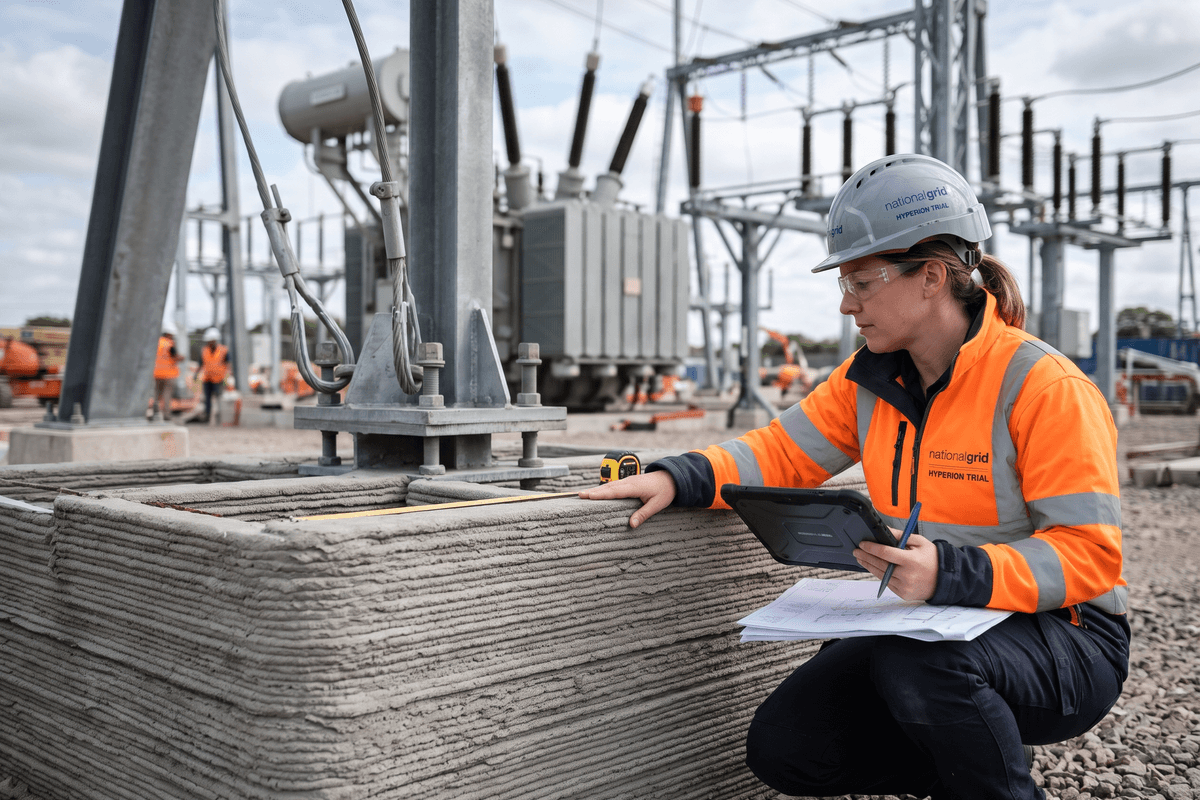

National Grid is testing foundations made by 3D printing for use at its electricity substations. Hyperion Robotics, a Finnish company, began commercial production at its first UK factory, Forge I in Flixborough near Scunthorpe, in August. The factory is designed to produce more than 50 foundations a week, and the trial is being watched closely because it targets one of the slowest and most weather-sensitive parts of building critical infrastructure. As Professional Engineering reports, National Grid is moving cautiously, but the approach is now being tested against real design criteria.
Why foundations matter to schedules
The UK has a poor record on delivery. Research by Boston Consulting Group, cited by the Competition and Markets Authority last December, found that 58% of 48 road projects were delivered late, adding on average nearly a third to their anticipated delivery times. Among 27 railway projects analysed, 56% ran behind schedule. Weather is one reason, and concrete work is exposed to it. Putting foundations in place for an electricity substation can take the best part of a week, and potentially longer in winter.
National Grid Electricity Transmission operates about 350 substations, and each typically needs between 100 and 150 foundations, depending on size and voltage. Multiplied across a network, even small gains in each foundation's build time matter.
What the trial involves
National Grid put out a call three years ago for companies to reduce the carbon emissions linked to its construction work. Hyperion proposed 3D-printed foundations that use less concrete than conventionally manufactured equivalents. A robotic arm extrudes cementitious material through a nozzle, building the shape layer by layer. The printed mortar acts as permanent formwork, and the structure is completed with steel reinforcement and low-carbon, self-compacting concrete.
Hyperion uses topology optimisation, modelling the stresses on different parts of a foundation and removing concrete and steel where they are not needed. The result resembles a tree stump, with a trunk rising from a slab at the base.
The numbers in the sources
The figures National Grid and Hyperion have cited so far are summarised below.
| Measure | Figure in source |
|---|---|
| Foundations per week at Forge I (design capacity) | More than 50 |
| Time for one printed foundation to be ready | Within only a day or so |
| Time typically required by conventional methods | Five or more |
| Concrete reduction, depending on foundation size | 50–60% |
| Substations on National Grid's network | About 350 |
| Foundations per substation | Typically 100–150 |
These are developer and client figures, and the trial has not yet shown them across a full programme of live substation work.
Testing before critical use
National Grid is taking a staged approach. Muhammad Shaban, lead innovation engineer at National Grid Electricity Transmission, said:
“We started with non-critical structures because we don’t want to take risks with our network.”
Initial use has been for foundations supporting CCTV cameras, lighting columns and fence posts. National Grid worked with Hyperion and academics at the University of Sheffield on full-scale tension and overturning moment tests at the university's Integrated Civil and Infrastructure Research Centre, alongside testing at National Grid's Yorkshire Green site.
Behzad Nematollahi, senior lecturer at the University of Sheffield, explained the engineering basis:
“They just rely on the load and the structural capacity of the cast concrete and the reinforcement inside,”
The foundations met all the design criteria in Sheffield's tests and exceeded some of them. The university's team is now testing a second generation with thicker slabs designed to support high-voltage equipment. National Grid is also exploring whether these foundations could support more critical structures within substations.
Why the regulatory angle matters
One of the largest barriers to wider use of 3D-printed concrete is that much of the regulatory framework was written for conventional construction. Hyperion's approach sidesteps that barrier by designing to existing standards. For engineers, this is a practical lesson: a new construction method can be introduced sooner if its structural case is built on established, well-understood behaviour.
Shaban also made clear that printing is not a universal answer. Simple structures such as cable trenches and slabs are probably still better built conventionally. The value lies in complex shapes and in design changes. As Shaban put it:
“Even 10 minutes before, you can just change the design a bit, and then the printer will straight away take up the design changes and then print it,”
A wider pattern of standards and delivery
Standardisation is a common thread across this week's engineering news. The Rail Safety and Standards Board has introduced a new Railway Industry Standard, Design of Traction-Battery Systems for Rail Vehicles and their Charging Systems, so that train builders and operators work to one set of requirements rather than developing bespoke approaches for each fleet, as reported by Professional Engineering. RSSB CEO Mark Phillips said:
“These new standards give the railway a common framework for introducing them safely and reliably, while avoiding unnecessary cost and duplication.”
On the commercial side, the Government has accepted 15 of the CMA's 19 civil engineering recommendations, with three more accepted in principle and one already implemented, according to the Civil Engineering Contractors Association (CECA). CECA's Director of Policy & Public Affairs, Ben Goodwin, said:
“The inappropriate use of Z clauses to amend standard forms of contract can undermine the principles of collaborative working, equitable risk sharing and streamlined project management across the infrastructure sector.”
Contractual risk allocation is the recommendation accepted only in principle. The Government has committed to setting out by spring 2027 whether the Department for Transport intends to review Z clauses. For professionals, procurement terms are as important as technical choices when a new method such as printed foundations is considered for a project.
What to watch for next
- Second-generation foundations: Results from Sheffield's testing of thicker slabs for high-voltage equipment will show whether the design can carry more critical loads.
- Move to critical structures: National Grid's decision on whether printed foundations support more critical substation structures will be the real test of confidence in the method.
- Output at Forge I: Whether the factory reaches its design target of more than 50 foundations a week will indicate how quickly the supply chain can scale.
- Government review of Z clauses: The spring 2027 position from the Department for Transport will determine whether contract terms begin to change.
For engineers working on substations and other infrastructure, the practical step now is to ask how new construction methods are being validated against existing standards, and to build that evidence into early design and procurement decisions.