
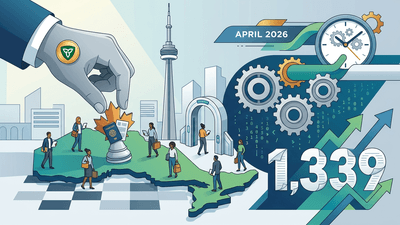



April 2026 has officially marked a decisive turning point in the Canadian immigration landscape. For years, Immigration Consultants have treated the federal Express Entry system as the primary artery for economic immigration, with Provincial Nominee Programs (PNPs) serving as strategic backups. However, as the federal government recalibrates its broader targets and delegates unprecedented autonomy to the provinces, that hierarchy has fundamentally flipped. The recent Ontario Immigrant Nominee Program (OINP) targeted draw, coupled with sweeping federal fee increases and new provincial authorities, signals a seismic shift in how practitioners must advise, position, and process their clients.
As professionals navigating this evolving terrain, understanding the intersection of targeted provincial draws and federal policy updates is no longer optional—it is the baseline for survival and success in 2026.
The OINP Blueprint: Analyzing the 1,339-ITA Draw
In mid-April, Ontario executed a highly targeted draw that sent a clear message to the market. As reported by ImmigCanada, the province issued Invitations to Apply (ITAs) to 1,339 skilled workers. But the true story isn't in the volume of the invitations; it is in the surgical precision of the targeting.
Ontario is aggressively utilizing its PNP allocations to plug immediate, critical gaps in its labor market, heavily favoring candidates in healthcare, advanced technology, and skilled trades. For Immigration Consultants, this draw underscores a critical reality: generalist profiles are increasingly being left in the federal pool, while candidates with specific, high-demand National Occupational Classification (NOC) codes are being fast-tracked provincially.
Strategic Implications for Client Profiling
To capitalize on Ontario's aggressive recruitment strategy, consultants must refine their client intake and profiling processes. Consider implementing the following steps:
- Deep NOC Auditing: Do not settle for a primary NOC if a client's work history legitimately supports a secondary NOC in a priority sector. A slight, legally sound adjustment in how a client's experience is framed can mean the difference between an ITA and another year in the pool.
- Targeted Employer Outreach: For candidates requiring job offers, consultants should guide clients toward regions in Ontario outside the Greater Toronto Area (GTA), where the OINP often applies lower score thresholds to stimulate regional economic development.
- Continuous CRM Tagging: Ensure your practice management software tags clients not just by Comprehensive Ranking System (CRS) score, but by OINP priority sector. When Ontario announces a surprise draw, you should be able to instantly query your database for eligible candidates.
"The April OINP draw is a masterclass in economic engineering. Provinces are no longer waiting for the federal government to supply the workers they need; they are actively hunting them in the pool."
The April 2026 Policy Overhaul: 9 Critical Changes
While Ontario was busy issuing ITAs, the federal landscape shifted beneath our feet. According to a comprehensive breakdown by Trenity Consultants, April 2026 introduced nine critical changes to Canada's immigration system. For practicing RCICs and immigration lawyers, two of these changes demand immediate operational adjustments: significant fee increases and expanded provincial powers.
1. Navigating the New Fee Structure
IRCC regularly adjusts fees to account for inflation, but the April 2026 hikes are particularly impactful given the current economic climate. Increases across Permanent Residence processing fees, the Right of Permanent Residence Fee (RPRF), and various temporary resident applications require immediate action from your firm's administrative side.
Action Plan for Consultants:
- Update Retainer Agreements: Immediately revise your standard Retainer Agreements to reflect the new government disbursements. Failure to do so could result in consultants absorbing the cost difference or facing uncomfortable renegotiations with clients.
- Revise Trust Account Projections: Ensure that your accounting team is aware of the new fee structures to maintain strict compliance with CICC client account regulations.
- Proactive Client Communication: Draft a standardized, empathetic communication to your existing clients explaining the IRCC fee hikes. Frame it as a mandatory federal update, distancing your professional fees from the government's rising costs.
2. The Era of Expanded Provincial Autonomy
Perhaps the most consequential of the nine changes is the formal expansion of provincial powers in the immigration selection process. Provinces have successfully lobbied for more control over their demographic and economic destinies. This means we can expect not only more frequent draws like Ontario's 1,339-ITA event but also the introduction of entirely new, province-specific pilot programs that bypass traditional federal constraints.
Federal vs. Provincial Dynamics: A 2026 Practice Matrix
To visualize how these changes impact daily consulting strategies, consider the shifting dynamics between federal and provincial pathways. The table below outlines how consultants must adjust their strategic focus.
| Strategic Element | Traditional Approach (Pre-2026) | New Reality (April 2026 Onward) |
|---|---|---|
| Primary Strategy | Maximize federal CRS score (Language, Education). | Align NOC and experience with specific PNP priority sectors. |
| Cost Management | Static government fee projections. | Dynamic budgeting; absorbing April 2026 fee hikes into client planning. |
| Draw Predictability | Bi-weekly, predictable federal Express Entry draws. | Highly targeted, irregular provincial draws requiring constant monitoring. |
| Client Advising | Focus on generalized "Canadian experience." | Focus on regional retention and specific provincial labor shortages. |
Future-Proofing Your Immigration Practice
The events of April 2026 are not isolated incidents; they are the blueprint for the future of Canadian economic immigration. The Ontario PNP draw proves that the provinces have the appetite and the infrastructure to process massive volumes of targeted candidates. Meanwhile, the sweeping federal changes—particularly the fee hikes and the formal delegation of new powers to the provinces—confirm that IRCC is increasingly comfortable playing a regulatory and final-clearance role, rather than acting as the sole selector of talent.
For Immigration Consultants, this requires a fundamental pivot. We must become regional economists as much as we are legal practitioners. We must understand the labor demands of Sudbury as intimately as we understand the Immigration and Refugee Protection Act (IRPA). By updating our fee structures to reflect the new realities, auditing our client pools for provincial eligibility, and embracing the decentralization of Canadian immigration, we can turn the complexities of April 2026 into a distinct competitive advantage for our practices.