
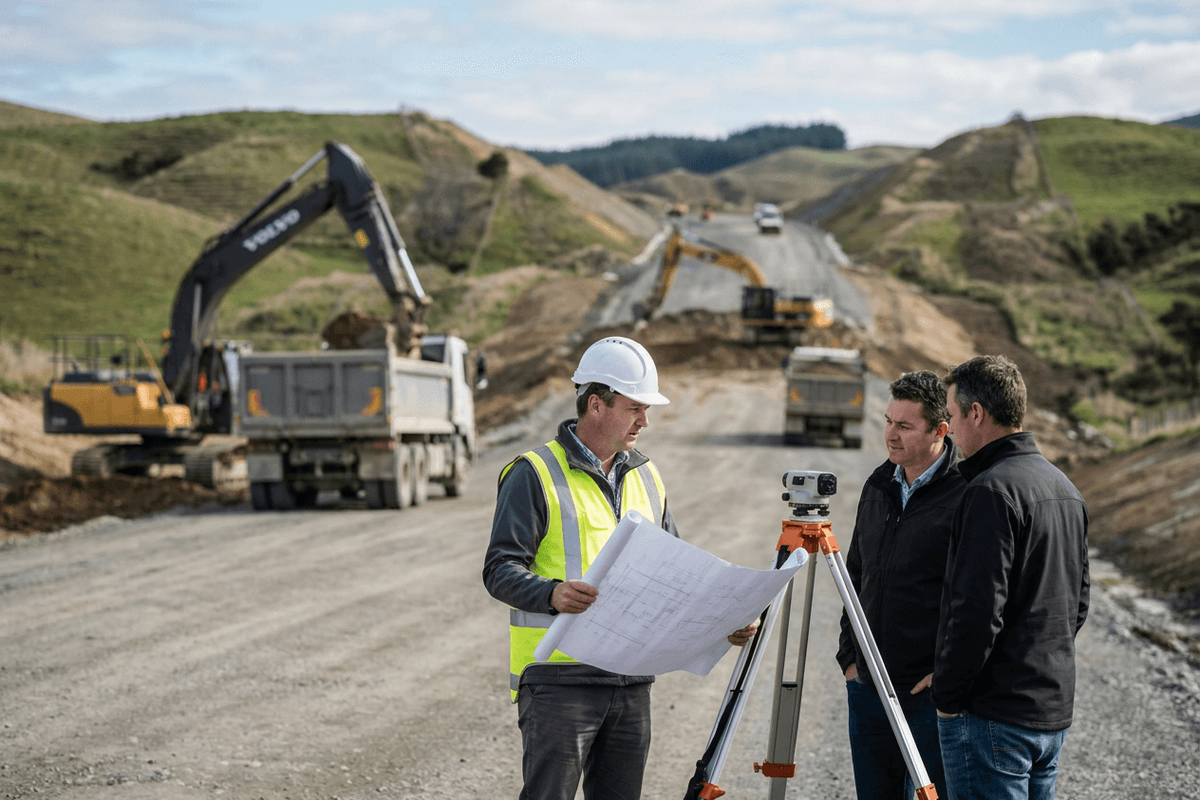

When international infrastructure giant Jacobs was selected by ACCIONA to deliver multidisciplinary engineering, design, and digital delivery services for the NZ$3.6 billion (US$2.1 billion) Warkworth–Te Hana highway public-private partnership, it marked far more than a routine contract award. As New Zealand's largest transport PPP to date, the 26-kilometre corridor across challenging Northland terrain represents a definitive test case for how the domestic civil engineering sector executes megaprojects under modern risk-sharing models. Between twin motorway tunnels, 15 major bridge structures, and complex geotechnical stabilization across notorious Northland alluvium, the project crystallizes the exact intersection of digital delivery, geotechnical ingenuity, and practical civil design that will define Aotearoa's infrastructure landscape over the coming decade.
The Architecture of a Mega-PPP: Complexity at Scale
Transport corridors across the upper North Island have long tested the limits of New Zealand's contracting and engineering capabilities. The extension of the northern motorway from Warkworth to Te Hana—bypassing the notorious Dome Valley bottleneck—involves extreme topography, complex seismic considerations, and unstable hillside formations prone to deep-seated slips. Delivering this through a Public-Private Partnership (PPP) model places an acute engineering burden on the design consortium.
In traditional measure-and-value or standard design-build arrangements, the interface risks between earthworks, structural bridges, and long-term asset operation often leak back into client contingency budgets. Under the Warkworth–Te Hana PPP structure, design and construction risks are bundled directly with decades of operational performance. For Jacobs and ACCIONA, multidisciplinary design cannot simply produce compliant drawings; it must guarantee total constructability, lifecycle durability, and rapid construction sequencing.
"A project of this scale leaves zero margin for fragmented design. When you are engineering twin tunnels and 15 major bridges through volatile terrain under an availability-based PPP, digital integration and constructability are the only things standing between margin and catastrophic cost escalation."
Corridor Complexity by the Numbers
To understand the engineering scale of the Warkworth–Te Hana alignment, consider the core structural and civil metrics defined within the project scope:
| Key Asset Component | Scope & Technical Challenge | Primary Engineering Focus |
|---|---|---|
| Twin Tunnels | Sub-surface highway traversal through variable greywacke and soft rock formations | Sequential excavation, structural lining, and advanced fire-life-safety systems |
| 15 Major Bridges & Viaducts | Deep valley crossings over ecologically sensitive watercourses | Seismic isolation, foundation piling in alluvial soils, and precast modular erection |
| Earthworks & Slopes | Massive cut-and-fill operations through moisture-sensitive Northland clays | Dewatering, shear-strength stabilization, and continuous slope-monitoring instrumentation |
| Digital Delivery Model | Fully integrated digital twin from early design through hand-over and asset operations | Automated clash detection, 4D construction scheduling, and automated asset tagging |
Bridging Theory and Site: The Stormwater and Civil Reality
While megaprojects capture national headlines through structural spans and tunnel bores, their real-world survivability hinges on drainage and water management. Modern regional planning frameworks across New Zealand enforce increasingly aggressive attenuation, retention, and ecological neutrality standards. Yet, as highlighted in recent professional analysis from Engineering New Zealand on driving better project outcomes, a persistent friction point remains between theoretical hydrological modeling and practical on-site execution.
On steep, cut-and-fill greenfield corridors like Warkworth–Te Hana, theoretical stormwater designs that look flawless in continuous simulation software frequently fail when exposed to the brutal realities of site grading, unexpected subgrade permeability shifts, or intense subtropical rain events during active construction. Civil and structural teams cannot afford to treat stormwater infrastructure as an afterthought squeezed into utility corridors after geometric alignments are locked.
- Constructible Attenuation: Swales, treatment wetlands, and detention basins must be designed with realistic operational gradients and practical clean-out access, avoiding deep, narrow designs that create ongoing maintenance liabilities.
- Erosion Control During Construction: Bulk earthworks in Northland clays require immediate, phased drainage stabilization to prevent mass scour that undermines newly formed embankments and contaminates downstream catchments.
- Asset Lifecycle Resilience: In a multi-decade PPP concession, culvert sizing, energy dissipation structures, and fish-passage baffles must resist accelerated abrasion and sedimentation without requiring frequent, disruptive motorway lane closures.
When design teams actively bridge this gap between desk-bound calculations and construction-phase soil dynamics, project margins and environmental compliance stay intact. The lesson applies equally to municipal subdivision work and multi-billion-dollar highway schemes.
The Next Generation: Automation, Robotics, and Systems Thinking
Executing infrastructure projects of this complexity requires a talent pipeline that is comfortable operating at the intersection of mechanical automation, structural sensing, and software-driven systems design. While major consultancies deploy enterprise BIM and digital twins, the foundational capabilities of New Zealand's emerging engineers are gaining serious international validation.
A prime example of this technical calibre emerged this year when University of Canterbury engineering students won the 2026 International Warman Design and Build Competition. Competing against premier universities across Australasia, the Kiwi team designed and built an automated robotic system capable of autonomous navigation and mineral transport. What might appear as a contained mechatronics exercise represents the exact competencies now disrupting large-scale infrastructure delivery:
- Autonomous Monitoring: The integration of real-time sensor loops and algorithmic decision-making demonstrated in robotic competitions translates directly to autonomous tunnel scanning, drone-based volumetric earthwork verification, and automated geotechnical slip monitoring.
- Modular Mechanical Design: Rapid prototyping and deterministic assembly are vital for modern offsite bridge construction, where mechanical tolerances govern bridge launching and modular segmental erection.
- Systems Co-Design: Modern infrastructure no longer consists purely of static civil assets; smart highways require simultaneous optimization of mechanical systems, structural fabrics, and digital telematics from day one.
For New Zealand engineering practices facing chronic senior talent shortages, the rapid maturation of graduate capabilities in automated systems provides a crucial lever for scaling productivity without relying solely on expanding headcount.
Honouring Precedent: Why Engineering Heritage Informs Megaproject Resilience
Amidst the rush toward digital twins, automated construction logistics, and billion-dollar commercial frameworks, it is easy for contemporary engineers to overlook the historical foundation beneath modern infrastructure. However, engineering in New Zealand's treacherous geology has always demanded a deep understanding of precedent and long-term material performance.
This perspective is actively curated by regional bodies across the country. As detailed in the recent Engineering Heritage Otago Chapter update, ongoing initiatives to document, protect, and evaluate historic structures throughout the southern South Island provide invaluable empirical data for current practitioners. Historic viaducts, masonry abutments, and century-old maritime timber works reveal how native materials, ground conditions, and coastal microclimates perform over generational timescales.
When engineers evaluate the 100-year design life of viaduct piers and tunnel linings on the Warkworth–Te Hana corridor, they are relying on empirical degradation rates first observed on early New Zealand public works assets. Heritage engineering is not merely an exercise in archival preservation; it serves as Aotearoa's longest-running structural health monitoring database.
Strategic Implications for Kiwi Consultancies and Contractors
The appointment of global tier-one firms like Jacobs and ACCIONA to headline the Warkworth–Te Hana corridor sends a clear signal about the operational scale required to win and deliver national infrastructure under modern fiscal settings. However, it also unlocks substantial opportunities for domestic specialist firms that can integrate seamlessly into high-performance delivery consortiums.
To capitalize on this and future pipeline announcements, New Zealand engineering practices must focus on three core areas:
- Mastery of Digital Project Integration: Generic CAD delivery is dead. Consultancies must prove fluency in multidisciplinary Common Data Environments (CDEs), automated quantity takeoff, and parametric structural modeling that interface directly with head contractors' cost and scheduling engines.
- Geotechnical Risk Ownership: Ground risk remains the primary killer of commercial viability on highway projects. Specialists who offer definitive, instrumentation-backed geotechnical solutions—rather than heavily qualified, conservative reports—will remain indispensable partners for major PPP consortia.
- Practical Constructability Reviews: High-level design consultancies must reintroduce direct construction experience into their design quality assurance loops. Early contractor involvement (ECI) principles must permeate downstream design stages to eliminate detailing that cannot be safely or efficiently built in wet weather.
The Road Ahead
The NZ$3.6B Warkworth–Te Hana highway stands as a watershed undertaking for New Zealand infrastructure. It tests whether private-public partnerships can deliver transformational, resilient civil assets through brutal terrain without the crippling disputes that marked previous procurement experiments. Success will not be measured solely by the final ribbon cutting, but by the standards it establishes along the way: how effectively design teams merge cutting-edge digital delivery with grounded, on-site construction pragmatism.
As work ramps up on this monumental northern lifeline, the engineers shaping its alignment are doing more than connecting communities—they are redefining the baseline capability, multidisciplinary agility, and long-term vision of engineering across Aotearoa.