
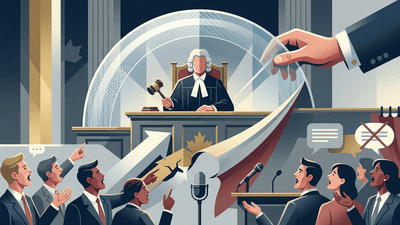



In the delicate ecosystem of Canadian democracy, the judiciary occupies a uniquely insulated position. Judges are unelected, holding their offices during "good behaviour" to ensure their rulings remain untainted by the shifting winds of public opinion. Yet, in an era where court decisions routinely shape national policy on everything from environmental regulation to criminal bail reform, the demand for public accountability has never been higher. This inherent tension recently boiled over when the Canadian Bar Association (CBA) issued a stark warning to the media and the public against "delegitimizing" judges—a move that has sparked intense debate within the legal profession regarding the boundaries of free expression and institutional protection.
The controversy centers on a recent CBA news release that cautioned commentators against employing rhetoric that undermines the legitimacy of the courts. While the Association’s intent—protecting the administration of justice from bad-faith, populist attacks—is rooted in fundamental legal principles, critics argue the messaging was overly broad. As highlighted in a poignant critique published by the Macdonald-Laurier Institute, the CBA's stance has been characterized as a "vague attempt to shame scrutiny of the courts."
For legal professionals in Canada, this debate is not merely academic. It directly impacts how litigators interact with the media, how law firms advise clients on public communications, and how the profession fulfills its dual mandate: defending the administration of justice while advocating for necessary legal reforms.
The Catalyst: Scrutiny vs. Delegitimization
The intersection of law and politics in Canada has grown increasingly complex since the advent of the Charter of Rights and Freedoms. Courts are frequently asked to adjudicate highly polarized issues. Consequently, judicial decisions are dissected not just in law journals, but on social media, in partisan newsletters, and on national television.
The CBA’s intervention appears to be a response to a rising tide of ad hominem attacks against judges—instances where commentators bypass legal reasoning to attack a judge's character, perceived political leanings, or background. However, Kerry Sun, writing in the National Post and amplified by the Macdonald-Laurier Institute, argues that the CBA's broad brush threatens to chill legitimate democratic debate.
"When courts assume the role of policymakers—wading into polycentric issues that affect the daily lives of citizens—they inevitably invite the kind of robust scrutiny traditionally reserved for the political branches of government. Shielding them from this scrutiny under the vague guise of preventing 'delegitimization' disserves the public."
This critique raises a vital question for the profession: Where exactly is the line between robust, even aggressive, critique of a judicial decision and the "delegitimization" of the institution?
The Professional Obligation of Lawyers
Canadian lawyers are uniquely positioned in this debate. Under the Federation of Law Societies of Canada’s Model Code of Professional Conduct (specifically Chapter 5.6), lawyers are required to "encourage public respect for and try to improve the administration of justice." Yet, the commentary to the Code explicitly recognizes that lawyers have a right—and sometimes a duty—to criticize the courts.
The Code distinguishes between criticism that is "reasoned and respectful" and that which is "irresponsible or abusive." The challenge in today's hyper-connected media landscape is that nuanced, reasoned critiques are often co-opted or stripped of context by partisan actors looking to score political points.
Practical Implications for Canadian Legal Practice
The ongoing debate over judicial scrutiny has several immediate, practical implications for lawyers, particularly those engaged in high-profile litigation, appellate work, or public law.
- Litigation PR and Media Relations: When stepping onto the courthouse steps to address the media following a controversial loss, counsel must carefully calibrate their language. Critiquing the legal test applied by the judge is fair game; suggesting the judge was biased by political affiliation risks crossing the line into professional misconduct and institutional delegitimization.
- Client Counseling in the Digital Age: Clients, particularly corporate entities or advocacy groups, often want to take to social media to blast an unfavorable ruling. Lawyers must proactively advise clients on the risks of contempt of court and the strategic pitfalls of attacking the bench, especially if an appeal is planned.
- The Lawyer as Public Intellectual: As the media increasingly turns to legal experts to decode complex rulings, lawyers must serve as translators rather than cheerleaders or arsonists. The profession has a collective interest in educating the public on why a court ruled a certain way, even when criticizing the ultimate conclusion.
Defining the Boundaries: A Comparative Analysis
To help practitioners navigate this fraught landscape, it is useful to categorize public commentary. The table below outlines the key distinctions between constructive legal scrutiny (which the profession must protect) and institutional delegitimization (which the CBA rightly warns against).
| Aspect of Commentary | Constructive Legal Scrutiny | Institutional Delegitimization |
|---|---|---|
| Focus of Critique | The legal reasoning, interpretation of precedent, or factual findings of the specific decision. | The personal character, perceived political biases, or demographic background of the judge. |
| Language Used | Objective, analytical, and grounded in established legal principles (e.g., "The court erred in its application of..."). | Inflammatory, conspiratorial, or dismissive (e.g., "Actist judge legislating from the bench..."). |
| Underlying Intent | To highlight legal errors, advocate for appellate review, or spur legislative reform. | To erode public trust in the judiciary's authority and independence. |
| Impact on Justice | Drives the evolution of the law and maintains democratic accountability. | Undermines the rule of law and the enforceability of court orders. |
Looking Ahead: The Future of Judicial Public Relations
The backlash to the CBA’s news release, as articulated by the Macdonald-Laurier Institute, underscores a growing reality: the judiciary can no longer rely solely on the traditional deference of the public and the press. As courts continue to issue rulings that deeply impact social and economic policy, they will remain in the crosshairs of public debate.
For the legal profession, the answer is not to shame the media into silence, nor is it to blindly defend every judicial utterance. Instead, the Canadian bar must step into the breach. Lawyers must embrace their role as civic educators, providing the public with the tools to critically assess court decisions based on legal merit rather than partisan alignment. Furthermore, courts themselves may need to adapt, perhaps by issuing plain-language summaries of complex decisions—a practice the Supreme Court of Canada has successfully championed—to ensure their reasoning is accessible directly to the public, bypassing the spin cycle.
Ultimately, a confident, independent judiciary should not fear scrutiny; it should welcome it as a hallmark of a healthy democracy. By fostering an environment where rigorous, respectful debate is encouraged, Canadian legal professionals can help ensure that the courts remain both accountable to the public and insulated from the destructive forces of delegitimization.