
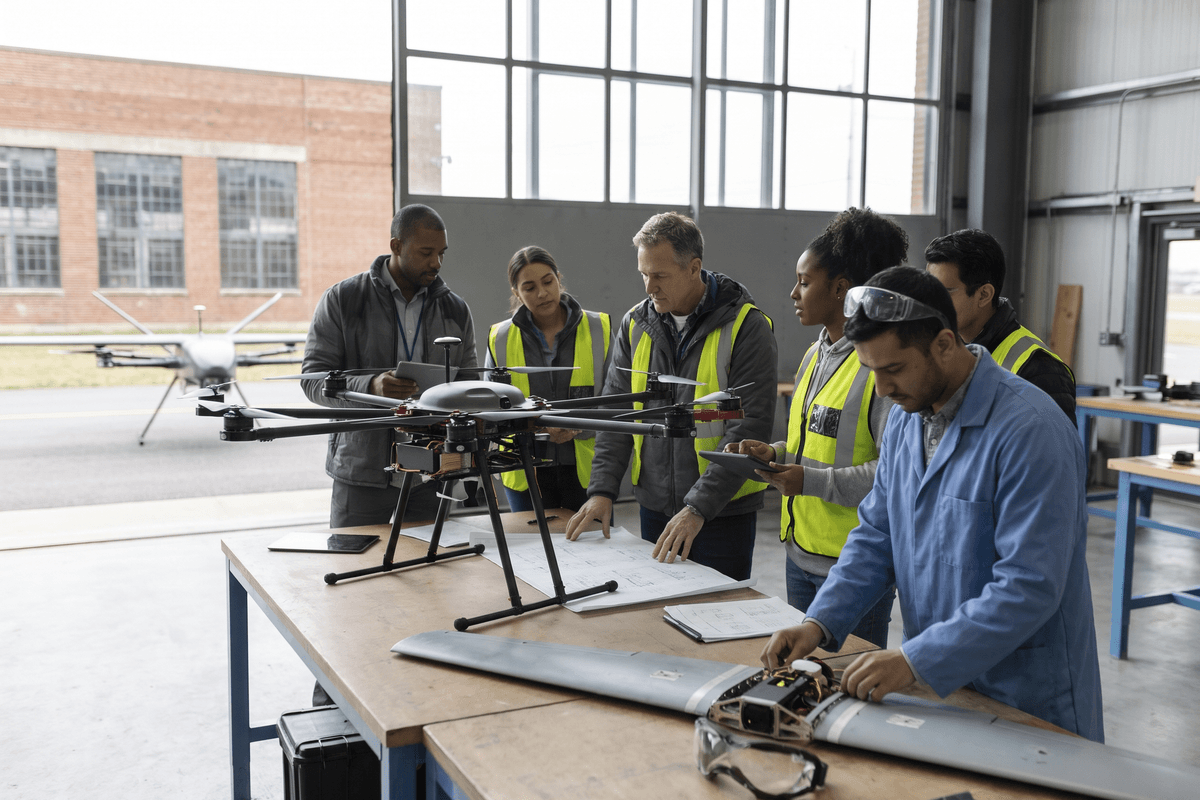

Ninety-plus university teams from more than thirty countries have signed up for a single engineering competition, and the UK is at the centre of the story. The Institution of Mechanical Engineers (IMechE) has announced record international interest in its UAS Challenge for 2027, the largest cohort in the competition's 13-year history. For UK engineers, the figures are more than a headline. They show where the next generation of systems thinkers is being trained, and they point to the skills that industrial sites across the country will soon need.
A Record Field and What It Reveals
According to the IMechE announcement, more than 90 teams from over 30 countries registered for the 2027 challenge. The competition is designed to build practical aerospace and systems engineering skills, asking students to conceive, design, and develop unmanned aircraft systems rather than simply study them. You can read the full announcement on the IMechE news page.
Why Scale Matters
A competition that grows to 90 entrants is not just a bigger event. It creates a denser network of university teams, sponsors, industrial mentors, and graduate recruiters. For UK institutions, it also means a larger pool of international students gaining hands-on experience in British engineering practice, standards, and professional culture. Those graduates will shape supply chains, design offices, and research groups for decades.
A Thirteen-Year Trajectory
The growth of the challenge over more than a decade reflects a steady shift in how engineering education is valued. Universities increasingly recognise that theory alone does not produce graduates who can integrate propulsion, avionics, structures, and software into a working system. Competitions that demand delivery under real constraints fill that gap, and they reward teams that can manage trade-offs between weight, power, cost, and reliability.
Why Unmanned Systems Are a Systems-Engineering Test
Unmanned aircraft are a demanding discipline precisely because they force systems integration at small scale. A team cannot succeed by excelling in one domain. Aerodynamics that ignores battery chemistry will fail on endurance. Control software that ignores sensor latency will fail in flight. The skill set being developed is transferable well beyond aerospace.
Typical competencies that teams must demonstrate include:
- Requirements definition: translating a mission brief into measurable performance targets.
- Cross-disciplinary design: balancing mechanical, electrical, and software decisions within a single architecture.
- Verification and testing: proving performance through ground and flight trials, not just simulation.
- Project and risk management: keeping schedules and budgets intact while technical problems emerge.
- Documentation and communication: presenting design rationale to judges and technical audiences.
These are precisely the capabilities that UK employers report as scarce. Graduates who have lived through a failed test flight and a redesign under deadline arrive with a very different understanding of engineering than those who have only completed coursework.
Digital Tools Are Changing the Pace
Industry commentary reinforces why this matters now. An Autodesk perspective published in Professional Engineering through IMechE argues that digital and technological change within UK manufacturing and industrial design is accelerating. The piece, available via IMechE's coverage of Autodesk's director of industry development, examines how engineering firms are navigating automation, predictive tooling, and rapid industrial shifts. Its headline captures the mood:
"The rate of change is accelerating beyond comprehension."
For a student team, that acceleration is a practical reality. Simulation, generative design, and digital twins are no longer specialist tools reserved for large primes. The challenge for educators and employers is ensuring that students learn to use these tools critically, validating digital outputs against physical test data rather than trusting them blindly.
From Student Airframes to Production Lines
The link between a university drone competition and a car factory might seem distant, but the two meet in the discipline of integrated systems. Bentley Motors recently marked the start of construction on a dedicated axle assembly and chassis module facility in Stoke-on-Trent, developed with partner ZF Foxconn Chassis Modules. As described in Bentley's announcement, the site supports advanced UK manufacturing across combustion, hybrid, and electric vehicle architectures.
That multi-powertrain scope is itself a systems problem. A single facility must accommodate different architectures, changing component mixes, and evolving electrical and structural requirements. Engineers planning such a site must think about flexibility, integration of automated handling, quality verification, and the interfaces between mechanical assemblies and electrical systems. These are the same interdependencies that a UAS team faces at smaller scale.
Comparing the Two Environments
The table below highlights how the skills developed in a university challenge map onto industrial contexts such as the Stoke-on-Trent facility.
| Dimension | University UAS Challenge | Industrial Facility Delivery |
|---|---|---|
| Core objective | Deliver a working unmanned system to mission brief | Deliver a production-ready assembly capability |
| Integration challenge | Airframe, propulsion, avionics, and control software | Mechanical assemblies, electrical systems, and automation |
| Verification method | Ground and flight testing | Factory acceptance, process validation, and quality audits |
| Constraint | Weight, endurance, and competition deadlines | Cost, takt time, throughput, and multi-powertrain flexibility |
| Transferable skill | Systems thinking under pressure | Systems thinking across long lifecycles |
What UK Engineering Professionals Should Do
A record international field is an opportunity as much as a signal. Engineers and employers who want to benefit should consider a practical set of actions.
- Engage with student competitions. Offer mentoring, technical reviews, or test facilities to university teams. Early contact builds a recruitment pipeline and sharpens your own team's communication skills.
- Audit your systems skills. Map where your organisation relies on integration expertise, and identify where junior engineers lack exposure to cross-disciplinary work.
- Adopt digital tools with validation discipline. Pair simulation and digital twin outputs with physical testing, and build this habit into graduate training from the start.
- Plan for multi-architecture flexibility. As facilities such as the Stoke-on-Trent site demonstrate, production capability must accommodate combustion, hybrid, and electric designs. Design processes and skills accordingly.
- Champion international collaboration. Students from more than thirty countries bring different approaches. Employers that engage with international talent gain perspectives that domestic pipelines alone cannot provide.
Looking Ahead to 2027
The surge of interest in the IMechE UAS Challenge suggests that the UK's engineering community is becoming a destination for ambitious, globally connected students. The competition's growth to over 90 teams reflects confidence in practical, project-based learning, and it arrives at a moment when industry is wrestling with digital acceleration and the complex integration demands of new vehicle and aerospace architectures.
The question for UK engineering professionals is whether they will treat this momentum as a spectator sport or as a source of talent and ideas. Those who engage early, whether by mentoring a team, hosting a test day, or designing their graduate programmes around systems integration, will be best placed to turn a record-breaking competition into lasting industrial capability.