
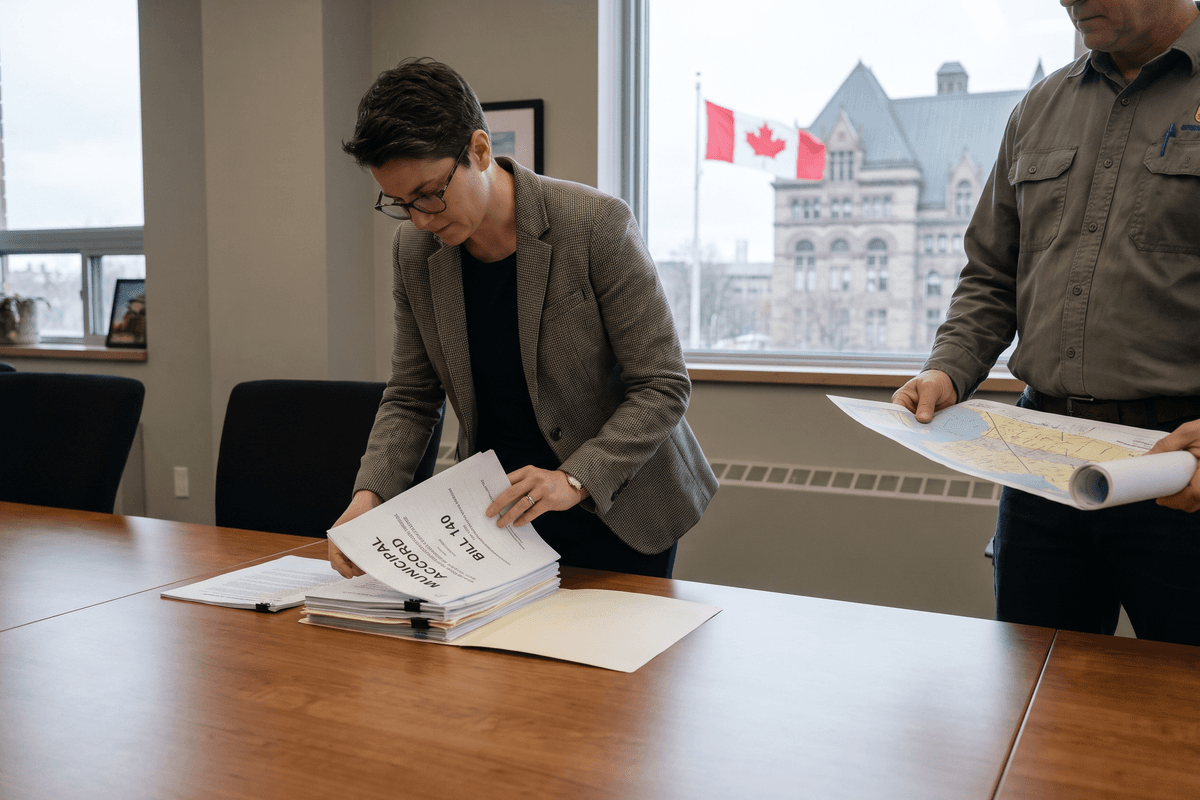

Canadian municipalities are facing an unprecedented re-engineering of their statutory authority, caught in an escalating pincer movement between aggressive provincial pre-emption and highly prescriptive federal infrastructure pacts. Nowhere is this tension more acute than in Ontario, where environmental lawyers and municipal leaders are sounding alarms over proposed legislation under Bill 140 that systematically strips municipal veto power and local consent requirements for new landfill sites. For local councils, the bill represents far more than an environmental deregulation measure; it marks an existential shift in the balance of intergovernmental power, signaling that local land-use authority can be overridden whenever municipal boundaries conflict with regional waste economics or provincial growth directives.
This legislative rollback arrives at a precarious moment for local administrators across Canada. As provinces flex constitutional muscle to streamline approvals and override local councils, municipalities are concurrently being induced to surrender fiscal levers in exchange for federal and provincial capital injections. From Ontario communities trading development charges for piped infrastructure to Western councils grappling with severe budget curtailments, city halls find themselves forced into a transactional reality: trading local policy discretion for fiscal solvency.
The Bill 140 Precedent: Dismantling Municipal Environmental Vetoes
Under the provincial framework established in 2020 via Bill 197, municipalities previously held statutory consent rights over new landfill proposals within their jurisdictions and within adjacent 3.5-kilometre buffer zones. That municipal veto—hard-won after decades of contentious siting battles—is now being actively unraveled. Legal experts and municipal advocates warn that gutting these provisions under Bill 140 disenfranchises local host communities, strips councils of statutory standing in environmental assessment regimes, and leaves agricultural aquifers and greenfield parcels vulnerable to commercial waste consolidation.
"Removing municipal consent requirements reduces local councils to passive bystanders on projects that carry multi-generational environmental, financial, and traffic consequences for their residents."
— Municipal legal analysts reviewing proposed amendments under Bill 140
For municipal chief administrative officers (CAOs) and town planners, the implications extend beyond solid waste. The stripping of local consent establishes a troubling template for other provincially favored infrastructure corridors, aggregate extraction sites, and industrial developments. If municipal planning protections can be legislatively neutralized under the banner of regional efficiency, the legal security of municipal Official Plans and community secondary plans is fundamentally compromised.
Carrots, Sticks, and Fiscal Surrender: The Development Charge Bargain
While provincial deregulation strips municipal regulatory authority from above, senior governments are applying an equally potent lever from below: conditional capital finance. Through initiatives like the joint federal-provincial Development Charge Reduction Program, municipal councils are being offered millions in essential subsurface utility grants—on the explicit condition that they slash or eliminate local growth levies that protect property taxpayers from subsidizing sprawl.
Recent accords demonstrate how quickly mid-sized and small communities are signing away local revenue tools to bridge chronic infrastructure deficits:
- Peterborough’s Growth-Fee Concession: The City of Peterborough secured up to $39.9 million in joint infrastructure funding, but only after council agreed to halve development charges across all residential housing forms. While the capital provides immediate relief for critical sewer and water upgrades, it creates an acute revenue shortfall for future community centres, fire stations, and transit expansions.
- Petrolia’s Complete Fee Moratorium: In southwestern Ontario, the Town of Petrolia finalized a deal for $2.3 million in direct municipal utility funding by agreeing to eliminate local development charges entirely over a three-year window.
These conditional funding formulas force councils into a zero-sum dilemma: forfeit sovereign development levy autonomy to secure immediate grant money, or retain local fee structures and watch capital reserves run dry while developers sit on stalled land assets.
| Municipality | Grant Allocation | Statutory / Fiscal Concession Required | Long-Term Municipal Balance Sheet Impact |
|---|---|---|---|
| City of Peterborough | $39.9M (Joint Tri-Level) | 50% reduction in development charges across all residential categories | Accelerates piped-servicing projects while widening long-term growth-funding gaps for parks and emergency services. |
| Town of Petrolia | $2.3M (Infrastructure Grant) | 100% moratorium on residential development charges for three years | Eliminates developer contributions; forces capital replacement costs onto existing property tax base post-2028. |
| Ontario Host Communities (Bill 140) | N/A (Regulatory Pre-emption) | Complete loss of municipal veto and consent rights over landfill siting | Loss of local land-use authority, depression of adjacent land values, increased road maintenance liabilities. |
The Operating Crunch: Capital Cannibalization and Fiscal Friction
The erosion of local control is unfolding against a background of severe municipal operating distress across the country. Denied access to elastic tax revenues like sales or income taxes, local councils are hitting the mathematical wall of property tax tolerance.
In Alberta, Calgary City Council has been locked in high-stakes budget reviews to slash operating programs and pause capital projects ahead of its municipal budget release. Facing acute public pushback over escalating residential mill rates and utility bill hikes, Calgary’s administrators have been tasked with identifying surgical program cuts to keep residential tax increases within manageable boundaries.
This dynamic—where local councils must cannibalize their own discretionary services to keep pace with basic inflationary asset management—contrasts sharply with the obligations pushed downward by senior governments. Municipalities are expected to deliver front-line solutions to social crises without structural operational support.
Social Delivery Mandates vs. Core Infrastructure Gaps
Across urban and rural Canada, local governments are absorbing downloading pressures across public safety, mental health, and non-market housing:
- The Urban Frontline: In British Columbia, the mayors of Vancouver and Victoria have publicly endorsed federal commitments to tackle chronic homelessness, but continue to emphasize that municipal budgets cannot indefinitely fund emergency shelters, supportive housing operational costs, and street-level healthcare responses without sustained, statutory transfers from provincial health ministries.
- Rural and Mid-Sized Pressures: In Manitoba, prairie administrators in Portage la Prairie are combing through federal budget provisions to secure specialized grants for non-market housing stock and community safety enforcement, struggling to finance community stabilization out of a constrained rural assessment base.
- Overlooked Regional Corridors: While federal funding flows into select housing-linked pockets, foundational connective infrastructure is left stranded. Northern Ontario municipal associations recently mounted unified lobbying efforts after major regional expansions to the Trans-Canada Highway were omitted from senior infrastructure priorities, leaving northern councils to shoulder outsized transit safety liabilities and supply-chain vulnerabilities.
As noted by the Federation of Canadian Municipalities (FCM) following the release of Budget 2026, local governments stand ready to execute on federal targets—such as modernizing permitting architectures and unlocking residential density—but conditional, application-based funds cannot replace comprehensive structural funding frameworks that cover operating asset management.
Strategic Playbook: How Municipalities Can Navigate Legislative Subordination
Faced with legislative moves like Bill 140 that limit local rights, and funding structures that demand fee concessions, municipal councils and executive leadership teams need clear, practical strategies to protect their communities:
1. Pivot from Statutory Vetoes to Host Community Agreements (HCAs)
With provincial legislation curtailing direct veto powers over waste and infrastructure siting, municipal legal teams must preemptively draft municipal servicing and road-use bylaws. If a council cannot outright veto a landfill or heavy industrial development under planning statutes, it can aggressively regulate haulage routes, stormwater run-off connections, noise bylaws, and require comprehensive, legally binding Host Community Agreements (HCAs) funded by the proponent to cover capital road rehabilitation and perpetual environmental monitoring.
2. Establish Development Charge "Sunset and Reconciliation" Reserves
Municipalities accepting capital funding in exchange for discounting or waiving development charges (as seen in Peterborough and Petrolia) must ring-fence incoming infrastructure grants strictly for long-life capacity assets. CAOs must simultaneously institute internal "shadow accounting" reserves to measure the exact growth-revenue deficit created by the discount. Councils should insert strict sunset clauses into local bylaw amendments ensuring that growth fees automatically revert to full cost-recovery levels once conditional provincial/federal funding allocations expire.
3. Form Regional Coalition Blocs on Shared Environmental Assets
Single municipalities pushing back against environmental pre-emption are easily overridden by Queen's Park or other provincial legislatures. However, regional alliances—such as upper-tier county councils partnering with lower-tier townships, conservation authorities, and Indigenous governing bodies—can present unified legal and political resistance. Pooling financial resources to commission independent hydrogeological, aquifer-protection, and cumulative health assessments makes it legally precarious for provincial ministries to issue Environmental Compliance Approvals over unified regional dissent.
The Road Ahead: Reclaiming the Municipal Mandate
The intensifying battle over Ontario’s Bill 140 is a bellwether for the future of Canadian local governance. When provincial cabinets can eliminate local environmental consent with the stroke of a legislative pen, and federal departments demand fee concessions in exchange for basic water mains, the concept of municipal autonomy is pushed to its absolute limits.
Municipal leaders cannot afford to operate under the assumption that long-standing statutory protections are inviolable. Navigating the 2026–2030 mandate requires municipal executives who are as adept at hardline intergovernmental negotiation and legal hedging as they are at capital budgeting. Only by recognizing the transactional nature of modern Canadian federalism can local councils safeguard their communities' environmental assets while preserving long-term fiscal solvency.