
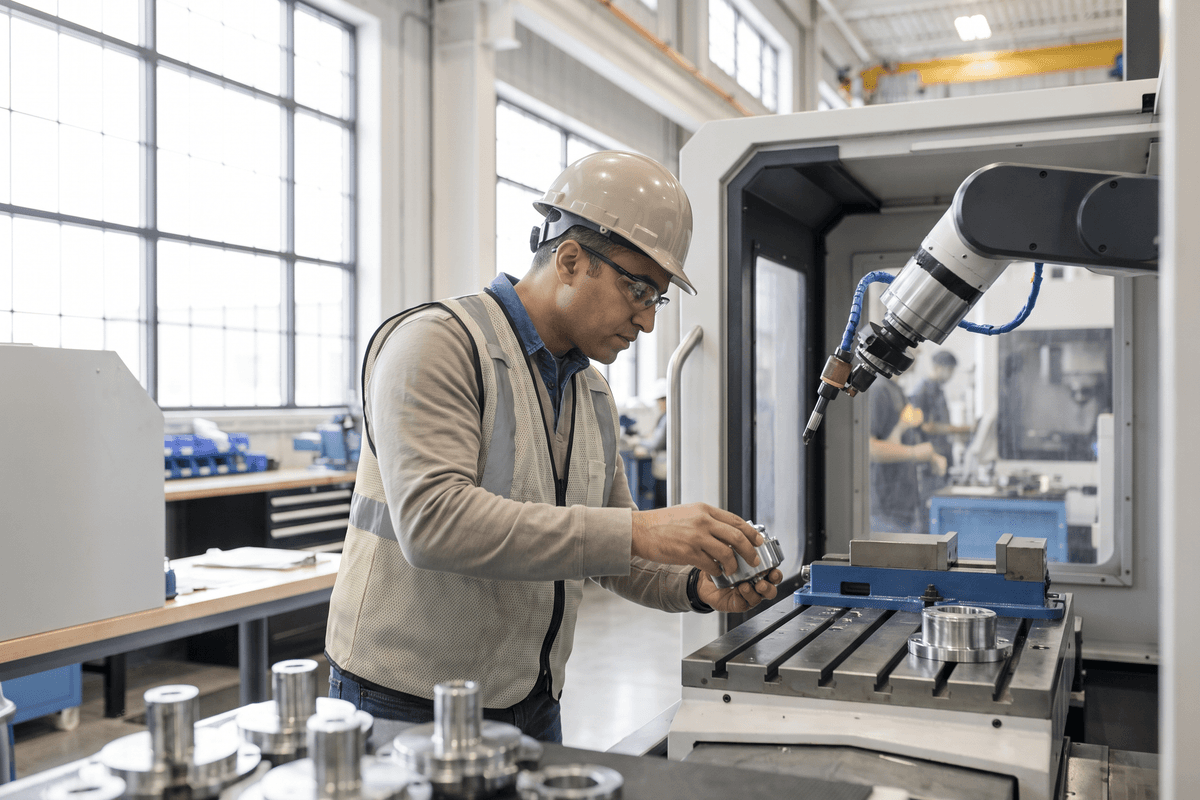



On shop floors across the American industrial heartland, the long-heralded revival of domestic manufacturing is transitioning from policy talking point to heavy metal reality. Surging capital expenditures, historic demand for advanced metalworking machinery, and relentless investments in high-precision tooling are colliding to create a structural transformation in U.S. industrial engineering. As detailed by recent manufacturing momentum analyses in Quality Magazine, the convergence of sustained capital allocation, multi-axis machining orders, and productivity-driven automation is setting a high-stakes operational backdrop for the International Manufacturing Technology Show (IMTS 2026).
For plant managers, systems engineers, and manufacturing executives, this is not merely a cyclical equipment refresh. It represents an architectural pivot in how precision components are designed, fabricated, inspected, and scaled across mission-critical supply chains—spanning aerospace, defense, semiconductor tooling, and power generation.
The Hardware Reality Behind the Reshoring Boom
For years, economic skeptics questioned whether reshoring initiatives could survive the brutal cost dynamics of globalized supply chains. Today, the answer is arriving in multi-ton shipments of five-axis machining centers, electrical discharge machining (EDM) units, laser powder bed fusion systems, and ultra-high-speed horizontal milling platforms. The sheer volume of machinery orders reflects a domestic industrial base that is actively building internal capacity to insulate itself against geopolitical fragility and logistics bottlenecks.
Engineering teams are no longer procuring machinery simply to add incremental spindle hours; they are investing to achieve radical part complexity in single setups. Multi-tasking turn-mill centers and automated flexible manufacturing systems (FMS) are replacing conventional cellular layouts, collapsing production sequences that once took weeks across multiple specialized shops into fully autonomous, single-clamping operations.
"The current trajectory of manufacturing technology procurement isn't just about replacing aging spindles—it is a total operational redesign aimed at eliminating setup variance, compressing lead times, and embedding deterministic quality at the machine level."
The Triad of Modern Industrial Engineering: Precision, Automation, Metrology
As documented in recent industry reporting, the surge in capital equipment is defined by three converging technological imperatives:
- Multi-Axis Kinematic Versatility: Modern 5-axis and simultaneous multi-axis machines eliminate manual re-fixturing, directly driving geometric dimensioning and tolerancing (GD&T) accuracy down to single-digit micron thresholds.
- Integrated In-Situ Metrology: Machine-mounted touch probes, confocal chromatic sensors, and on-spindle laser scanning are moving quality verification directly into the machining cycle, turning machine tools into autonomous inspection platforms.
- Lights-Out Automation Architecture: Standard installations now routinely package automated tool changers with 120+ capacity, robotic pallet pools, and automated guided vehicles (AGVs) that keep high-capital assets cutting metal through unattended third shifts.
Comparative Evolution: Conventional Machining vs. 2026 Integrated Production Cells
| Engineering Metric | Conventional Manufacturing Setup (Pre-2020) | Next-Gen Advanced Cell (2026 Standard) |
|---|---|---|
| Setup & Changeover Time | Hours to days; reliant on manual dial indicators and custom jigs | Minutes; automated zero-point clamping systems with RFID tool tracking |
| Quality Control Protocol | Post-process CMM inspection rooms; batch scrap risks | In-situ probing, adaptive cutting-force feedback, and closed-loop tool wear compensation |
| Spindle Utilization Rate | 35% – 50% (constrained by single-shift manual operations) | 75% – 90% (supported by lights-out pallet pools and automated loading) |
| Engineering Integration | Siloed CAD/CAM post-processing and standalone shop floor consoles | Model-Based Enterprise (MBE) with native digital twins and edge AI vibration monitoring |
The Human-Machine Bottleneck: Automation as the New Labor Strategy
Underlying this machinery investment wave is an unavoidable demographic reality: the persistent shortage of veteran toolmakers, CNC setup technicians, and seasoned manufacturing engineers. While previous industrial eras expanded capacity by hiring additional operators, the 2026 playbook leverages software-driven toolpath optimization and robotics to multiply the output of existing engineering personnel.
CAM programming has transformed from a craft into an automated systems discipline. Cloud-native toolpath generators, physics-based cutting simulation engines, and automated feature recognition (AFR) are enabling manufacturing engineers to program complex thin-walled aerospace structural components or hardened mold dies in hours rather than days. By embedding collision avoidance and dynamic feed-rate adjustment directly into the digital twin before a chip is ever cut, facilities are achieving "first-part-good" production runs on multimillion-dollar raw forgings.
Addressing the Critical Tolerance Disciplines
- Thermal Drift Compensation: High-end machine tools now incorporate real-time temperature sensors across castings and ballscrews, with mathematical compensation models counteracting environmental shop floor swings.
- Dynamic Tool-Life Management: Acoustic emission sensors and spindle motor current analytics detect micro-chipping and flank wear before tool failure damages high-value workpieces.
- Standardized Interoperability: Widespread deployment of open communication protocols (such as MTConnect and OPC UA) allows unified MES dashboards to orchestrate disparate machine brands into cohesive digital factories.
Looking Ahead: Strategic Imperatives for U.S. Engineering Leadership
As the sector accelerates toward IMTS 2026, the competitive line between agile precision manufacturers and commoditized machine shops will sharpen significantly. Capital investment alone is insufficient; competitive advantage will belong to organizations that re-engineer their entire workflow around model-based definitions, uncompromised quality analytics, and agile production architectures.
Engineering leaders must take decisive steps to align their operations with this capital and technology surge:
- Audit Capital Allocation for Unattended Capability: Prioritize machine tool acquisitions that offer native automation hooks, zero-point workholding integration, and high-capacity tooling carousels over standalone bare-bones machines.
- Democratize In-Line Metrology: Eliminate the traditional CMM bottleneck by outfitting front-line machine tools with automated probing routines and optical verification sensors.
- Cultivate Systems-Level Engineering Talent: Upskill technicians in multi-axis CAM programming, sensor integration, and industrial data networking rather than isolated manual machining disciplines.
The manufacturing momentum sweeping the United States proves that the domestic factory floor is no longer a relic of the past, but the focal point of cutting-edge computational physics, advanced materials science, and precision systems engineering. The investments made today in metalworking technology are cementing the industrial baseline for the next generation of American engineering leadership.