
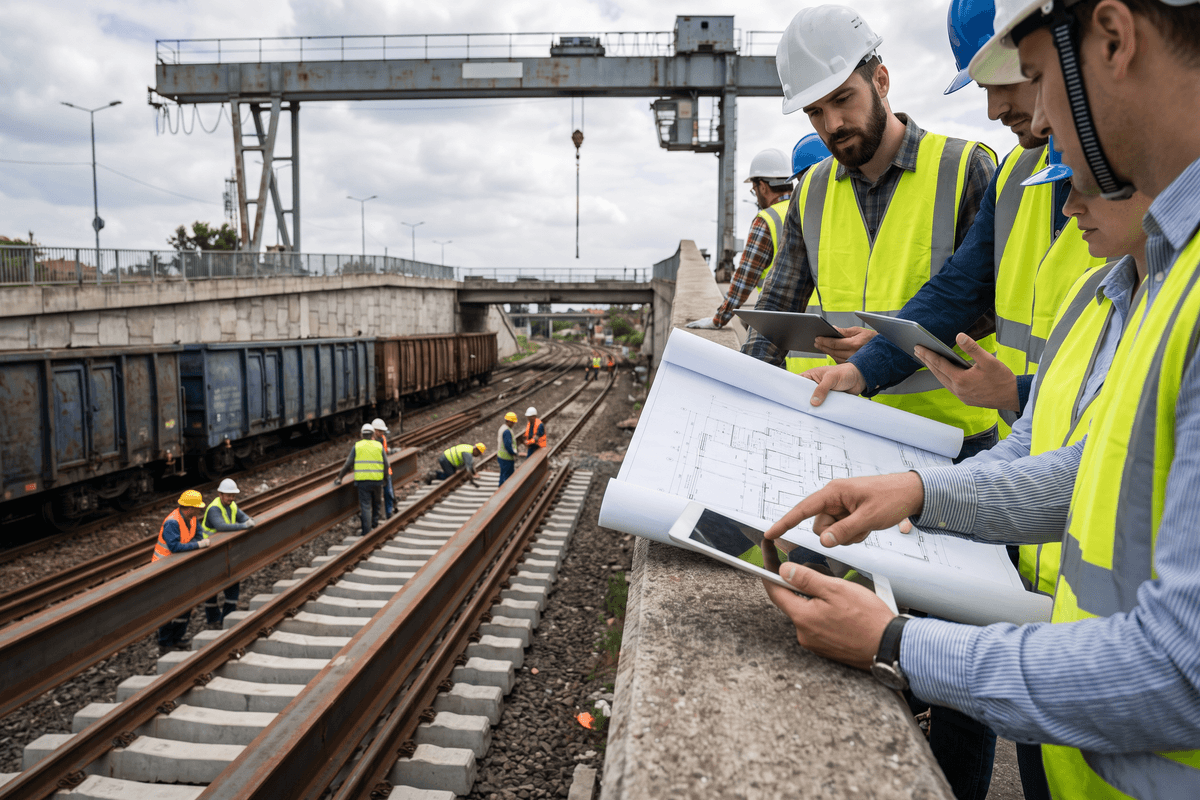



Across the United States, civil and structural engineering teams are confronting a fundamental structural inflection point: the collision of legacy 20th-century assets operating well beyond their design life and a massive redirection of capital toward complex, mission-critical infrastructure. When Amtrak awarded civil engineering leader HNTB the architectural and engineering contracts to replace two 113-year-old bridges along the Northeast Corridor in Maryland, it underscored a defining reality for practicing engineers. Delivering next-generation capacity no longer means building on greenfield sites; it requires surgically excising century-old steel and masonry while maintaining operational continuity on the nation’s busiest transportation arteries.
This replacement initiative is far more than a localized bridge swap. It represents a broader macro-shift sweeping American engineering and construction. As detailed in FMI’s Q4 2026 Engineering and Construction Outlook, engineering demand has not contracted—it has decisively migrated. While commercial real estate and traditional residential sectors cool, resources are pouring into heavy civil modernization, high-voltage grid upgrades, advanced industrial manufacturing, and hyperscale digital infrastructure.
Surgical Civil Engineering: Modernizing Century-Old Rail Spans
The Northeast Corridor (NEC) serves as the economic backbone of passenger rail in the Eastern United States, carrying hundreds of thousands of daily commuters alongside high-speed Acela services. However, the bridges carrying this traffic across Maryland’s waterways were constructed during the Taft administration. Replacing two 113-year-old structures requires solving intricate technical constraints that did not exist when the original spans were erected in 1913.
HNTB’s engineering scope extends beyond structural replacement to comprehensive corridor optimization. Modern high-speed rail demands strict tolerances that legacy bridge geometries simply cannot accommodate:
- Geometric Realignment & Superelevation: Redesigning approach geometry and bridge decks to eliminate legacy curvature speed restrictions, enabling trains to maintain higher continuous speeds without compromising passenger ride quality or wheel-rail interface dynamics.
- Signal and Electrification Modernization: Integrating advanced Positive Train Control (PTC) arrays, micro-processor-controlled interlocking systems, and modernized catenary support structures directly into the new civil abutments and piers.
- Geotechnical and Hydrological Resiliency: Designing deep substructures and scour-resistant foundations capable of withstanding 100-year and 500-year flood events exacerbated by changing Atlantic coastal climate patterns.
- Zero-Disruption Phasing: Utilizing Accelerated Bridge Construction (ABC) methodologies—such as lateral sliding and self-propelled modular transporters (SPMTs)—to install pre-constructed spans during compressed weekend work windows.
"The challenge on the Northeast Corridor is not merely structural capacity; it is the geometric and dynamic integration of modern, high-speed rolling stock into right-of-ways constrained by century-old urban and environmental boundaries." — Transportation Systems Engineering Analysis
The Capital Re-Route: Where Engineering Capacity Is Flowing
The structural work underway in Maryland mirrors the broader capital realignment identified across the United States. According to market data from FMI's 2026 Outlook, engineering firms that built their business models on office towers and speculative developments are rapidly retooling project teams toward power, heavy civil, and advanced industrial sectors.
| Engineering Sector | Primary Growth Driver | Core Engineering Competencies Required | 5-Year Horizon |
|---|---|---|---|
| Passenger & Freight Rail | NEC Modernization / Federal IIJA Grants | Track alignment, catenary engineering, ABC methods, signal systems | Sustained High Growth |
| Data Infrastructure | Generative AI Compute & Cloud Scaling | High-voltage substations, liquid cooling loops, structural thermal management | Rapid Expansion |
| Semiconductor Fabrication | $1T Global Sector Milestone / CHIPS Act | Vibration mitigation, ultra-pure fluid mechanics, cleanroom MEP | Peak Capital Deployment |
| Traditional Commercial Office | Hybrid Work & High Interest Realities | Adaptive reuse, structural re-coring, MEP electrification | Contraction to Flat |
This re-allocation is visible not just in civil transit, but in high-tech industrial manufacturing. At SEMICON West 2026, industry leaders highlighted that the semiconductor sector has officially scaled into a $1 trillion global industry, with more than 100 advanced wafer fabrication and advanced packaging facilities under construction or planned worldwide. For industrial and structural engineers, fab delivery presents extreme performance challenges: designing isolated, massive monolithic slab foundations capable of sub-micron vibration dampening, alongside complex process piping for specialty gases and advanced packaging environments.
The Green Engineering Mandate: Decarbonization and Material Innovation
Whether modernizing rail bridges in the Mid-Atlantic or constructing mega-fabs in the Sunbelt, engineering firms are operating under stringent environmental and embodied carbon constraints. According to ENR’s 2026 Top 100 Green Design Firms ranking, green design and sustainable engineering revenues grew by nearly 6% year-over-year, establishing low-carbon delivery as a mandatory baseline rather than an optional add-on.
Construction leaders are responding to these requirements with industrialized sustainability. DPR Construction climbed to No. 3 on ENR's 2026 Top Green Contractors list, driven by large-scale integration of low-embodied-carbon structural concrete mixes, mass timber industrial framing, and closed-loop water treatment systems across mission-critical sites.
Cross-Disciplinary Material Intelligence
The push for material performance extends far beyond structural concrete. In the mobility and mechanical engineering disciplines, material science is transforming component integration. An analysis by the American Society of Mechanical Engineers (ASME) explores how specialty automotive glass is quietly revolutionizing vehicle architecture. Instead of acting as passive structural barriers, engineered glass formulations now incorporate embedded LiDAR apertures, head-up display optics, thermal-insulating coatings, and structural electronics—a multidisciplinary paradigm shift directly analogous to embedding fiber-optic health monitoring and automated stress sensors into modern civil bridge decks.
Engineering Execution: Strategic Imperatives for Practitioners
As U.S. engineering firms navigate this massive realignment toward complex, mission-critical infrastructure, three operational imperatives have emerged for technical leaders and project executives:
- Mastering Digital Twinning in Live Operations: When replacing structures like Maryland’s 113-year-old bridges, digital twins must go beyond 3D geometry to model 4D construction staging, real-time track deflection, and thermal stress during live rail operations.
- Industrializing Offsite Modularization: With chronic shortages of specialized on-site civil and electrical trade labor, firms must design spans, electrical sub-stations, and cleanroom MEP skids for factory prefabrication and rapid on-site assembly.
- Unified Decarbonization Accounting: Incorporating real-time Life Cycle Assessments (LCAs) into preliminary engineering designs to optimize concrete mix designs, steel sourcing, and operational energy profiles before breaking ground.
The Road Ahead: Building for the Next Century
The bridge replacements along Maryland’s Northeast Corridor symbolize an overdue transition in American engineering: retiring early-20th-century assets to lay the groundwork for a faster, electrified, and more resilient transportation backbone. When paired with the relentless expansion of semiconductor fabs, advanced material applications, and digital power infrastructure, the engineering profession is executing one of the most consequential capital pivots in modern history.
For engineering professionals across the country, the mandate is unambiguous: technical mastery in the coming decade will be defined not by building new structures in empty fields, but by the ability to rebuild, decarbonize, and technologically elevate the critical systems that keep the modern economy running—without taking them offline for a single day.