
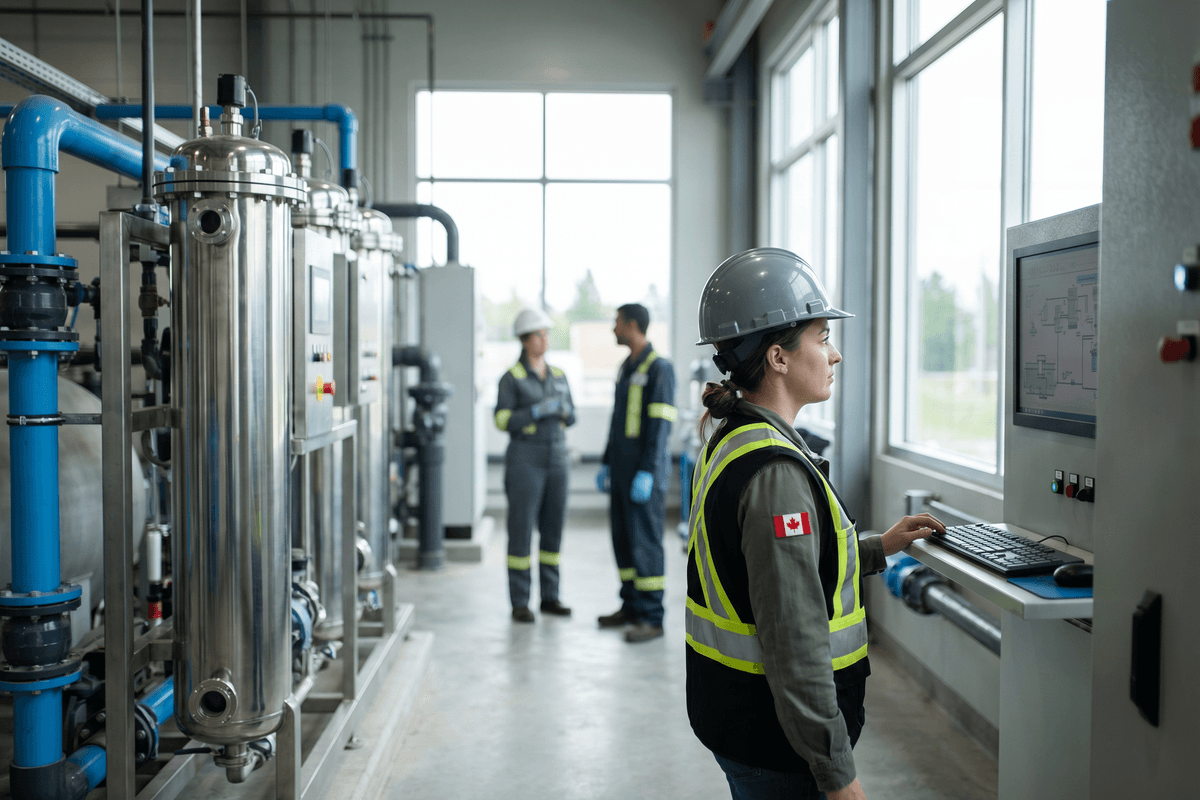



For decades, Canadian engineering viewed water management through a largely linear lens: source, treat, utilize, and discharge. But as the twin pressures of industrial decarbonization and municipal climate resilience mount, the geometry of fluid engineering is becoming distinctly circular. Water is no longer just a utility; it is the critical path for both achieving net-zero emissions in heavy industry and ensuring public health in growing municipalities.
Two recent projects—one in the heart of Alberta's petrochemical corridor and another in a mid-sized British Columbia municipality—perfectly illustrate this shift. While vastly different in scale and scope, both projects highlight a fundamental transformation in how Canadian engineers are designing, procuring, and operating water infrastructure.
The Industrial Mega-Scale: Engineering the Closed Loop at Dow's Path2Zero
In Alberta's Industrial Heartland, the push for decarbonization is driving unprecedented innovation in process engineering. A prime example is Xylem's recently secured long-term agreement to design, build, and operate an advanced industrial water management system at Dow's Fort Saskatchewan complex.
Dow's Path2Zero project aims to build the world's first net-zero carbon emissions integrated ethylene cracker and derivatives facility. However, decarbonizing a facility of this magnitude isn't just about capturing carbon; it requires a total reimagining of the plant's thermal and fluid dynamics.
The Engineering Challenges of Industrial Water Reuse
At the petrochemical level, water is used extensively for cooling, steam generation, and as a process solvent. Transitioning to a closed-loop reuse system introduces immense complexity for engineering teams. Key technical hurdles include:
- Thermal Management: Reusing water in high-heat industrial processes requires sophisticated cooling towers and heat exchangers that must operate within strict thermodynamic tolerances to prevent system degradation.
- Contaminant Profiling: Industrial wastewater contains complex organic compounds and dissolved solids. Engineers must design multi-stage filtration systems—likely integrating ultrafiltration (UF) and reverse osmosis (RO)—to achieve boiler-feed water quality from process effluent.
- Automated Control and Redundancy: Because the water system is integrated directly into the ethylene cracker's critical path, any downtime in water processing results in catastrophic plant shutdowns. The control systems must feature triple-redundancy and predictive maintenance algorithms.
"The transition to net-zero industrial operations is fundamentally a fluid management challenge. You cannot decarbonize a facility like an ethylene cracker without simultaneously engineering a closed-loop water reuse system that minimizes thermal waste and chemical discharge."
What makes the Xylem-Dow partnership particularly notable for the engineering sector is the procurement model. By opting for an end-to-end Design-Build-Operate (DBO) contract, Dow is ensuring that the engineers designing the system are inherently tied to its 20-year lifecycle performance. This forces a shift away from "value engineering" capital costs at the expense of long-term operational efficiency (OPEX).
The Municipal Modernization: Cranbrook's $13M UV Upgrade
While Alberta's industrial sector focuses on closed-loop process water, Canadian municipalities are tackling a different engineering challenge: modernizing legacy surface water treatment to handle shifting climate patterns and stricter regulatory frameworks.
In British Columbia, construction is officially underway on Cranbrook's new $12.9-million drinking water disinfection facility. This project represents a critical upgrade for the city, introducing ultraviolet (UV) treatment to a surface water system that previously relied heavily on traditional chemical disinfection.
Hydraulics and Photochemistry in Harmony
For civil and environmental engineers, integrating UV disinfection into an existing municipal water grid is a delicate exercise in fluid dynamics and photochemistry. Unlike chlorine, which provides a residual disinfectant as water travels through the pipes, UV light inactivates pathogens instantly as the water passes through a reactor. The engineering success of the Cranbrook project hinges on several factors:
- Reactor Hydraulics: Engineers must design the piping and reactor chambers to ensure perfect plug-flow. If the water velocity is too high, or if turbulence causes short-circuiting, pathogens may pass through without absorbing the required UV dose.
- Transmittance Monitoring: Surface water quality fluctuates with seasonal runoff and storm events. The system must continuously monitor UV transmittance (UVT) and automatically adjust lamp intensity or flow rates to maintain regulatory compliance.
- Integration with Legacy Infrastructure: Retrofitting a $13M facility into an existing municipal grid requires careful phasing. Engineers must maintain uninterrupted water service to the city while tying in the new high-voltage UV reactors and updated SCADA (Supervisory Control and Data Acquisition) systems.
The Cranbrook project underscores a broader trend in Canadian municipal engineering: the move toward multi-barrier treatment strategies that reduce reliance on chemical dosing while increasing resilience against waterborne pathogens like Cryptosporidium and Giardia, which are notoriously resistant to chlorine.
Comparing the Scales: Industrial vs. Municipal Engineering Priorities
To understand the current landscape of Canadian water engineering, it is helpful to contrast the priorities driving these two distinct sectors.
| Parameter | Industrial Reuse (e.g., Dow Path2Zero) | Municipal Treatment (e.g., Cranbrook UV) |
|---|---|---|
| Primary Goal | Zero liquid discharge, thermal efficiency, operational uptime. | Public health, regulatory compliance, multi-barrier protection. |
| Core Technologies | Reverse Osmosis, Ultrafiltration, Advanced Oxidation. | UV Disinfection, Coagulation/Flocculation, Chlorination. |
| Engineering Focus | Chemical separation and thermodynamic closed-loops. | Fluid dynamics, dose pacing, and legacy grid integration. |
| Procurement Model | Design-Build-Operate (DBO) / Long-term partnerships. | Traditional Design-Bid-Build or Construction Management. |
The Path Forward for Canadian Engineering Firms
The convergence of industrial decarbonization and municipal modernization is creating a massive backlog of highly complex water infrastructure projects across Canada. For engineering consulting firms, this represents both a lucrative opportunity and a significant talent challenge.
Firms can no longer afford to silo their process engineers from their civil infrastructure teams. A project like Dow's Path2Zero requires the structural engineering to house massive treatment trains, the civil engineering to manage site hydrology, and the chemical engineering to design the membrane processes. Similarly, municipal projects like Cranbrook's UV facility require electrical engineers for high-draw UV ballasts, software engineers for SCADA integration, and civil engineers for hydraulic profiling.
As we look to the next decade of Canadian infrastructure, the ability to execute these multi-disciplinary, highly integrated fluid management systems will separate the tier-one engineering firms from the rest of the pack. Water is no longer just flowing through our infrastructure; it is the engine driving our transition to a resilient, net-zero future.