
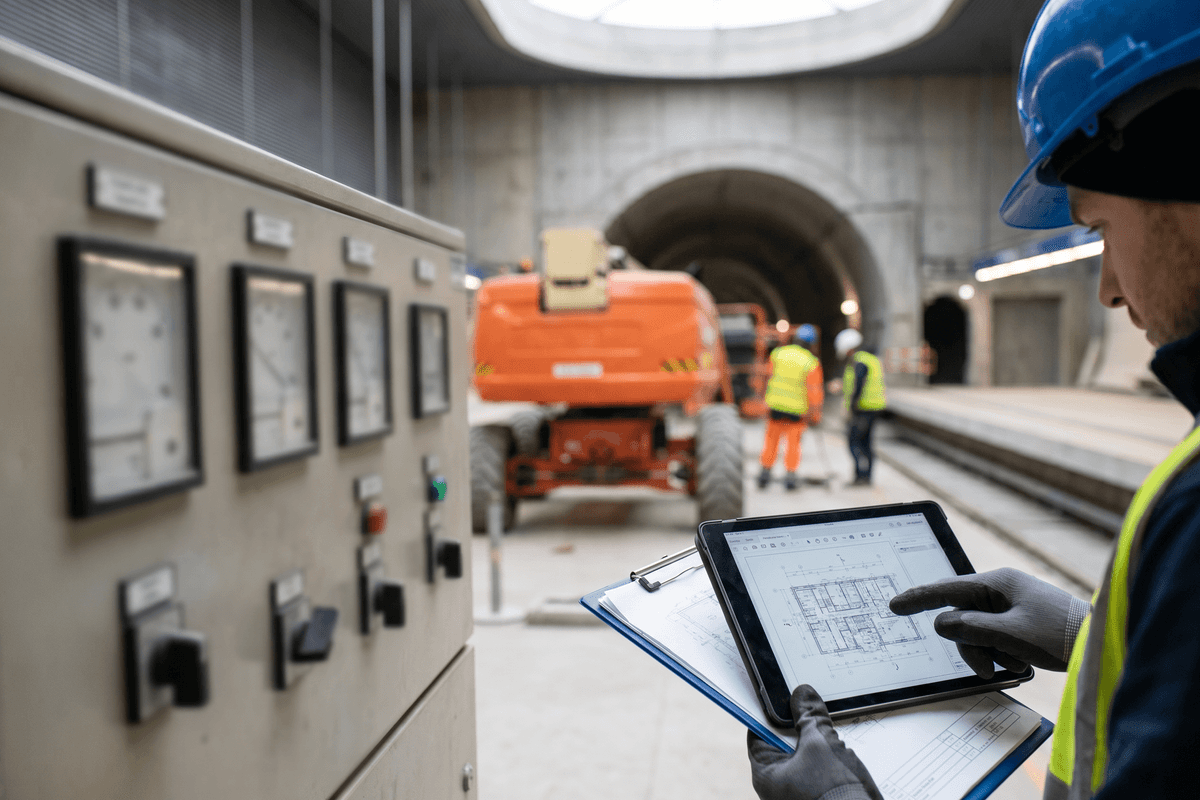



The Pivot from Concrete to Code
Vancouver’s Broadway corridor is not just one of the busiest arterial routes in North America; for the past several years, it has been a high-stakes engineering theater. As the Broadway Subway Project officially advances into its dynamic train testing phase, the narrative of this $2.8 billion megaproject is fundamentally shifting. For Canadian engineering professionals, the transition from heavy civil construction to complex systems integration represents the most critical—and often the most volatile—phase of any urban transit delivery.
Megaprojects are effectively two distinct engineering endeavors stacked on top of one another. The first is the physical reshaping of the earth: the tunnel boring, the station excavations, and the concrete pours. The second, which is now underway beneath Vancouver, is the digital and electrical awakening of that infrastructure. Dynamic testing is where structural tolerances meet software algorithms, and where the true success of the project's design phase is finally proven.
The Mechanics of Dynamic Testing on the Millennium Line Extension
The Broadway Subway Project is a 5.7-kilometre extension of the existing Millennium Line. Because it utilizes the SkyTrain network's proprietary automated, driverless technology, the commissioning phase is exponentially more complex than that of a conventional light rail transit (LRT) system.
Dynamic testing is not simply about running a train back and forth to see if the tracks hold. It is a rigorous, multi-tiered validation process that ensures every subsystem communicates flawlessly. For engineering teams on the ground, this phase is broken down into several hyper-focused objectives:
- Kinematic Envelope Verification: Before high-speed tests occur, engineers must conduct clearance testing. Because the Millennium Line relies on Linear Induction Motor (LIM) technology, the tolerance between the train's undercarriage and the guideway's reaction rail is measured in millimetres. Any deviation in the track slab pour or rail alignment must be identified and rectified.
- Communications-Based Train Control (CBTC) Integration: The backbone of the SkyTrain system is its moving-block CBTC signalling. Dynamic testing verifies the handshake between the onboard computers, the guideway transponders, and the central control facility. Engineers must simulate peak-load headways, emergency braking scenarios, and system failures to validate the software's fail-safe mechanisms.
- Traction Power and Harmonics: Drawing power from newly constructed substations, the testing phase monitors voltage drops, harmonic distortion, and regenerative braking efficiency. Engineers must ensure that the new 5.7-kilometre segment does not destabilize the legacy power grid of the existing network.
- Life Safety and Tunnel Ventilation: Running trains dynamically allows engineers to test the aerodynamic effects within the bored tunnels (piston effect) and validate the automated tunnel ventilation systems under realistic conditions.
"The dynamic testing phase is the ultimate truth-teller in transit engineering. It is the moment where the silos between civil contractors, trackwork installers, and systems integrators are completely dismantled by necessity. If a conduit was misplaced by two inches three years ago, dynamic testing is when you find out."
Contrasting Phases: Civil Construction vs. Systems Commissioning
To understand the sheer pivot required by project management teams during this milestone, it is helpful to contrast the engineering mindsets required for the civil phase versus the commissioning phase.
| Project Parameter | Heavy Civil Phase (2021-2025) | Systems & Commissioning Phase (2026) |
|---|---|---|
| Primary Risk Factor | Geotechnical surprises, utility conflicts, supply chain delays. | Software bugs, subsystem interface failures, legacy integration. |
| Engineering Focus | Structural integrity, material science, geotechnical engineering. | Electrical engineering, software validation, systems architecture. |
| Tolerance Scale | Centimetres (excavation, concrete pours). | Millimetres and Milliseconds (LIM clearance, data latency). |
| Workforce Profile | Heavy equipment operators, structural engineers, trades. | Systems integrators, software engineers, testing technicians. |
Legacy Integration: The True Engineering Test
Perhaps the most significant challenge highlighted by the Broadway Subway's testing phase is legacy integration. Building a greenfield transit system in isolation is challenging; grafting a state-of-the-art extension onto an operating, decades-old transit network is a monumental feat of engineering.
The Millennium Line has been operational since 2002. The hardware and software protocols governing the existing fleet and central control must interface seamlessly with the new infrastructure installed along the Broadway corridor. Engineering teams are currently tasked with ensuring backward compatibility.
This involves migrating legacy control systems to recognize new track circuits, ensuring that older rolling stock can communicate with newly installed guideway antennas, and balancing the traction power network so that a train crossing the boundary from the old infrastructure to the new infrastructure experiences zero power interruption or data packet loss.
Lessons for Canada's Transit Pipeline
The milestones being achieved in Vancouver reverberate far beyond British Columbia. Across Canada, an unprecedented wave of urban transit megaprojects is either underway or in the procurement pipeline. From the Ontario Line in Toronto to the REM extensions in Montreal and the Green Line in Calgary, the engineering sector is hungry for empirical data on systems integration.
The Broadway Subway Project offers three critical lessons for national engineering professionals:
- Systems-First Design: Civil designs must be heavily influenced by systems requirements from day one. The spatial proofing of electrical rooms, conduit routing, and signaling equipment cannot be an afterthought. The smooth transition into dynamic testing in Vancouver is a testament to rigorous early-stage interface management.
- Procurement Evolution: Traditional design-build contracts often treat systems integration as the final step. Progressive engineering firms are advocating for procurement models that bring systems integrators into the alliance much earlier, reducing the friction between the civil builder and the technology provider.
- Talent Scarcity: The transition to dynamic testing highlights a critical bottleneck in the Canadian engineering labor market: a severe shortage of experienced rail systems engineers and CBTC specialists. Firms that invest in training electrical and software engineers specifically for transit commissioning will hold a massive competitive advantage over the next decade.
Looking Forward: The Final Mile to Revenue Service
As the test trains begin to run beneath Broadway, capturing data and validating thousands of discrete engineering decisions, the finish line for the Broadway Subway Project comes into sharp focus. However, dynamic testing is not a process that can be rushed. It requires patience, precision, and an unwavering commitment to public safety.
For the Canadian engineering community, watching the successful execution of this phase is both instructive and inspiring. The Broadway Subway Project is proving that despite the immense complexities of subterranean urban construction, our industry possesses the technical acumen to deliver world-class, fully automated transit systems. As we move deeper into an era defined by sustainable urban mobility, mastering the "commissioning crucible" will be the defining characteristic of Canada's top engineering firms.