
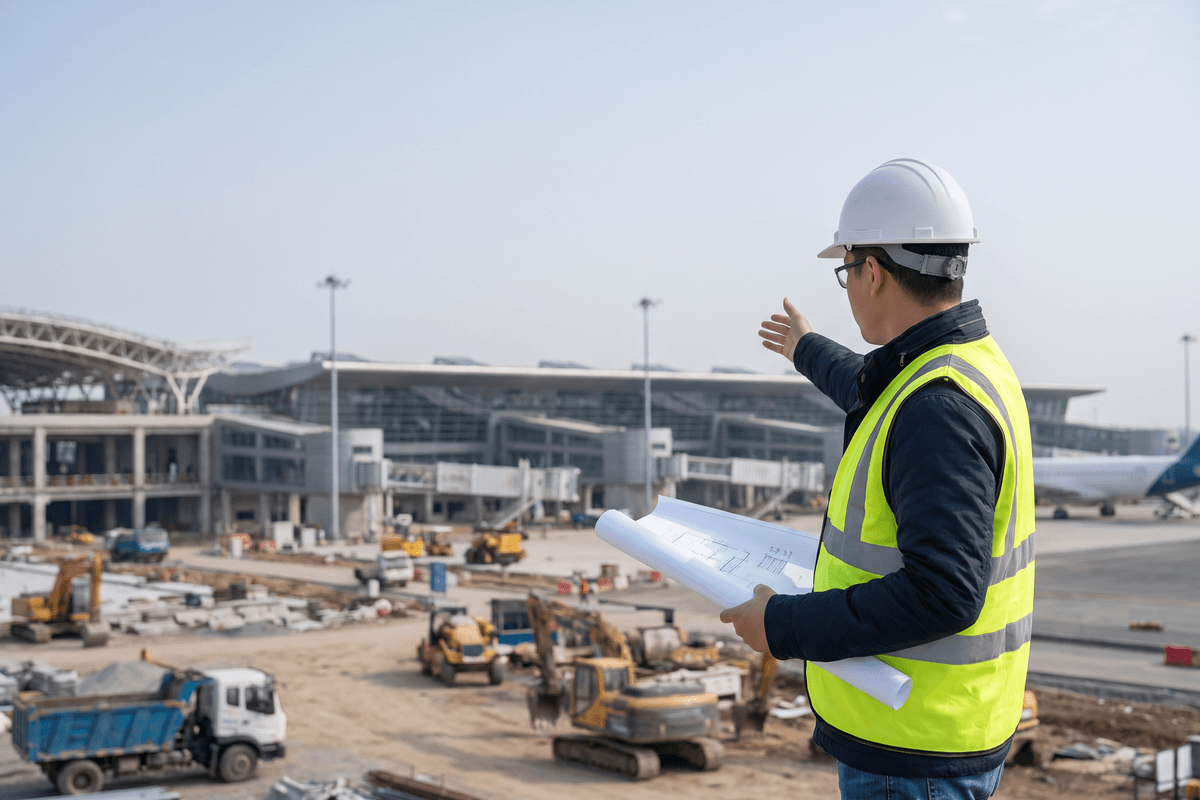



Executing a multibillion-dollar civil infrastructure program is an enormous undertaking under ideal conditions; doing so in the middle of an active hub processing upwards of 35 million passengers annually without disrupting a single flight operation borders on surgical precision. With the completion of its final concourse phase, the $5.1-billion Salt Lake City International Airport (SLC) Redevelopment Program officially marks the culmination of a decade-long masterclass in programmatic phasing, geotechnical innovation, and complex airfield logistics. The achievement provides civil engineers, program managers, and specialty trade contractors across the United States with an indispensable blueprint for brownfield asset renewal in high-consequence operational environments.
Across the country, the engineering discipline is confronting an unprecedented wave of modernization demands. From complex horizontal directional drilling (HDD) projects beneath major waterways to mass timber structural systems in high-tech laboratories, specialty contractors are being pushed to execute high-tolerance work within compressed spatial and temporal footprints. Examining the mechanical and logistical realities of the SLC buildout alongside recent breakthroughs profiled in ENR East's specialty contracting and megaproject showcase reveals how integrated digital delivery, rigorous subsurface engineering, and specialized trade execution are rewriting the standards for modern capital delivery.
The Phasing Equation: Rebuilding an Aviation Hub from the Inside Out
The core challenge of the SLC redevelopment was not simply structural or architectural; it was operational continuity. The original terminal complex, designed in the late 1970s for roughly half its eventual passenger throughput, required a complete ground-up replacement. Rather than executing piecemeal renovations, the Salt Lake City Department of Airports and its design-build partners opted for a clean-sheet dual-concourse design linked by an underground pedestrian conveyance tunnel, delivered across multiple distinct phases over ten years.
To sustain airline gate capacity and FAA-mandated airfield safety clearances, the project team implemented an intricate demolition-and-rebuild sequence. As new concourse segments (Concourses A and B) were commissioned, older finger concourses were systematically decommissioned, abated, and demolished within feet of active taxiways.
"Phasing a $5-billion airfield overhaul while managing 35 million annual passenger movements requires treating logistical sequencing as a first-order engineering discipline, equal in priority to structural design or foundation mechanics."
Geotechnical and Seismic Engineering in the Intermountain Basin
Situated in the Great Salt Lake Basin, the SLC site presented severe subsurface challenges. The soil stratigraphy consists of deep deposits of soft, compressible lacustrine clays, silts, and high groundwater tables, compounded by high seismic risk associated with the nearby Wasatch Fault Zone. Structural stability required an aggressive, site-wide ground improvement campaign:
- Stone Column Ground Improvement: Thousands of vibro-replacement stone columns were installed across the terminal and concourse footprint to mitigate liquefaction risk and increase bearing capacity.
- Deep Foundation Systems: Driven steel pipe piles and auger cast-in-place (ACIP) piles were anchored deep into stable strata to support the immense axial and lateral loads of the terminal's structural steel framing.
- Seismic Base Isolation and Expansion Joints: The structural envelope incorporates flexible expansion joints and specialized drift tolerances to accommodate inter-story displacement during potential seismic events without compromising life safety or building envelope integrity.
Subsurface Precision: Connecting Megaproject Civil Lessons Nationwide
The ground-level complexities mastered at Salt Lake City mirror a broader evolution in specialty civil and subterranean engineering across the United States. As highlighted in ENR East's review of leading specialty contractors, complex infrastructure execution is increasingly defined by how teams navigate severe environmental, geological, and spatial constraints.
A prime example is the recent execution of record-setting Horizontal Directional Drilling (HDD) operations, such as high-diameter utility crossings beneath the James River. Much like the precision underground tunneling at SLC, deep-bore utility installations demand real-time telemetry, advanced mud-recycling systems, and meticulous borehole stability management to avoid hydraulic fractures in sensitive aquatic ecosystems.
Comparing Complex Delivery Models Across Civil & Specialty Disciplines
To understand how specialty trades and prime contractors are managing risk across different asset classes, consider the structural and operational trade-offs across current infrastructure typologies:
| Infrastructure Discipline | Primary Engineering Constraint | Primary Technological Enabler | Operational Downtime Allowance |
|---|---|---|---|
| Aviation Hub Redevelopment (e.g., SLC) | Live airfield clearances, passenger flow, seismic foundation design | 4D BIM phasing, dynamic compaction, automated baggage tunnels | Zero (Continuous 24/7/365 operations) |
| Trenchless Marine Crossings (e.g., James River HDD) | Annular pressure spikes, mixed-face geology, drill string torque | Gyro-steering telemetry, high-capacity mud recycling units | Zero (Navigational channel must remain clear) |
| Advanced Structural (Mass Timber Lab Builds) | Vibration dampening, moisture management, MEP integration | Offsite CNC fabrication, multi-axis timber connectors, digital twin | Standard greenfield/brownfield building hours |
The Next Generation of Structural Framing: Mass Timber and Prefabrication
While aviation megaprojects like Salt Lake City deploy thousands of tons of structural steel and cast-in-place concrete to achieve massive clear-span concourses, the broader specialty contracting landscape is also witnessing an accelerating pivot toward alternative structural systems. In life sciences and higher-education research facilities across the Eastern Seaboard, mass timber is transitioning from boutique architectural showcase to mainstream structural solution.
Engineers are combining cross-laminated timber (CLT) panels and glued-laminated timber (glulam) frames with specialized concrete toppings to solve one of the most stubborn structural challenges in modern laboratory design: vibration control. High-sensitivity mass spectrometers and optical lithography equipment require strict vibration criterion (VC) curves. By utilizing composite timber-concrete floors, engineering teams achieve both the carbon sequestration advantages of mass timber and the stiffness and mass needed to dampen mechanical and footfall vibrations.
- Precision Offsite Fabrication: Multi-axis CNC milling allows structural timber members and mechanical service penetrations to be pre-cut with millimeter tolerances, slashing field labor requirements.
- Just-in-Time Site Logistics: Components arrive pre-sequenced, allowing small crane crews to erect floor plates in days rather than weeks, mirroring the tightly choreographed gate deliveries used on airfield projects.
- Embodied Carbon Reduction: Replacing conventional structural steel and cast concrete cores with certified engineered wood dramatically lowers the upfront carbon footprint of specialized industrial and research facilities.
Programmatic Takeaways for U.S. Engineering Leaders
The successful delivery of the $5.1-billion Salt Lake City hub and the high-tolerance civil executions emerging nationwide highlight several structural imperatives for engineering executives and project leaders:
1. Interface Management Over Contract Separation: On programs spanning 5 to 10 years, the friction between civil, structural, MEP, and specialty trade packages represents the largest single source of delay and cost growth. Early contractor involvement (ECI) and trade-led VDC coordination must be mandated before steel is ordered or earth is moved.
2. Subsurface Real-Time Monitoring: Whether driving displacement piles through soft silt or steering an HDD drill bit 100 feet beneath a riverbed, reliance on historic geotechnical boring data is insufficient. Acoustic telemetry, ground penetrating radar (GPR), and automated settlement sensors are now baseline prerequisites for de-risking subterranean operations.
3. Resilience as an Operational Asset: Infrastructure built in 2026 must be designed for extreme operating conditions. At SLC, that meant engineering for severe seismic events and extreme temperature deltas in the Intermountain West; for coastal and riverine civil projects, it means hardening against storm surges and rising water tables while meeting aggressive regional sustainability targets.
As the United States enters the next major cycle of public and private infrastructure reinvestment, the completion of Salt Lake City International Airport stands as definitive proof that complex, decadal megaprojects can be delivered without sacrificing operational uptime. For an engineering sector tasked with rebuilding America's most critical assets under full load, the playbook has officially been written.