
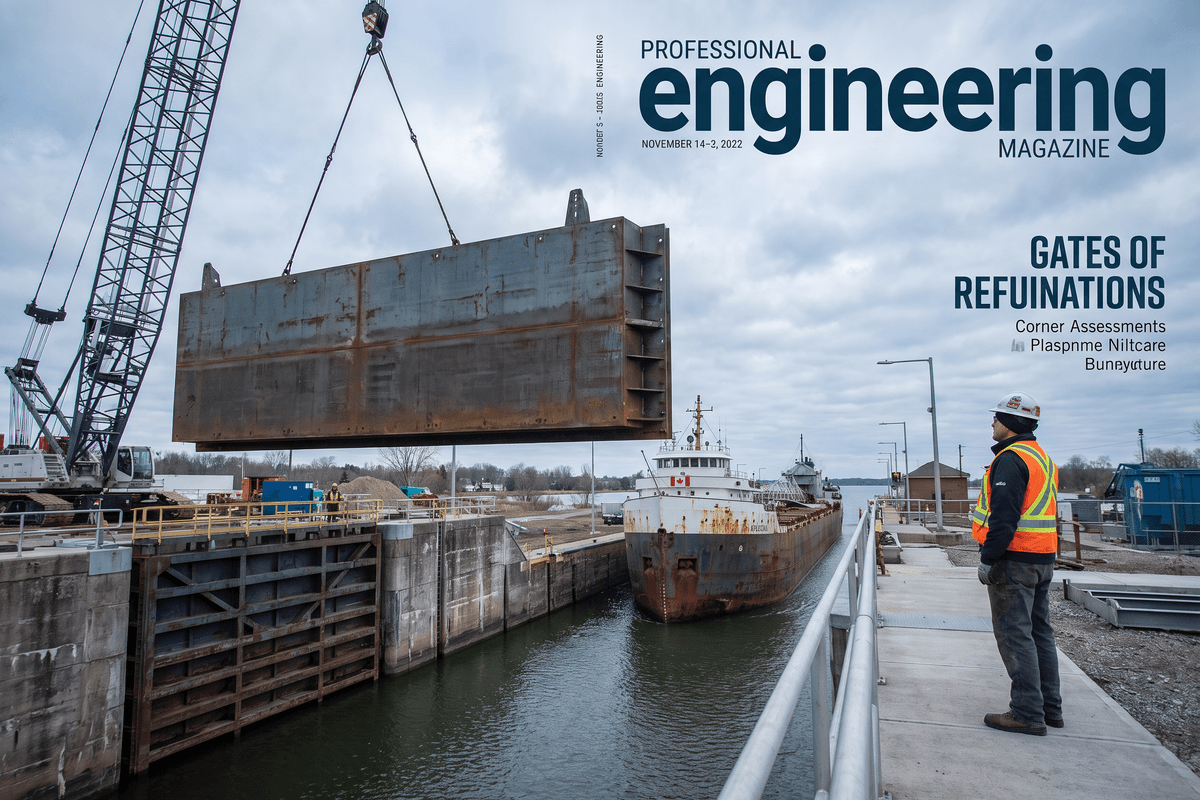

Few civil infrastructure assets in North America carry the strategic weight and acute single-point vulnerability of the St. Marys River lock system. For decades, the entire continental industrial supply chain—linking Canadian steelmakers in Hamilton and Sault Ste. Marie to Upper Great Lakes iron ore mines, grain terminals, and energy corridors—has rested on the shoulders of a single operational chamber: the 1,200-foot Poe Lock. That high-wire operational reality is now one decisive step closer to structural redundancy as the US$3.2-billion New Lock at the Soo modernization project officially crossed the 50 percent completion milestone.
For Canadian consulting engineers, heavy civil contractors, and marine infrastructure planners, the progression of this massive bi-national gateway offers a textbook masterclass in deep bedrock excavation, underwater mass concrete placement, and complex hydraulic modernization in extreme climatic conditions. More critically, it establishes a fortified backbone for the Great Lakes–St. Lawrence Seaway navigation corridor, directly safeguarding billions of dollars in annual Canadian manufacturing and resource trade.
The Architecture of Redundancy: Engineering the New Lock Chamber
The Soo Locks complex at Sault Ste. Marie connects Lake Superior to Lake Huron, overcoming a 21-foot elevation drop across the St. Marys Falls. While four U.S. locks historically occupied the footprint alongside the Canadian lock (which serves recreational and smaller commercial traffic), only the Poe Lock, completed in 1968, possesses the 1,200-foot length, 110-foot width, and 32-foot depth required to handle modern 1,000-foot "lakers" carrying up to 70,000 tonnes of taconite pellets and metallurgical coal per transit.
The New Lock project is engineered to build an exact twin of the Poe Lock within the footprint of the decommissioned, obsolete Davis (opened 1914) and Sabin (opened 1919) locks. This requires a three-phase civil mega-program managed by the U.S. Army Corps of Engineers (USACE) with substantial multi-disciplinary design and contracting interfaces:
- Phase 1 (Upstream Channel Deepening): Dredging and bedrock extraction across the upper approach channel to a consistent 30-foot navigation depth, completed in 2022.
- Phase 2 (Upstream Approach Walls Rehabilitation): Structural stabilization and reconstruction of historic approach walls using high-capacity post-tensioned rock anchors and underwater tremie concrete caps.
- Phase 3 (New Lock Chamber Construction): Demolition of legacy masonry and unreinforced concrete, followed by massive structural bedrock excavation, construction of new 1,200-foot monolithic concrete lock walls, miter gate fabrication, culvert hydraulic systems, and modern SCADA control infrastructure.
"Operating a critical continental supply chain with zero redundancy across a 21-foot elevation differential has represented North America’s most acute industrial risk. Reaching the halfway mark on the new chamber transitions this project from an emergency planning concept to an impending operational reality."
— Great Lakes Civil Infrastructure Review
Deep Geotechnical Challenges: Bedrock Excavation and Hydrostatic Control
Executing heavy civil blasting and bedrock excavation mere metres away from active, operating lock walls and high-head hydroelectric generating facilities represents an extreme engineering challenge. The local geology comprises Jacobsville Sandstone—a fractured, sedimentary bedrock characterized by variable compressive strengths, jointing, and high permeability under hydrostatic head.
1. Controlled Blasting and Vibration Isolation
Excavating down more than 50 feet into bedrock to reach design foundation grade for the new chamber invert required strict vibration limits (measured via multi-axis peak particle velocity monitors) to prevent structural damage or settlement to the adjacent MacArthur Lock and Poe Lock operating mechanisms. Engineers deployed pre-split line drilling, high-frequency non-electric detonators, and electronic delay timing to direct blast energy inward, away from critical surrounding assets.
2. Mass Concrete Mix Design and Thermal Stress Management
With hundreds of thousands of cubic metres of concrete required for the lock monoliths, thermal cracking during curing represented a primary failure mode. Project engineers utilized low-heat Portland cement formulations blended with high volumes of supplementary cementitious materials (slag cement and Class F fly ash), paired with aggregate pre-cooling and liquid nitrogen dosing during summer batching. During Northern Michigan/Northern Ontario winter regimes, extensive insulated formwork and hydronic curing blankets were mandated to sustain internal hydration temperatures above 10°C while preventing steep thermal gradients across the core and surface.
| Engineering Parameter | Poe Lock (Existing Linchpin) | New Soo Lock (Under Construction) | Operational / Strategic Advantage |
|---|---|---|---|
| Chamber Dimensions | 1,200 ft × 110 ft × 32 ft | 1,200 ft × 110 ft × 32 ft | Full 1:1 operational redundancy for 1,000-ft lakers |
| Hydraulic Filling System | Bottom longitudinal culverts with butterfly valves | Optimized high-efficiency culverts & dual-redundant reverse tainter valves | Reduced turbulence, shorter fill/empty cycle times, lower surge forces |
| Gate Mechanism | Electro-mechanical miter gates (1960s legacy) | High-strength structural steel miter gates with advanced hydraulic actuators | Enhanced fatigue resistance, real-time stress telemetry, automated seating |
| Structural Monitoring | Periodic manual survey & piezometers | Embedded fiber-optic strain gauges & automated vibrating-wire piezometers | Real-time digital twin integration for structural health monitoring |
| Estimated Project Cost | ~$40M (1968 actuals) | US$3.2 Billion (Phase 1–3 Total) | Modern seismic, environmental, and longevity design life (50+ years) |
The Strategic Economic Reality for Canadian Heavy Industry
While situated on the U.S. side of the border, the Soo Locks are intimately bound to the Canadian economy. The St. Marys River is the central valve of the Great Lakes shipping network, carrying roughly 80 million tonnes of raw materials each year. Canadian heavy industry is uniquely dependent on this single passage:
- Ontario Steel Production: Primary blast furnaces operated by Algoma Steel in Sault Ste. Marie, and ArcelorMittal Dofasco and Stelco in Hamilton, rely extensively on Minnesota iron ore pellets shipped through the locks. A multi-week closure of the Poe Lock without a twin would halt primary raw material deliveries, cascading into automotive and construction supply chains within weeks.
- Western Grain Export Corridors: Prairie wheat and canola moved by rail to terminals in Thunder Bay, Ontario, pass through the Soo Locks aboard Canadian-flagged bulk carriers bound for Quebec transfer ports and international ocean vessels.
- Critical Minerals and Green Transformation: As Canadian industry scales its electric-arc furnace (EAF) and direct-reduced iron (DRI) production capabilities, bulk movements of scrap, DRI pellets, and regional limestone flux remain dependent on high-volume maritime transport, which operates at an 80% lower greenhouse gas emission profile per tonne-kilometre compared to diesel rail freight.
Lessons for Canadian Waterway and Marine Civil Projects
The engineering methodologies proven during the first 50 percent of the Soo Lock modernization carry direct applications for major Canadian public works, particularly upcoming renewals across the Welland Canal, the St. Lawrence Seaway lock systems, and coastal port expansion programs in Prince Rupert and Montreal:
1. Dynamic Digital Twin Modeling for High-Head Hydraulics
Modern lock design requires precision fluid dynamic modeling to minimize hawser forces on vessels during rapid filling and emptying cycles. The New Lock utilizes CFD (computational fluid dynamics) verified by physical 1:25 scale hydraulic models to optimize culvert intake geometry, dissipating energy and preventing boundary layer cavitation—a core engineering standard being adopted in Canadian hydraulic infrastructure refurbishments.
2. Embedded Structural Health Telemetry
Rather than relying on retroactive non-destructive testing (NDT), the new monolithic walls incorporate dense arrays of fiber-optic distributed strain and temperature sensors directly into the rebar cages. This allows engineers to track internal hydration, long-term freeze-thaw degradation, and shear stress across rock anchor interfaces in real time throughout its 50-year design life.
3. Phased Cross-Border Contracting and Supply Chains
The mega-project highlights the depth of cross-border procurement, from Canadian structural steel fabricators and aggregate producers to specialized marine tunneling and diving contractors operating in cold-water environments. The technical milestone achieved at Sault Ste. Marie underscores how complex infrastructure requires agile program management to absorb macroeconomic inflation, supply-chain bottlenecks, and harsh seasonal operational windows.
Looking Forward: The Final Run to 2030
With 50 percent of the engineering and construction scope now executed, focus shifts to the installation of massive structural miter gates, electrical sub-stations, automated hydraulic control rooms, and downstream wall tie-ins. The expected commissioning target toward the end of the decade will mark the definitive closure of one of North America's most hazardous supply chain vulnerabilities.
For Canada's engineering community, the New Lock at the Soo stands as a towering benchmark of cold-region heavy civil execution. By locking in logistical reliability across the Upper Great Lakes, this multi-billion-dollar project provides the structural certainty needed to anchor Canada's industrial, metallurgical, and transport engineering sectors for the next half-century.