
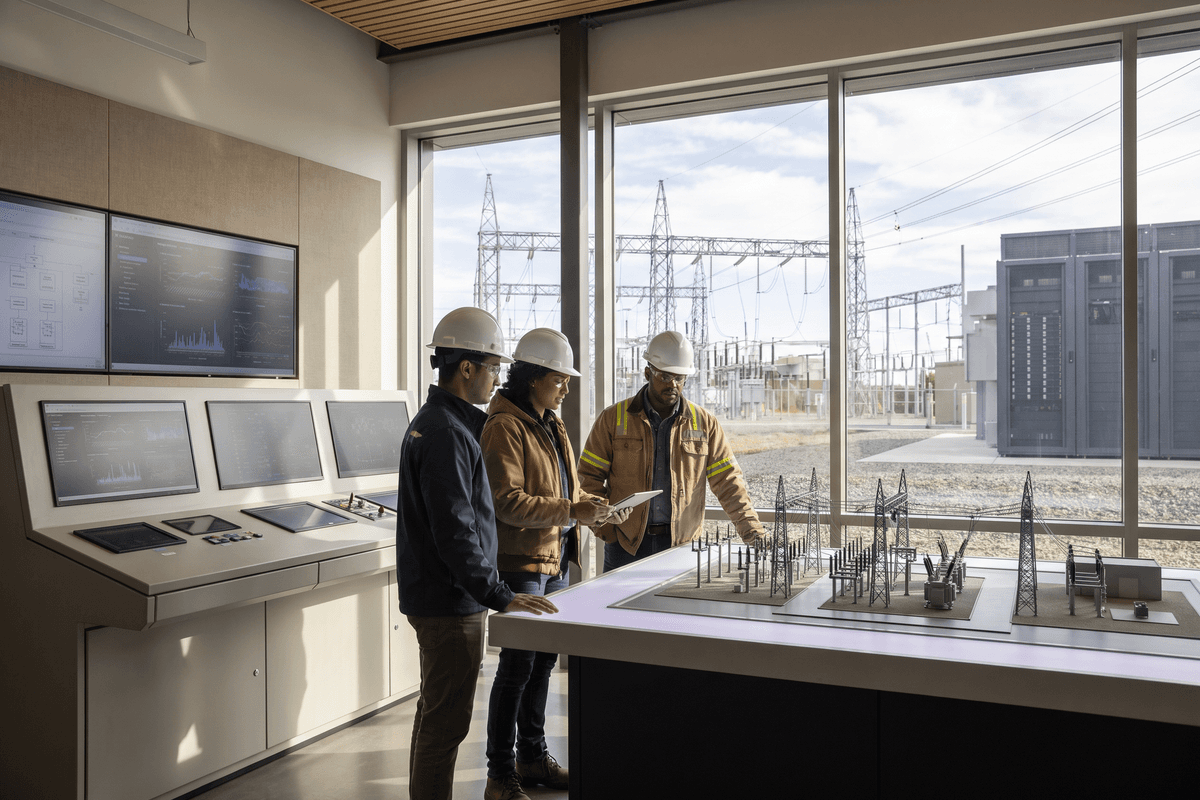



The United States is entering the most capital-intensive electrical infrastructure expansion since the post-war grid buildout. Driven by the unrelenting compute demands of artificial intelligence clusters and hyperscale cloud architecture, North American data center infrastructure plans have surpassed an astonishing $5 trillion in cumulative project value. For power systems engineers, utility executives, and engineering, procurement, and construction (EPC) leaders, this tidal wave of capital represents both an unprecedented commercial opportunity and a severe technical stress test. The timeline required to erect a 100-megawatt compute warehouse—often 18 to 24 months—is colliding directly with the three-to-seven-year lifecycles required to engineer, permit, and energize high-voltage utility interconnects and substation assets.
This structural misalignment is forcing a fundamental paradigm shift in how capital projects are engineered, contracted, and powered across North America. As utilities race to scale generation and transmission capacity to meet once-in-a-generation load requirements, the entire heavy engineering and construction ecosystem is recalibrating around power availability, advanced materials, and specialized technical labor.
The Backlog Anchor: Hyperscale Projects Offset Commercial Cooling
The macroeconomic impact of this power-centric infrastructure boom is already visible in broader industry metrics. While commercial real estate sectors such as office construction and discretionary commercial retail experience headwinds driven by financing costs, hyperscale digital infrastructure has stepped in as the primary shock absorber for the U.S. construction industry.
Data from the Associated Builders and Contractors reveals that national construction backlog rebounded in August, bolstered significantly by the fact that roughly one in six contractors is now actively engaged on data center projects. This concentration of engineering and trades talent reflects an aggressive migration of resources toward mission-critical infrastructure.
"The sheer volume of hyperscale power demands has effectively insulated industrial and electrical contractors from broader economic drag, pivoting the entire sector toward high-density power delivery, substation engineering, and thermal management systems."
The scale of work required on these facilities diverges sharply from conventional commercial engineering. A single modern AI training cluster requires electrical distribution densities, emergency backup generation, liquid cooling loops, and switchgear arrays that resemble industrial process plants rather than traditional commercial real estate.
| Engineering Parameter | Standard Commercial Facility | Hyperscale AI Data Center | Grid & Engineering Impact |
|---|---|---|---|
| Power Density | 5 – 10 W / sq. ft. | 100 – 1,000+ W / sq. ft. | Demands direct high-voltage interconnects (138kV–500kV) and dedicated substation assets. |
| Thermal Management | Standard DX Rooftop Units / CAV | Direct-to-Chip Liquid Cooling & Closed-Loop Chilled Water | Requires complex MEP process piping, corrosion inhibitors, and high pumping power loads. |
| Redundancy Architecture | N (Utility Feed Only) | 2N / N+1 with BESS, Microturbines, & Fast-Start GenSets | Spurs massive demand for battery storage integration and dual-feed switchgear engineering. |
| Lead Times for Primary Gear | 12 – 24 weeks | 80 – 140+ weeks (Power Transformers & Breakers) | Mandates programmatic procurement and design-around-availability engineering strategies. |
The Generation Gap: Solving the Interconnection Bottleneck
The primary barrier to executing this $5 trillion project pipeline is no longer capital availability or compute hardware allocation; it is the physical capacity of the electrical grid. In key regional hubs across Northern Virginia, the Midwest, Texas, and the Pacific Northwest, Regional Transmission Organizations (RTOs) and vertically integrated utilities are facing multi-gigawatt interconnection queues that stretch well into the 2030s.
To navigate these structural bottlenecks, engineering firms and hyperscalers are deploying alternative generation and co-location strategies:
- Behind-the-Meter (BTM) Generation: Engineering on-site reciprocating natural gas engines, aeroderivative gas turbines, and small modular reactor (SMR) pilots directly adjacent to data halls to bypass transmission queues.
- Hybrid Microgrids and BESS: Integrating utility-scale battery energy storage systems (BESS) to perform peak-shaving, load-smoothing, and provide instantaneous frequency response during transient computational load spikes.
- Grid-Enhancing Technologies (GETs): Deploying dynamic line rating (DLR) sensors, advanced power flow control hardware, and topology optimization software to extract an additional 15% to 30% of transmission capacity out of existing right-of-way corridors.
The Upstream Pipeline: Semiconductor Tooling and Academic Infrastructure
The physical expansion of data centers represents only the downstream manifestation of a broader, national technological push. To sustain this trajectory, the United States is rapidly constructing the domestic upstream supply chain—from advanced semiconductor packaging to advanced power engineering and chemical process optimization.
Addressing the acute shortage of specialized engineers required to fabricate the silicon powering these facilities, leading academic institutions are mobilizing cross-state technical partnerships. In the Midwest manufacturing corridor, Purdue University and the University of Illinois Urbana-Champaign launched a joint semiconductor workforce development initiative. By integrating curriculum, microelectronics cleanroom access, and direct industry pipelines, the partnership directly targets the projected deficits in microelectronics packaging, chip fabrication, and power semiconductor engineering.
Concurrently, the energy, advanced materials, and chemical processes underpinning grid infrastructure are receiving historic physical investments. In Texas, the University of Texas at Austin marked the opening of the 207,000-square-foot Autry C. Stephens Engineering Discovery Building, culminating an $820 million overhaul of the Cockrell School of Engineering’s physical footprint. Designed to bridge petroleum, chemical, and materials research with industry deployment, the facility directly supports advanced energy engineering, thermal dielectric fluids development, and grid-scale materials science required for next-generation baseload power systems.
Strategic Implications for Engineering and Utility Leadership
As the $5 trillion pipeline advances from planning boardrooms into the field, engineering and utility leaders must adapt their delivery playbooks to navigate extreme equipment lead times, talent constraints, and technical complexity.
- Early-Engagement EPC Models: Fixed-price, design-bid-build delivery models are increasingly unviable for high-voltage and hyperscale facilities due to fluctuating component availability. Progressive design-build (PDB) and integrated project delivery (IPD) frameworks allow engineers to lock in long-lead procurement—such as large power transformers (LPTs) and high-voltage breakers—early in the conceptual design phase.
- Standardized Substation and Data Hall Modularization: Engineering firms are shifting from bespoke facility layouts to standardized, factory-fabricated electrical skids, modular substation control houses, and packaged liquid-to-air cooling plants. This modularization compresses on-site craft labor hours and accelerates commissioning schedules.
- Cross-Disciplinary Power-to-Silicon Systems Engineering: Modern infrastructure requires systems engineers who understand the entire digital-to-physical loop—from the compute load transients of a GPU cluster to the harmonic distortion and reactive power dynamics introduced onto the transmission grid.
The road ahead will test the technical agility of America's engineering ecosystem. Meeting the sheer scale of the AI infrastructure mandate requires more than just capital deployment; it requires a coordinated, interdisciplinary effort uniting utility grid modernizers, heavy civil constructors, academic research centers, and upstream semiconductor innovators. The firms that master this end-to-end integration will not only capitalize on an unprecedented $5 trillion market cycle—they will build the technical backbone that powers the next century of industrial growth.