
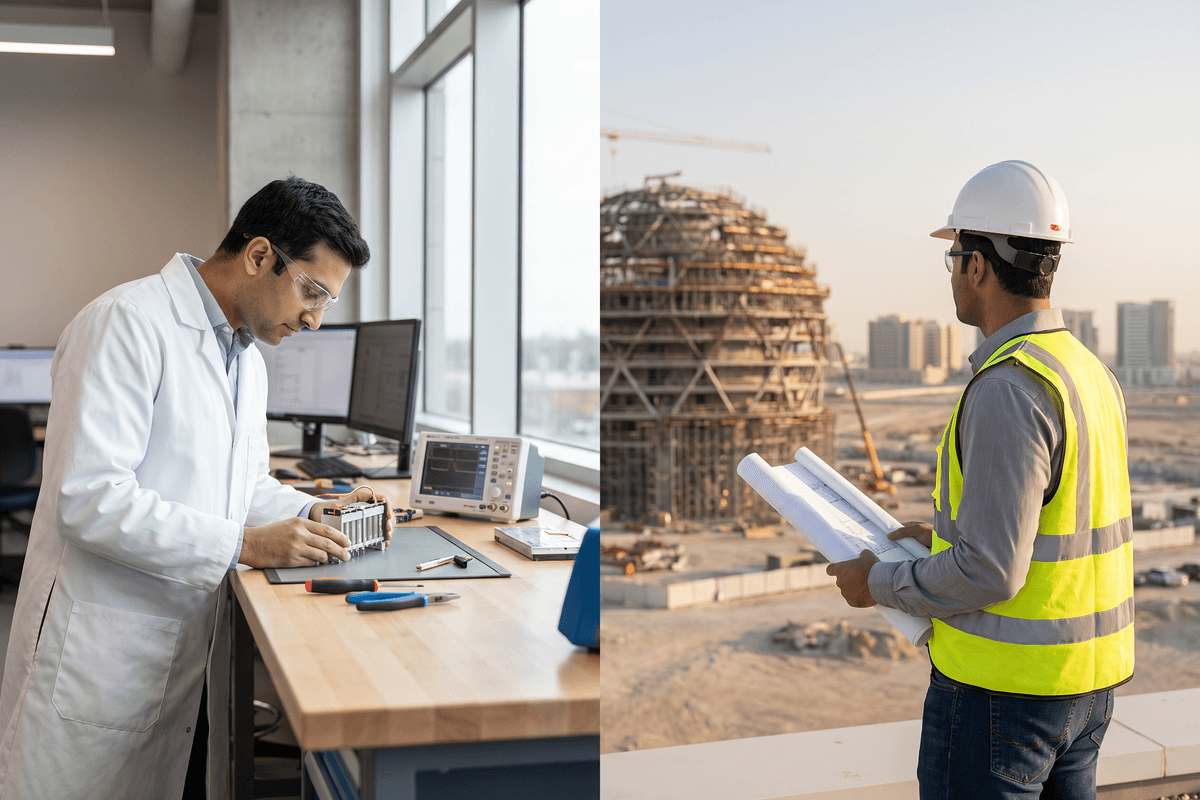

In the span of a single week, the trajectory of Canadian engineering was perfectly encapsulated by two distinct, yet fundamentally connected, developments. In southwestern Ontario, a legacy automotive partnership doubled down on the microscopic intricacies of battery cell chemistry. Halfway across the world in the United Arab Emirates, a Canadian engineering giant was tapped to oversee the structural and acoustic behemoth that will be the Abu Dhabi Sphere. Together, these projects illustrate the modern dual mandate of Canada's engineering sector: anchoring deep-tech intellectual property at home while exporting elite, macro-scale systems integration to the global market.
For engineering professionals, this divergence is more than just industry news. It represents a fundamental restructuring of the talent market, demanding a hybrid workforce capable of navigating both the hyper-specialized world of materials science and the sprawling complexities of international megaprojects.
The Domestic Anchor: Windsor's Evolution from Assembly to IP Generation
The foundation of Canada's industrial engineering sector has long been tied to automotive manufacturing. But as the industry transitions to electrification, the value chain has shifted from assembly to chemical and thermal engineering. This shift was cemented this week as Stellantis Canada and the University of Windsor celebrated the 30th anniversary of their Automotive Research and Development Centre (ARDC) by spotlighting a cutting-edge new battery technology centre.
The ARDC has historically been a proving ground for automotive structural testing and lighting. However, the integration of a dedicated battery centre transforms the facility into a critical node for North American electric vehicle (EV) development. This is not merely an academic exercise; it is a strategic maneuver to keep high-value engineering jobs within Canadian borders.
The Engineering Implications of the Battery Centre
For chemical, electrical, and materials engineers, the ARDC expansion signals a long-term commitment to domestic R&D. The challenges being tackled in Windsor are among the most complex in modern engineering:
- Thermal Management: Designing pack-level cooling systems that can withstand extreme Canadian winters and high-demand fast charging without risking thermal runaway.
- Cell Chemistry Optimization: Iterating on solid-state and advanced lithium-ion formulations to increase energy density while reducing reliance on volatile supply chains for rare earth metals.
- Lifecycle Engineering: Developing protocols for battery second-life applications and recycling, a growing sub-discipline driven by impending North American environmental regulations.
"The transition from internal combustion to electrification isn't just a change in propulsion; it's a complete rewiring of the engineering skill set required to bring a vehicle to market. Facilities like the ARDC ensure that the IP generation—not just the final assembly—happens in Canada."
Furthermore, the ongoing partnership with the University of Windsor ensures a localized talent pipeline, allowing students to transition seamlessly from academic theory to applied, industry-funded research. This closed-loop ecosystem is essential for retaining top-tier engineering talent that might otherwise migrate to Silicon Valley or Detroit.
The Global Export: AtkinsRéalis and the Abu Dhabi Sphere
While Stellantis focuses on the microscopic scale of battery cells in Ontario, Montreal-based AtkinsRéalis is operating on a radically different scale. The firm was recently confirmed as the lead design and supervision consultant for the new Sphere venue in Abu Dhabi. Following the viral success of the MSG Sphere in Las Vegas, the Abu Dhabi iteration presents a unique set of engineering hurdles that will test the limits of structural and environmental design.
Winning the lead role on a project of this magnitude underscores the global cachet of Canadian engineering firms in managing complex, multi-disciplinary megaprojects. It is a testament to the sector's ability to export high-level project management, structural innovation, and acoustic engineering.
Engineering the Desert Megasphere
Exporting Canadian engineering expertise to the Middle East is not new, but the Sphere represents a generational challenge. AtkinsRéalis engineers will be tasked with solving several critical bottlenecks:
- Extreme Thermal Dynamics: The exterior of the Sphere will be clad in acres of LED screens. Operating this massive heat-generating electronic array in the extreme ambient temperatures of the UAE desert requires unprecedented HVAC and passive cooling innovations.
- Acoustic Geometry: The internal volume of a spherical venue is notoriously hostile to high-fidelity audio. The structural design must perfectly integrate with advanced acoustic dampening materials to prevent devastating echo and reverb.
- Exoskeletal Load Bearing: Supporting the sheer weight of the external screens while maintaining an uninterrupted internal cavern requires advanced parametric modeling and high-tensile structural steel engineering.
The Talent Equation: Two Distinct Profiles
For engineering professionals and project managers, these two developments highlight a bifurcation in the Canadian talent market. The skills required to excel in domestic deep-tech R&D are vastly different from those needed to manage global megaprojects. Understanding this divide is crucial for career trajectory planning.
| Sector Focus | Core Engineering Disciplines | Primary Technical Challenge | Strategic Value to Canada |
|---|---|---|---|
| Domestic Deep-Tech (e.g., ARDC Battery Centre) | Chemical, Electrical, Materials Science, Mechatronics | Micro-scale optimization, thermal management, rapid prototyping | Retaining Intellectual Property (IP) and advanced manufacturing capabilities |
| Global Megaprojects (e.g., Abu Dhabi Sphere) | Structural, Civil, Mechanical (HVAC), Systems Integration | Macro-scale load bearing, extreme climate adaptation, logistics | Exporting high-margin consulting services and global brand prestige |
Engineers entering the workforce today must decide which side of this dual engine they wish to power. The R&D track offers stability, deep specialization, and the chance to solve foundational scientific problems. The global megaproject track offers high-stakes project management, international exposure, and the challenge of integrating complex systems on a massive scale.
Conclusion: A Balanced Portfolio for the Future
As we look toward the end of the 2020s, the health of Canada's engineering sector will be defined by its ability to sustain this dual engine. The Stellantis battery centre in Windsor proves that we can build the localized infrastructure necessary to generate the technologies of tomorrow. Simultaneously, AtkinsRéalis's triumph in Abu Dhabi demonstrates that Canadian firms remain apex competitors on the global stage.
For the Canadian engineering professional, the message is clear: whether you are optimizing the thermal threshold of a lithium-ion cell in an Ontario lab, or calculating the wind-load on an LED exoskeleton in the Arabian desert, the demand for Canadian expertise has never been more robust, or more diverse.