


If you paused your ESG compliance planning at any point in the last eighteen months because it felt like the ground kept moving, you weren't imagining it. It genuinely did — and it moved again, significantly, in March 2026.
The EU's Omnibus I Directive entered into force on 18 March 2026, and it is, without much competition, the biggest single change to the Corporate Sustainability Reporting Directive since CSRD was introduced. If your understanding of CSRD is even a year old, it's worth a five-minute rebuild, because several of the assumptions that shaped SME planning around it no longer hold.
What actually changed
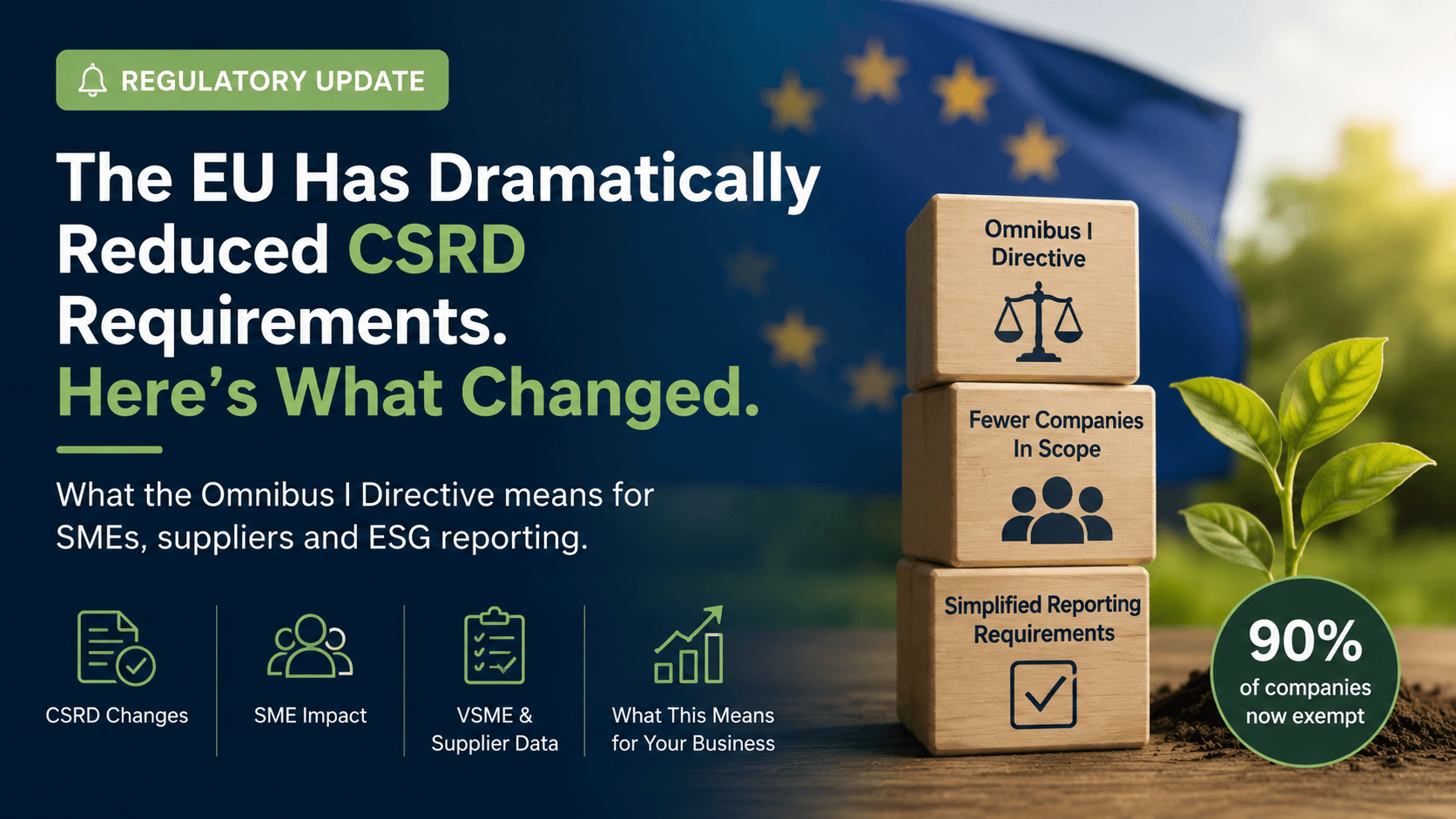
The scope threshold for mandatory CSRD reporting jumped from roughly 250 employees and €50 million turnover to more than 1,000 employees and more than €450 million net turnover — both conditions now required, not either. The practical effect: an estimated 90% of the companies originally expected to fall into scope are now exempt. Listed SMEs specifically, who were due to be pulled in from financial year 2028 under the original "Wave 3" timeline, are now fully out of scope.
The reporting burden itself has also been cut sharply. The Commission has asked EFRAG to simplify the ESRS by reducing mandatory datapoints by around 70%, with the revised standards expected later in 2026.
Why this doesn't mean "stand down"
Here's where a lot of business owners will get the wrong takeaway. The legal obligation has genuinely retreated. The commercial pressure hasn't gone anywhere.
Large companies that remain in scope for CSRD still need supplier data to compile their own reports — and they're increasingly using the Voluntary SME Standard (VSME) as the common template for asking for it. So the practical experience for a supplier with, say, 80 employees hasn't really changed: you're still going to get a questionnaire from a large customer's procurement or sustainability team. What's changed is the legal footing underneath it — it's now a commercial ask rather than a statutory one, which is actually a meaningfully different negotiating position.
There's a genuinely useful protection buried in the detail too: companies with 1,000 or fewer employees can lawfully decline to supply data beyond what the finalised VSME standard requires, even when a large customer asks for more. Knowing that line exists — and where it sits — is worth more to most SME finance teams than knowing the full ESRS taxonomy ever was.
A decision framework, not a default answer
The honest advice for most SMEs right now isn't "you're exempt, do nothing" or "prepare for everything." It's four questions, worked through in order:

Work through these in order. If the answer to question two is yes, or question four is yes, that's your prioritisation signal — not the regulatory calendar.
Where this fits into a bigger picture
This kind of regulatory whiplash is exactly why I built a dedicated, dated section into Turning ESG into Performance: KPIs That Drive Strategy — covering the current position on ISSB, UK SRS and the Omnibus reforms, together with the practical decision frameworks needed as regulation continues to evolve. Regulation in this space is still moving quickly even as you read this, so the session is built to give you the current picture plus the judgement framework to keep making good calls as it continues to shift.
About the author: Karen Mustard is a management accounting specialist with particular expertise in performance management, sustainability, and ESG reporting. She is ESG Institute-certified in ESG reporting and the author of Sustainability: Cost or Profit Generator? Through her writing, training, and professional development courses, Karen helps accountants and business leaders translate complex ESG concepts into practical strategies that improve organisational performance and support informed decision-making.
Watch the full webinar: Turning ESG into Performance: KPIs That Drive Strategy — available now on LearnFormula.