
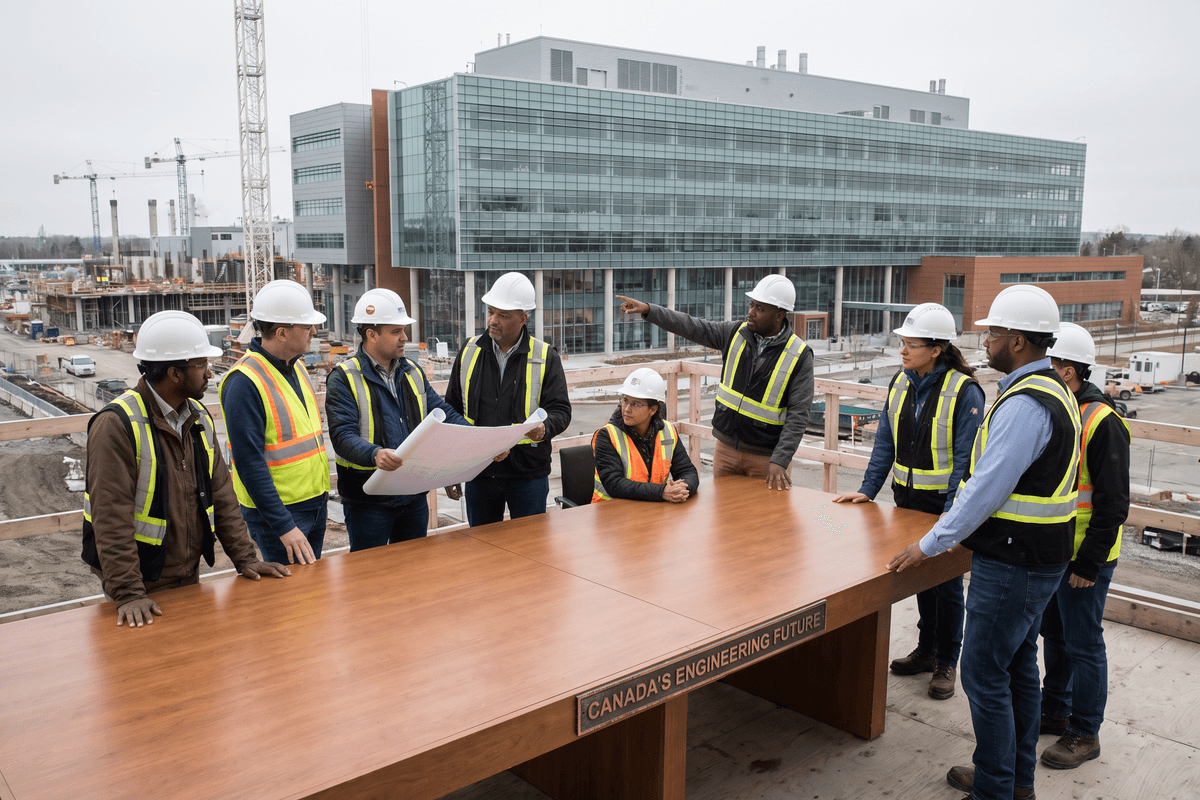

Canada’s industrial and infrastructure landscape is undergoing a decisive shift from strategic conceptualization to physical groundbreaking. For years, domestic engineering consultancies and project owners navigated feasibility assessments, regulatory gating, and preliminary front-end engineering design (FEED). Now, the floodgates of capital deployment are opening. The convergence of multi-billion-dollar clean energy portfolios, national critical mineral corridors, specialized federal science facilities, and institutional workforce hubs is putting unprecedented pressure on Canada’s technical execution capacity.
Between the comprehensive pipeline unveiled at the Canada Investment Summit 2026 and a sharp uptick in public sector capital awards across central and western Canada, engineering firms are facing a high-stakes operational reality. Delivering this unprecedented volume of work demands not just balance-sheet resilience, but advanced systems engineering, modular fabrication mastery, and a modernized domestic talent engine.
The FEED-to-Execution Crucible: Navigating the 2026 Megaproject Slate
The 50 major capital ventures spotlighted at the Canada Investment Summit 2026 reveal where the country’s industrial baseline is anchoring over the next two decades. Far from generic real estate or standard highway expansions, the pipeline is heavily concentrated in high-complexity sectors: commercial-scale green hydrogen and synthetic fuels, closed-loop critical mineral extraction and refining, deep-grid interconnection corridors, and automated multimodal logistics.
For engineering, procurement, and construction management (EPCM) leaders, projects transitioning from FEED to detailed design carry distinct operational challenges:
- Process Engineering Scalability: Novel metallurgical and electrochemical process flowsheets—particularly in battery-grade lithium, nickel refining, and low-carbon ammonia—are moving from pilot demonstration plants to full commercial footprints, requiring rigorous process safety management (PSM) and reliability engineering.
- Extreme-Climate Resiliency: Northern critical mineral deposits demand specialized geotechnical foundations, permafrost thermal monitoring, and self-contained microgrid engineering to ensure continuous uptime under harsh environmental stresses.
- Interconnection and Balance-of-Plant Complexity: With clean industrial power demands accelerating, industrial projects require specialized high-voltage substation design, HVDC converter engineering, and dynamic load-balancing systems to integrate with regional electrical grids.
"The transition of 50 flagship capital projects from the drawing board to detailed site engineering signals a structural pivot in Canadian engineering: success will no longer be measured by feasibility modeling, but by schedule certainty, procurement agility, and technical constructability in constrained labor markets."
Federal Momentum: Ottawa's High-Spec Infrastructure Surge
While industrial megaprojects capture national attention, public sector procurement is simultaneously setting historic benchmarks in structural, environmental, and specialized facility engineering. In the National Capital Region, institutional procurement reached an unprecedented crest this month, as detailed in recent reporting on the Ottawa construction contract surge in September 2026.
Central to this wave is a monumental $768.6-million contract for the TerraCanada National Capital Area science hub. Facilities of this nature represent the pinnacle of multidisciplinary building engineering. They require ultra-low-vibration baseline structures, biocontainment and radiological safety envelopes, high-efficiency particulate air filtration systems, and bespoke laboratory architectural engineering. Consulting engineers must reconcile strict carbon-neutral operational mandates with intense plug-load and process cooling requirements.
Simultaneously, the award of $78 million in engineering and preliminary works for the historic Alexandra Bridge replacement highlights the surging demand for heavy civil, heritage-integrated, and structural transportation engineering. The project requires complex hydrological modeling, dynamic river-ice load mitigation, and active transportation corridor planning across the Ottawa River—a testament to the technical balancing act between long-term durability and sensitive urban integration.
The Human Capital Engine: NAIT's $779-Million Advanced Skills Facility
Engineering plans and multi-billion-dollar backlogs are only as viable as the physical capacity to execute them. As advanced manufacturing, automated systems, and high-spec trades face mounting national shortages, institutional infrastructure is stepping in to close the capability gap.
In Edmonton, groundbreaking has commenced on the landmark NAIT $779-million Advanced Skills Centre. Designed to train thousands of skilled technologists, instrumentation specialists, and advanced trades professionals annually, this project represents one of the largest single workforce infrastructure investments in Canadian history.
From an engineering perspective, the NAIT facility is itself a showcase of high-performance educational and light-industrial design:
- Advanced Process and Mechanical Labs: Incorporating real-world automated process lines, high-voltage electrical training bays, and modular industrial simulation bays that mirror state-of-the-art industrial job sites.
- Sustainable Structural Design: Integrating mass-timber elements, low-carbon concrete mixes, and high-efficiency building envelopes to meet aggressive institutional net-zero targets.
- Digital Twin Integration: Deploying building information modeling (BIM) throughout the design-build lifecycle to serve as an operational digital twin for ongoing facilities management and academic study.
This facility addresses the sharpest bottleneck in Canadian engineering execution: the shortage of technical field personnel capable of interpreting advanced digital models, commissioning intricate instrumentation loops, and maintaining automated industrial hardware.
Strategic Comparison: Key Pillars of Canada's 2026 Engineering Buildout
To contextualize the technical challenges facing Canadian practitioners across these major capital initiatives, the table below outlines core disciplines, technical bottlenecks, and project delivery models across the primary sectors:
| Project Vector | Key Projects & Venues | Primary Engineering Disciplines | Critical Technical Hurdle | Dominant Delivery Model |
|---|---|---|---|---|
| National Clean Megaprojects | 50 Flagship Projects (Canada Investment Summit) | Chemical, Metallurgical, High-Voltage Electrical, Geotechnical | Scale-up of novel processes; remote-site cold-weather logistics | EPCM / Progressive Design-Build |
| Federal Science & Labs | $768.6M TerraCanada Science Hub (Ottawa) | Building Services (HVAC/MEP), Acoustic, Structural, Environmental | Vibration isolation; strict containment and net-zero alignment | Integrated Project Delivery (IPD) / Public-Private Partnership |
| Civil & Transport Infrastructure | $78M Alexandra Bridge Replacement Works | Civil, Heavy Structural, Hydrotechnical, Urban Transportation | River-ice hydrodynamic loading; heritage interface management | Design-Build / Construction Management at Risk |
| Advanced Technical Facilities | $779M NAIT Advanced Skills Centre (Edmonton) | Architectural Engineering, Mechanical, Electrical, Automation | High dynamic equipment loads; reconfigurable modular lab spaces | Progressive Design-Build / CM |
Strategic Implications for Engineering Leadership
For Canadian consulting engineering practices, contractors, and asset owners, navigating this simultaneous wave of industrial and institutional capital requires immediate strategic adjustments:
1. Decoupling Execution from Local Talent Constraints: With top-tier civil and process engineers stretched across concurrent multi-hundred-million-dollar programs, firms must master distributed global design workflows while maintaining clear Responsible Member and Engineer of Record (EOR) accountability under provincial professional engineering regulators.
2. Standardizing Modular and Off-Site Construction: Whether designing clean energy plants in remote northern corridors or laboratory modules for public research facilities in urban centers, engineering for off-site fabrication and modular pre-assembly (DfMA) is transitioning from a cost-saving preference to an operational necessity.
3. Strengthening Collaborative Contracting Muscle: The sheer scale of projects like the TerraCanada hub and multi-billion-dollar clean tech facilities is accelerating the move away from traditional fixed-price, adversarial tendering toward collaborative models like Integrated Project Delivery (IPD), Progressive Design-Build, and Early Contractor Involvement (ECI). Engineering leaders must adapt risk matrices and commercial structures accordingly.
As 2026 progresses, Canada’s engineering sector sits at the heart of the country's economic and technological transformation. By aligning deep technical rigor with modern procurement strategies and dedicated investments in human capital, the profession is setting the structural foundation for decades of resilient, clean growth.