
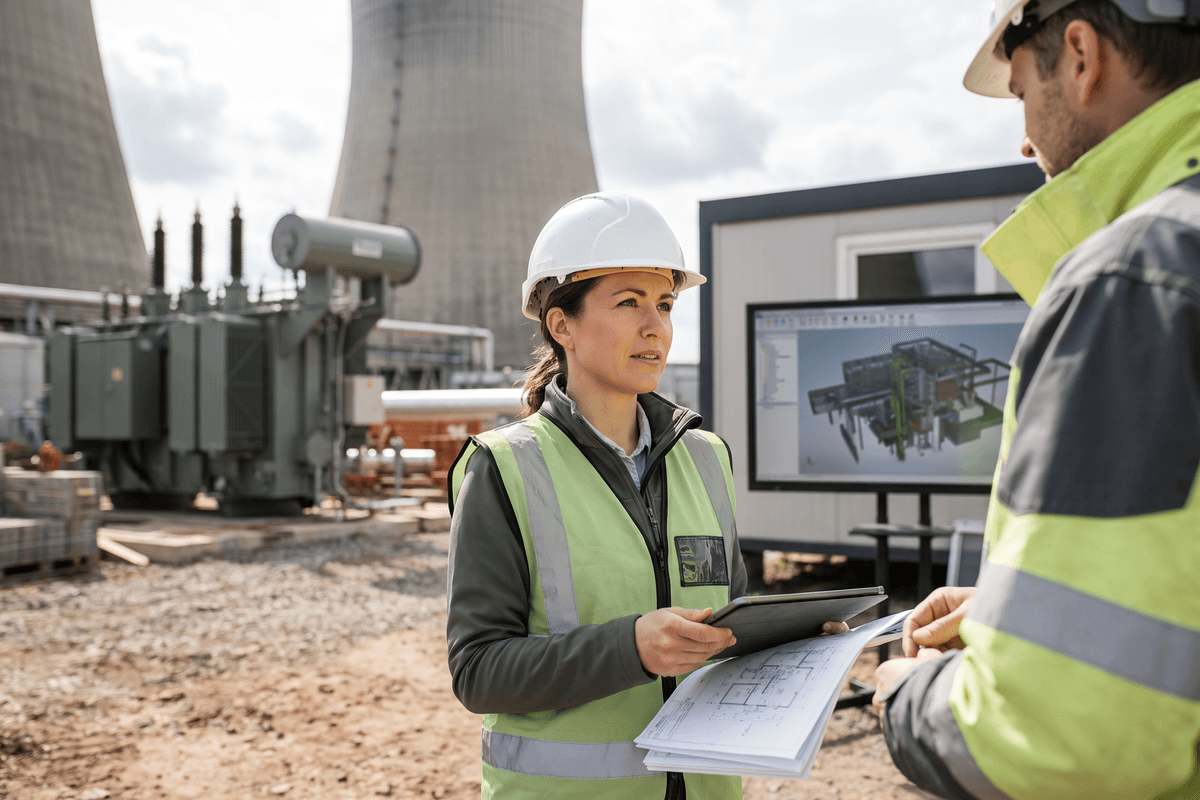



When heavy earthmoving equipment and specialised engineering crews mobilise on a multi-gigawatt nuclear asset, it signals more than just a scheduled lifecycle overhaul—it marks an inflection point for a nation's entire technical apparatus. The formal commencement of site work for the multibillion-dollar refurbishment of the Pickering Nuclear Generating Station by Ontario Power Generation (OPG), alongside heavyweight engineering partners including AtkinsRéalis Candu Energy and Aecon, is the flagship of a wider execution renaissance sweeping across Canadian engineering disciplines.
From complex nuclear reactor retubing and German-engineered critical mineral digital twin architectures to automated subsea handling systems and federal legislative rewrites designed to expedite project approvals, Canadian engineering is transitioning rapidly from speculative planning to high-stakes delivery. Navigating this multi-front expansion requires practitioners to master advanced digital workflows, demand modernised public procurement frameworks, and operate within streamlined regulatory environments.
1. The Megaproject Benchmark: Engineering the Pickering Nuclear Life Extension
The commencement of physical site infrastructure and preparatory engineering at the Pickering Nuclear Generating Station represents one of the largest clean baseload energy commitments in North America. Extending the operational life of Pickering's four 'B' units (Units 5 through 8) by an additional 30-plus years will preserve approximately 2,000 to 2,200 megawatts of zero-emission generating capacity, crucial for meeting Ontario's surging industrial, data centre, and residential electrification demands.
For nuclear, mechanical, and civil engineers, the Pickering refurbishment builds directly on the lessons learned from the ongoing Darlington Nuclear Refurbishment and Bruce Power Major Component Replacement (MCR) programs. However, Pickering presents distinct engineering constraints that demand tailored technical solutions:
- Precision Tooling and Metrology: Deconstruction and replacement of pressure tubes, calandria tubes, and feeder pipes require micro-millimetre precision robotics and laser metrology operating in complex radiological environments.
- CANDU Design Modernisation: Integrating digital instrumentation and control (I&C) architectures into legacy CANDU 792/850 MW system designs without compromising baseline safety cases.
- Supply Chain and Fabrication Orchestration: Coordinating thousands of Tier-1, Tier-2, and specialized domestic nuclear component manufacturers to ensure just-in-time delivery of long-lead forgings and zirconium alloys.
- Interface Management: Maintaining active station operations on adjacent balance-of-plant systems while executing high-density construction and heavy-lift logistics within containment structures.
"Executing a multi-unit nuclear life-extension is not merely a construction campaign; it is a masterclass in nuclear systems engineering, configuration management, and deterministic safety analysis performed under relentless schedule pressures."
2. Industrial Twin Automation: Bridging European Process Engineering and Canadian Minerals
While nuclear assets demand absolute precision in deterministic mechanics, Canada's critical mineral refining sector is establishing new paradigms in dynamic digital process automation. A prime example is the formal implementation agreement between Rock Tech Lithium and Siemens Canada to deploy advanced German engineering, simulation, and automation software for the planned Red Rock Lithium Converter in Ontario.
The deployment of Siemens' comprehensive digital enterprise portfolio—including end-to-end Process Automation (DCS), industrial communication, and real-time digital twin architectures—addresses a longstanding bottleneck in chemical engineering: scaling up hydrometallurgical and pyrometallurgical refining from bench-scale testing to commercial throughput without crippling commissioning delays.
| Engineering Parameter | Conventional Mineral Processing Approach | Advanced Digital Twin & Automation Model |
|---|---|---|
| Commissioning Strategy | Sequential on-site hardware loop-checks and wet commissioning | Virtual commissioning using simulated thermodynamic process models |
| Process Optimization | Manual DCS setpoint tuning based on periodic lab assays | Closed-loop, AI-driven process automation and real-time sensor analytics |
| Operational Continuity | Reactive maintenance schedules tied to run-hour metrics | Predictive condition monitoring and dynamic component degradation tracking |
| Traceability & ESG | Disjointed paper and siloed SCADA logging | Integrated digital product passports tracking energy and carbon intensity |
For Canadian chemical, control, and mining engineers, this collaboration highlights the growing necessity to pair physical chemical processing with sophisticated cyber-physical twins, ensuring domestic battery-grade lithium hydroxide meets the rigorous quality benchmarks demanded by global automotive OEMs.
3. Autonomous Subsea Systems: Maritime Automation Goes Global
Engineering innovation across Canada is not confined to land-based infrastructure and process plants. In the maritime and ocean engineering sector, Burnaby-based subsea pioneer Cellula Robotics partnered with Spanish marine handling specialist Industrias FERRI to launch Nautical Reach Systems in Canada.
The venture focuses specifically on solving one of the most mechanically and hydrodynamically demanding challenges in modern naval and marine engineering: automated Launch and Recovery Systems (LARS) for uncrewed surface and subsurface vehicles (UXVs and AUVs). Operating in high sea states requires sophisticated active heave-compensation engineering, high-torque hydraulic and electromechanical control loops, and autonomous tethering mechanisms that eliminate the need for human deck crews in hazardous marine conditions.
This initiative bridges Canadian advanced autonomous vehicle technology with European marine industrial manufacturing, providing critical sovereign capability for naval defence, offshore energy infrastructure inspection, and Arctic oceanographic research.
4. Regulatory Streamlining: The Building Canada Strong Act
A technical design is only as viable as its path through regulatory approval. Recognizing that protracted environmental assessments and redundant inter-jurisdictional reviews represent a structural risk to project viability, federal officials held technical briefings outlining the regulatory efficiency mechanisms embedded in Part 1 of the Building Canada Strong Act.
For engineering leads, environmental project managers, and regulatory directors, the proposed reforms target several critical friction points:
- Coordinated Multi-Agency Review Timelines: Establishing statutory clocks and harmonised review phases across federal departments to prevent cascading permitting delays.
- Equivalency and Regional Assessment Pathways: Allowing high-standard provincial engineering assessments to substitute for duplicative federal studies, accelerating the "first shovel" timeline.
- Predictable Impact Assessments for Critical Infrastructure: Setting standardized baseline data collection requirements for linear energy corridors, critical mineral extraction, and clean energy generation.
While regulatory acceleration is welcome, it shifts a greater burden of technical diligence onto licensed professional engineers (P.Eng.). Engineers of Record must deliver ironclad, defensible environmental baselines, geotechnical assessments, and risk mitigation designs that withstand heightened legal and public scrutiny under accelerated review cycles.
5. Elevating Engineering Value: Reforming Public Procurement
Technological advancement and legislative streamlining mean little if public sector procurement continues to treat engineering as a commoditized cost centre. This systemic challenge was the focal point of EngTalks: Elevating the Value of Engineering, convened by the Ontario Society of Professional Engineers (OSPE).
Industry leaders, consulting principals, and policy experts gathered to challenge conventional public sector procurement models, which frequently rely on Lowest Compliant Bid (LCB) criteria. The consensus was clear: lowest-cost procurement routinely results in downstream scope creep, costly change orders, deferred maintenance, and reduced lifecycle resilience.
"Engineering must be integrated at the earliest conceptual stages of infrastructure planning, not brought in downstream merely to stamp predetermined specs. Qualification-Based Selection (QBS) is an economic imperative if we are to build resilient, multi-decade assets."
The advocacy push centres on adopting Qualifications-Based Selection (QBS) across municipal, provincial, and Crown corporation projects. By evaluating engineering consultancies on technical capability, innovative methodology, risk mitigation competence, and past performance—rather than lowest initial design fee—owners unlock long-term asset value and life-cycle cost savings.
The Strategic Path Forward for Canadian Practitioners
The simultaneous progression of the Pickering refurbishment, high-tech industrial processing facilities, robotic marine handling systems, and regulatory modernisations demonstrates that Canadian engineering has entered an intense execution phase. For engineering firms and individual practitioners, thriving in this climate demands deliberate strategic action:
- Build Cross-Disciplinary Competencies: Civil and mechanical engineers must become proficient in digital twins, automated sensing, and cyber-physical systems integration.
- Master Accelerated Permitting Workflows: Consulting teams must build deep fluency in the Building Canada Strong Act mechanisms to de-risk client capital allocations.
- Champion Qualification-Based Selection: Engineering leadership must actively educate private and public sector clients on the compounding lifecycle returns of high-value engineering design over commoditised bidding.
The baseline for engineering excellence in Canada is rising. Those who combine deep domain technical precision with digital agility and proactive regulatory execution will anchor the nation's most transformative infrastructure developments over the coming decades.