
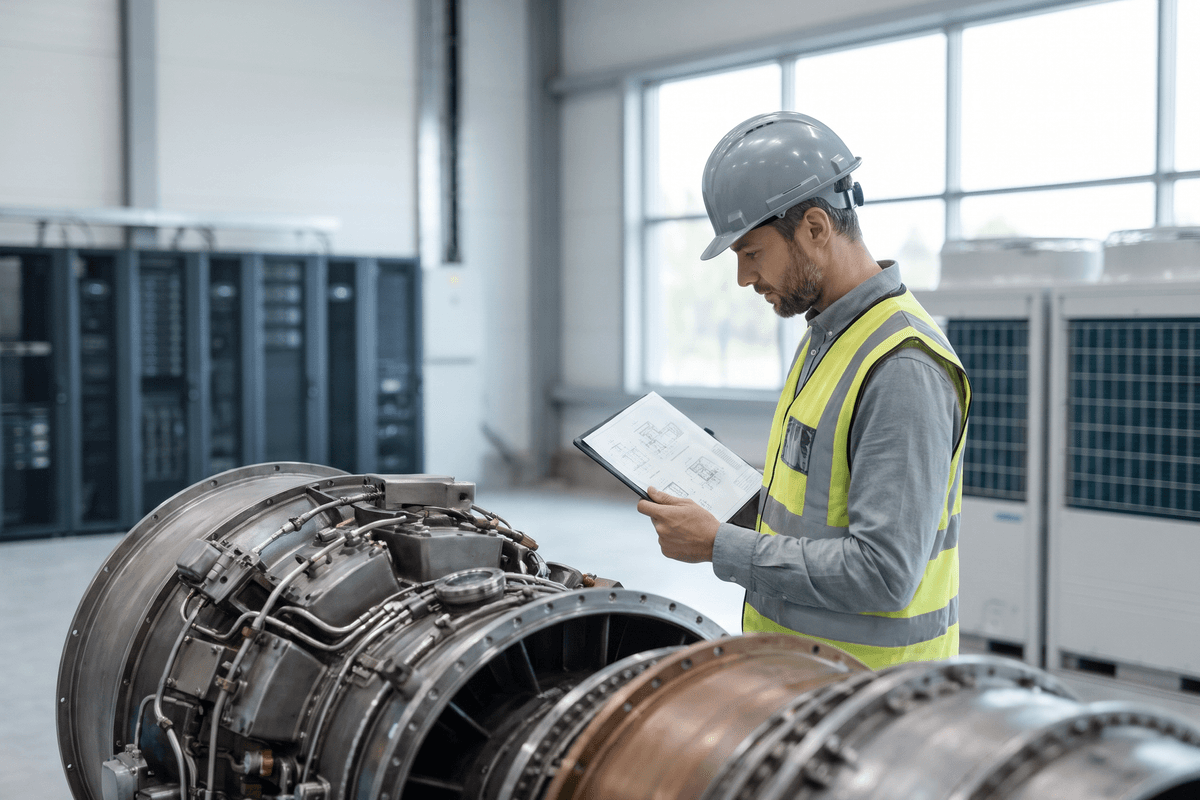

For decades, the mechanical engineer's job in American manufacturing often meant designing products that would be built somewhere else. That arrangement is changing. As production capacity returns to U.S. soil, the engineers who design, commission, and sustain the machines inside those plants are being asked to do something harder: build factories that can run reliably, adapt quickly, and support power-intensive industries at the same time. The question raised in ASME's examination of reshoring is blunt: are mechanical engineers ready?
The short answer is that readiness is uneven. The skills needed for a reshored factory, including automation integration, controls literacy, and close coordination with electrical and civil teams, are not always the ones taught in traditional mechanical programs or rewarded in conventional project roles. At the same time, the demand for engineering capacity is being pulled in multiple directions by nuclear deployments, AI-driven data centers, and heavy industrial expansion. This article examines what reshoring is asking of mechanical engineers, how adjacent sectors are shaping those expectations, and where practicing professionals should focus their development.
Reshoring Is a Systems Problem, Not Just a Plant Problem
Bringing production back to the United States is not simply a matter of leasing a building and installing equipment. A modern production line is an integrated system of motors, sensors, robotics, material handling, thermal management, and power distribution. When that system is designed offshore, the knowledge behind it often travels with the supplier. When it is designed domestically, U.S. engineers must own the full chain, from equipment specification through installation and long-term maintenance.
ASME's framing emphasizes that mechanical engineers are adapting to new factory-floor technologies and automation requirements. In practice, that adaptation touches three areas that engineers can no longer treat as separate disciplines:
- Automation integration: Robotic cells, conveyor networks, and automated inspection systems must be specified with mechanical tolerances, control architectures, and safety requirements in mind from the start.
- Power and thermal loads: Automated lines are electrically dense. Motor loads, drive heat, and cooling needs must be coordinated with electrical engineers early, not reconciled during commissioning.
- Lifecycle serviceability: Domestic plants will be judged on uptime. Designs must account for maintenance access, spare parts logistics, and the workforce that will service equipment over decades.
Reshoring is not a relocation event. It is a sustained requirement for engineering teams that can design, verify, and maintain production systems on U.S. soil.
That sustained requirement is where many organizations feel the strain. Reshored facilities need engineers who understand both the physical hardware and the software that drives it, and who can work across disciplines without waiting for handoffs.
The Power Demand Connection
Reshoring does not happen in isolation. It is occurring alongside a surge in electrical load from artificial intelligence facilities and new generation projects, and mechanical engineers are increasingly in the middle of that intersection. A recent ENR report on data center construction describes specialty electrical engineering and contracting firms restructuring workflows to handle massive utility and behind-the-meter power demands from expanding AI facilities. Those firms are not only reorganizing staff; they are changing how mechanical, electrical, and controls work is sequenced.
For mechanical engineers, the implication is clear. Power distribution equipment, switchgear enclosures, generator packages, and cooling systems all carry mechanical design requirements. The same engineering talent that is needed for a reshored automotive or electronics line is also in demand for data center infrastructure and onsite generation. Competition for qualified people is therefore not limited to manufacturing firms; it extends across every project type that draws on the same mechanical and thermal expertise.
Nuclear Deployment Adds a New Layer of Requirements
Small modular reactors are another area where mechanical engineering demand is rising quickly. World Nuclear News reports that engineering firm Sargent & Lundy has partnered with ENTRA1 Energy to provide design and engineering execution support for NuScale small modular reactor power plants across the southeastern United States. Projects of this kind depend on rigorous mechanical design, component qualification, and fabrication discipline, and they reward engineers who understand how factory-built modules move into field installation.
The overlap with reshoring is significant. Modular nuclear components are, in many cases, produced in controlled fabrication environments and then assembled on site. That approach makes the factory-floor capabilities discussed above directly relevant to energy infrastructure. Engineers who can translate between shop-level manufacturing constraints and field execution will find a growing number of openings.
What the Outlook Signals for Engineering Teams
Forward-looking industry analysis reinforces these pressures. Deloitte's 2027 Engineering and Construction Industry Outlook analyzes how large investments in digital infrastructure and data centers are driving engineering demand while firms navigate tight labor constraints and supply chain complexities. Those two constraints, labor and supply, are precisely the ones reshoring is meant to address, and they are also the ones most likely to slow it.
The following comparison summarizes how the demands on mechanical engineers differ across the three areas shaping the next phase of U.S. industrial work:
| Demand Area | Primary Mechanical Focus | Key Collaborators | Readiness Signal |
|---|---|---|---|
| Reshored manufacturing | Automated line design, serviceability, material flow | Controls, robotics, facilities | Can specify and commission a full automated cell |
| AI data centers and behind-the-meter power | Thermal management, enclosure design, generator packaging | Electrical contractors, utilities | Can coordinate heat and load with electrical scope early |
| SMR and nuclear deployment | Component qualification, modular fabrication, field integration | Engineering firms, fabricators, regulators | Can translate shop tolerances into field execution |
Taken together, the outlook suggests that mechanical engineers should expect more cross-sector mobility and more demanding documentation and qualification requirements. Projects are becoming more interdependent, and the cost of late coordination is rising.
Practical Steps for Mechanical Engineers and Their Employers
Readiness is not an abstract goal. It can be built through deliberate steps at the individual and organizational level. The following actions align with the skills reshoring and adjacent sectors are demanding:
- Build controls fluency. Understanding PLC logic, sensor networks, and drive configuration helps mechanical engineers specify systems that will actually run as designed.
- Learn electrical load basics. Familiarity with motor sizing, power quality, and heat rejection reduces rework when electrical and mechanical scopes meet.
- Engage early in design reviews. Serviceability, maintenance access, and thermal constraints are cheapest to address before procurement.
- Document for lifecycle use. Clear drawings, failure mode records, and spare parts lists support the long-term uptime that domestic plants depend on.
- Cross-train with field teams. Time spent on installation and commissioning sharpens design judgment in ways that office work alone cannot.
Employers have an equal responsibility. Firms that treat mechanical engineering as a narrow design function will struggle to deliver reshored facilities on schedule. Those that create integrated teams, invest in automation training, and give engineers visibility into power and nuclear projects will be better positioned to retain talent in a competitive market.
Looking Ahead
The reshoring trend is unlikely to be a short cycle. Production capacity that returns to the United States will need to be maintained, upgraded, and integrated with an electrical grid that is already absorbing large AI and nuclear loads. For mechanical engineers, that means the profession's center of gravity is shifting toward systems thinking, automation fluency, and close collaboration across disciplines. The engineers who thrive will be those who see the factory floor, the data center, and the reactor building as parts of the same national infrastructure challenge. Readiness, in other words, is no longer a question of whether mechanical engineers can adapt. It is a question of how quickly their organizations will let them lead that adaptation.