
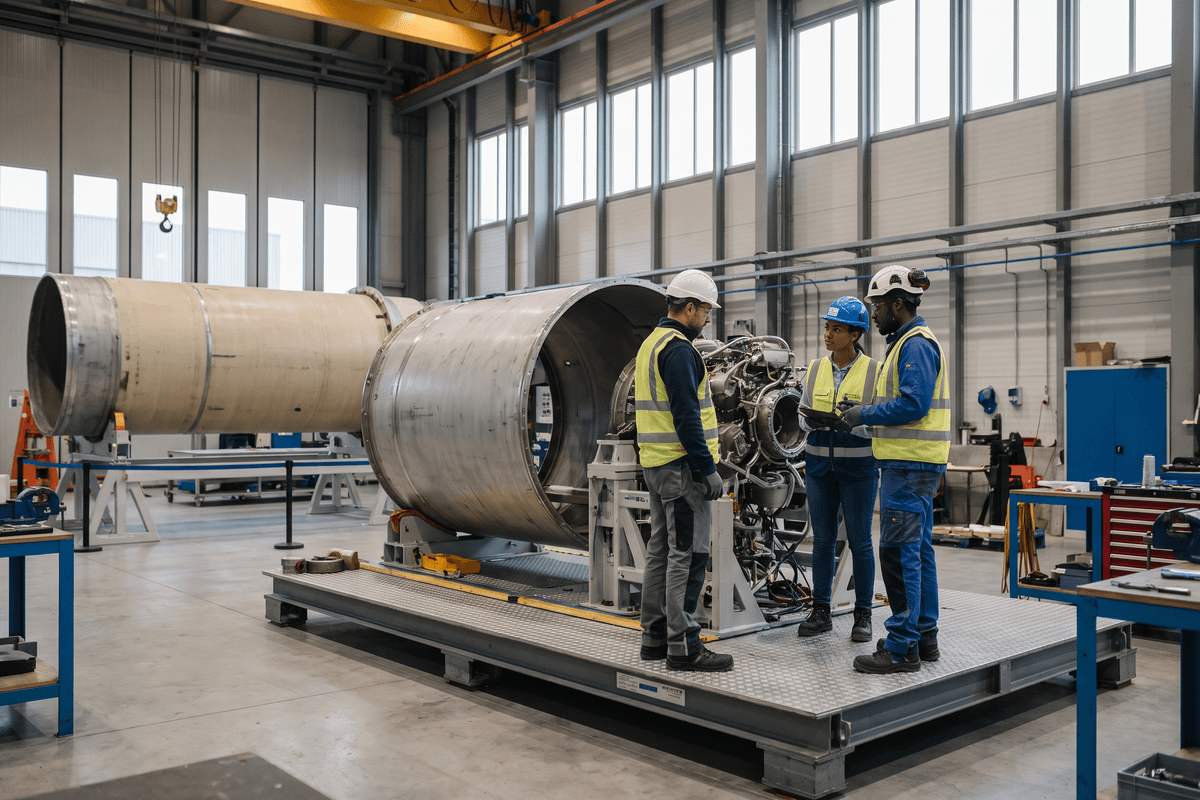



America’s aerospace and defense industrial base is undergoing its most aggressive engineering overhaul in over three decades. As precision munitions stockpiles deplete and next-generation defense platforms transition from digital blueprints to serial production, the bottleneck is no longer merely software or microelectronics—it is specialized, high-hazard manufacturing capacity. Leading this high-stakes industrial push, Avio USA has officially broken ground on a $500-million, 900,000-square-foot solid rocket motor complex in Virginia. Partnering with national builder HITT Contracting and multi-discipline engineering firm Dewberry, the sprawling facility represents a decisive domestic move to alleviate the nation's critical shortfall in solid rocket motors (SRMs) for tactical missile systems.
This massive greenfield project does not stand in isolation. It anchors a broader capital convergence across the United States defense-industrial and mission-critical engineering landscape. From billions in aerospace component tooling and plant expansions—including Bell Textron’s $632-million facility renovation in Fort Worth for next-generation military tiltrotors—to specialized component scaling like Collins Aerospace’s West Des Moines manufacturing expansion, structural, mechanical, and power engineers are facing an unprecedented challenge: delivering ultra-complex, high-consequence facilities at breakneck speed.
The Anatomy of High-Hazard Aerospace Engineering
Designing a 900,000-square-foot solid rocket motor facility is among the most demanding tasks in structural, process, and MEP (mechanical, electrical, plumbing) engineering. Unlike standard advanced manufacturing or commercial cleanrooms, an SRM plant must simultaneously accommodate energetic material handling, high-temperature thermal curing, stringent electrostatic discharge (ESD) mitigation, and Department of Defense explosive safety quantity distance (ESQD) standards.
Structural Hardening and Blast Attenuation
For engineering firms like Dewberry and general contractors like HITT Contracting, the layout of Avio USA's complex requires strict separation of propellant mixing, casting, curing, and final motor integration bays:
- Blast-Resistant Architecture: Reinforced concrete blast walls, frangible blowout panels, and earth-bermed barricades engineered to direct potential overpressure upward rather than outward into adjacent operational zones.
- Hazardous Area Classifications: Electrical designs complying with Class I and Class II, Division 1 hazardous environments, utilizing explosion-proof raceways, non-sparking flooring materials, and advanced ground-fault dissipation systems to eliminate any static ignition sources.
- Process Automation and Remote Mixing: Integrating heavy automated automated guided vehicles (AGVs) and tele-operated planetary mixers capable of handling viscous propellant formulations under high thermal stability constraints.
"The engineering barrier to entry for solid rocket propulsion is not just the chemistry—it is the physical envelope. Building nearly a million square feet of high-hazard energetic processing capacity demands a convergence of civil blast modeling, process HVAC, and structural isolation that very few teams can execute simultaneously."
Aerospace Reshoring and the Capital Surge Across Component Tiers
Avio’s Virginia plant represents the tip of a massive capital expenditure wave reshaping aerospace and defense production lines across the country. Commercial backlogs and major military contracts are driving heavy capital allocations into precision tooling, advanced metallurgy, and component sub-assembly.
| Company / Project | Capital Investment | Engineering / Construction Scope | Primary Technical Focus |
|---|---|---|---|
| Avio USA (Virginia) | $500 Million | 900,000 sq. ft. greenfield plant; HITT Contracting & Dewberry | Solid rocket motor manufacturing, propellant casting, tactical missile defense |
| Bell Textron (Fort Worth, TX) | $632 Million | Massive industrial plant modernization and tooling refit | FLRAA next-gen military tiltrotor production, composite airframe fabrication |
| Collins Aerospace (West Des Moines, IA) | Multi-Million | 14,000 sq. ft. precision manufacturing expansion | Advanced fuel nozzles, distribution manifolds, micro-machining |
At Bell Textron's Fort Worth operations, a $632-million overhaul is re-engineering manufacturing cells for the Future Long-Range Assault Aircraft (FLRAA) program. These facilities demand heavy structural dynamic isolation for high-speed 5-axis CNC gantry mills, large-scale autoclave curing infrastructure for composite aerostructures, and digitized quality inspection suites utilizing laser metrology and in-situ ultrasonic non-destructive testing (NDT).
Concurrently, RTX's Collins Aerospace is expanding its West Des Moines footprint by 14,000 square feet to scale up high-precision fuel distribution manufacturing. Micro-machining and fluid-dynamics validation require ultra-pure nitrogen environments, specialized chemical passivation lines, and micro-inch vibration damping—illustrating that precision engineering demands are escalating at every tier of the defense supply chain.
Integrated Delivery: Borrowing the 'Generator-to-Chip' Playbook
The defining constraint across all complex industrial projects in 2026—from energetic propulsion bays to advanced manufacturing lines—is the intersection of utility interconnection delays and compressed project schedules. The engineering sector is responding by discarding traditional, siloed design-bid-build approaches in favor of tightly synchronized, multi-party delivery frameworks.
A prime example of this execution shift can be seen in critical digital infrastructure, where engineering firm Stanley Consultants has partnered with Schneider Electric and Wärtsilä to launch a 'Generator-to-Chip' delivery framework. By unifying prime power generation, medium-voltage distribution switchgear, building management systems (BMS), and engineering design under a single coordinated engineering architecture, the alliance bridges the multi-year utility queue and slashes deployment timelines.
Cross-Sector Lessons for Industrial and Systems Engineers
- Parallel-Track Microgrids and On-Site Generation: High-energy manufacturing complexes cannot afford 36-to-48-month grid interconnection delays. Coordinated behind-the-meter generation (dual-fuel reciprocating engines, microturbines, and high-capacity battery storage) is rapidly becoming standard design practice.
- Pre-Engineered Modular Power Blocks: Integrating power distribution skids, switchgear, and uninterruptible power systems (UPS) offsite ensures that facility testing and commissioning occur concurrently with civil site work.
- Integrated Digital Twins for Process Safety: Using comprehensive Building Information Modeling (BIM) tied to real-time industrial IoT allows engineering teams to simulate explosive overpressure, chemical dispersion, and thermal cooling loads prior to concrete pours.
The Strategic Path Forward for U.S. EPC Leaders
The ground-breaking in Virginia and multi-million-dollar tooling investments in Texas and Iowa underscore a fundamental truth: rebuilding national industrial resilience is fundamentally a civil, mechanical, and systems engineering mission. For engineers and program executives, success in this hyper-demanding sector requires mastering the balance between speed, blast safety compliance, and energy self-reliance.
As Avio USA, HITT Contracting, and Dewberry push the Virginia rocket motor plant toward operational status, they are setting a new standard for high-hazard industrial delivery. The firms that succeed in this new era will be those that integrate specialized structural engineering with resilient on-site power and off-site modular fabrication—delivering mission-critical capacity exactly when national defense mandates require it most.