
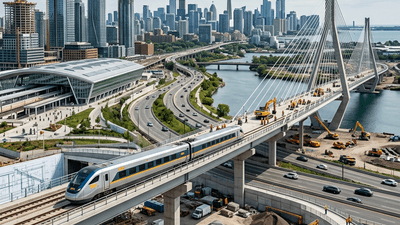



The Canadian engineering sector is standing at the precipice of a historic capital deployment phase. For the past two decades, much of the national conversation surrounding public works has been characterized by deferred maintenance and piecemeal upgrades. Today, we are witnessing a structural realignment. Driven by population growth, climate imperatives, and shifting geopolitical realities, Canada is entering an "infrastructure super-cycle"—a period defined not by isolated projects, but by holistic, multi-billion-dollar modernization programs.
At the helm of this transformation are Tier-1 global engineering and professional services firms. By securing massive, multi-year program management contracts, these industry giants are effectively blueprinting the nation's next growth phase. For engineering professionals across the country—from structural designers in regional offices to procurement specialists at mid-sized firms—understanding how these mega-contracts are structured is critical to navigating the decade ahead.
The Modernization Mandate: WSP Global and Stantec
The sheer scale of Canada's infrastructure deficit requires a level of execution that only a handful of firms can manage. Recent market analysis highlights how infrastructure leaders like WSP Global and Stantec are shaping Canada's next growth phase. These firms are no longer just acting as design consultants; they are functioning as integrated delivery partners for provincial and federal governments.
What makes this current phase distinct is the transition from traditional asset replacement to intelligent asset modernization. When a municipality contracts a Tier-1 firm to upgrade a water treatment facility or transit corridor, the mandate now explicitly includes climate resilience modeling, digital twin integration, and lifecycle carbon tracking.
"We are moving away from the era of 'design-bid-build' for critical infrastructure. The complexity of modern public works demands integrated, programmatic approaches where engineering firms act as strategic partners from conception through to decades of operation."
For WSP and Stantec, this growth phase is characterized by leveraging global expertise to solve localized Canadian challenges. Their dominance in the market signals a broader industry trend: the commoditization of basic design services, paired with a massive premium on complex, multidisciplinary project management and environmental integration.
Strategic Assets: The AECOM and DCC Partnership
While civil and municipal infrastructure form the bedrock of this super-cycle, strategic and defense infrastructure is rapidly emerging as a massive growth vector. The geopolitical landscape has prompted the federal government to modernize its military and strategic assets across the country, creating unprecedented opportunities for the engineering sector.
This shift was recently underscored when Defence Construction Canada (DCC) selected AECOM for a $270 million multi-year infrastructure program. This is not a standard procurement contract; it is a programmatic master services agreement designed to overhaul and modernize military infrastructure at scale.
Redefining Defense Infrastructure
For many civil and structural engineers, "defense infrastructure" might conjure images of armories or bunkers. However, the modern reality of DCC contracts encompasses a vastly broader and more sophisticated scope of work. The $270 million AECOM program will likely involve:
- Northern Asset Hardening: Upgrading facilities in Canada's North to withstand accelerating permafrost degradation and extreme weather events.
- Energy Independence: Designing microgrids and renewable energy integrations for military bases to ensure operational continuity independent of the civilian grid.
- Logistical Optimization: Overhauling transportation hubs, marine structures, and aviation facilities to support next-generation military hardware and rapid deployment capabilities.
- Environmental Remediation: Managing complex environmental assessments and cleanup operations at legacy sites.
AECOM's role will be to provide the overarching engineering, architectural, and project management framework required to execute these diverse initiatives cohesively over several years.
The Shift to Programmatic Procurement
The unifying theme between the civil modernization led by WSP/Stantec and the defense upgrades led by AECOM is the procurement model. Governments are increasingly abandoning single-project RFPs in favor of Multi-Year Program Management contracts.
Why? Because managing hundreds of individual tenders is administratively exhausting and highly inefficient for public sector bodies grappling with talent shortages. By awarding a $270 million program to a firm like AECOM, the government transfers the execution risk and administrative burden to the private sector. The engineering firm becomes the central node, responsible for maintaining quality, schedule, and budget across a portfolio of localized projects.
Mapping the Infrastructure Growth Vectors
To understand where the capital is flowing and what skills will be in highest demand, it is helpful to categorize the focus areas of these Tier-1 mega-contracts.
| Infrastructure Sector | Primary Drivers | Critical Engineering Competencies Required |
|---|---|---|
| Municipal & Civil (WSP, Stantec) | Population density, aging 1970s assets, net-zero mandates | Digital twin modeling, transit-oriented development, sustainable water management |
| Defense & Strategic (AECOM, DCC) | Geopolitical shifts, Arctic sovereignty, base modernization | Permafrost engineering, microgrid design, high-security facility architecture |
| Energy & Grid (Cross-Sector) | Electrification, EV adoption, industrial decarbonization | High-voltage transmission, distributed energy resource (DER) integration |
The Trickle-Down Effect: Opportunities for the Mid-Market
It is easy for mid-sized firms and independent engineering consultants to view the dominance of WSP, Stantec, and AECOM with trepidation. If the Tier-1 firms are winning all the massive programmatic contracts, where does that leave the rest of the industry?
The reality is highly lucrative for those positioned correctly. Tier-1 firms are built for scale, master planning, and overarching project management. They cannot—and do not want to—execute every localized geotechnical survey, specialized environmental assessment, or niche structural design in-house.
When AECOM secures a $270 million program across multiple provinces and territories, they immediately require regional partners. This creates a robust secondary market. Mid-sized Canadian engineering firms that can demonstrate agility, regional expertise, and compliance with federal procurement standards (including security clearances for DCC projects) will find themselves flush with subcontracting opportunities.
To capitalize on this, mid-market firms should focus on:
- Specialization: Cultivating deep expertise in niche areas (e.g., specific environmental remediations, local geotechnical anomalies) that Tier-1 firms lack in regional offices.
- Security and Compliance: Proactively securing the necessary facility security clearances and robust cybersecurity protocols required to partner on federal and defense contracts.
- Digital Interoperability: Ensuring their internal CAD, BIM, and project management software can seamlessly integrate with the massive digital ecosystems utilized by the major players.
Conclusion: Engineering the Next Decade
Canada's infrastructure super-cycle is fundamentally rewriting the rules of engagement for the engineering profession. The mega-contracts secured by WSP Global, Stantec, and AECOM are not just financial milestones; they are structural shifts in how the country designs, builds, and maintains its critical assets.
For Canadian engineers, this growth phase offers unprecedented career stability and the opportunity to work on nation-building projects of historic consequence. Whether you are leading a multi-disciplinary team at a Tier-1 giant or running a specialized regional consultancy, the mandate is clear: the future belongs to those who can execute at scale, integrate resilient design, and seamlessly navigate the complexities of programmatic delivery.