
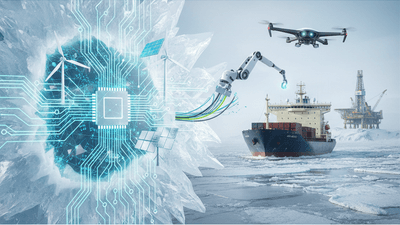



The drafting board is evolving. From the frozen, unforgiving expanses of the Canadian Arctic to the subterranean depths of our critical mineral mines, the Canadian engineering sector is undergoing a profound transformation. We are moving rapidly past the era of isolated, single-discipline projects. Today, the industry is being redefined by a powerful convergence: the explosive growth of artificial intelligence, the urgent mandate for heavy-industry decarbonization, and the revival of massive national security infrastructure.
For engineering professionals across the country, this shift represents both a formidable challenge and a generational opportunity. The traditional silos of civil, mechanical, and electrical engineering are dissolving, replaced by a demand for multidisciplinary systems thinkers who can integrate cutting-edge technology into extreme environments.
The AI Catalyst: U of T, AMD, and the Future of Compute
The clearest signal of this technological shift comes from a landmark announcement in higher education and tech. The University of Toronto's Department of Computer Science and tech giant AMD have officially launched a major research and development lab dedicated to next-generation AI and computing technologies.
This is not merely an academic exercise. As outlined by the University of Toronto, the initiative is designed to cement Canada's position as a global hub for innovation excellence while creating a pipeline of highly skilled, future-ready professionals. For the engineering sector, the implications of this R&D lab are twofold. First, it accelerates the domestic development of AI tools that will eventually find their way into structural analysis, generative design, and predictive maintenance. Second, it signals a massive upcoming demand for the physical infrastructure required to support advanced computing—namely, high-density data centers, advanced cooling systems, and upgraded power grids.
Yet, the rise of AI has not been without its anxieties. Recent market analysis surrounding major engineering firms like WSP highlights rising fears regarding AI's potential to automate traditional engineering services. However, industry analysts, including Jonathan Goldman at Scotia Capital, point out a crucial counter-narrative:
"While there are valid fears about AI disrupting routine design tasks, major engineering firms are uniquely positioned as direct beneficiaries of the AI boom. The infrastructure required to power the AI revolution—from energy generation to specialized facilities—requires complex, human-led engineering at an unprecedented scale."
National Security Meets Extreme Engineering: The Arctic Radar Project
While AI reshapes the digital and infrastructural landscape in our southern urban centers, a different kind of megaproject is taking shape in the far north. Stantec has been selected by Defence Construction Canada to deliver multidisciplinary engineering and design services for the first phase of Canada's Arctic Over-the-Horizon Radar (A-OTHR) project.
This initiative is a cornerstone of Canada's modernized defense strategy, designed to provide long-range early-warning radar coverage across the northern expanses. For engineers, the A-OTHR project represents the pinnacle of extreme-environment design. Professionals must navigate permafrost degradation, extreme thermal fluctuations, remote logistics, and the integration of highly sensitive radio-frequency technology into ruggedized structures. It is a stark reminder that as technology advances, the physical realities of Canada's geography still demand world-class civil, geotechnical, and structural engineering expertise.
Heavy Duty Decarbonization: Electrifying the Mine
Simultaneously, the push for net-zero emissions is forcing a complete redesign of heavy industrial equipment. This is vividly illustrated by MacLean Engineering's recent acquisition of $2.5 million in federal funding from Natural Resources Canada.
The funding is earmarked to accelerate the research, development, and commercialization of MacLean's GR8 EV Grader—a battery-electric vehicle (BEV) designed specifically for subterranean mining operations. Transitioning a massive piece of underground grading equipment from diesel to battery-electric is not a simple powertrain swap. It requires comprehensive re-engineering of thermal management systems, battery safety protocols in confined spaces, and the development of underground charging infrastructure. This project exemplifies how decarbonization strategies are directly translating into high-value R&D engineering jobs across the country.
Traditional Energy's High-Tech Pivot: Bay du Nord
Even traditional energy sectors are pivoting heavily into advanced R&D and massive engineering commitments. The Government of Newfoundland and Labrador's recent agreement with Equinor and BP to advance the Bay du Nord offshore oil project is a prime example.
Beyond the raw extraction of resources, the Bay du Nord agreement is fundamentally an engineering megaproject. The deal mandates a staggering 1.9 million person-hours of professional engineering work and includes a dedicated $100 million contribution specifically for research and development. Offshore projects of this scale now require advanced digital twin technology, automated safety systems, and rigorous environmental engineering to minimize ecological impact, showcasing how traditional sectors are absorbing high-tech engineering practices.
The Multidisciplinary Mandate: What This Means for Professionals
When we look at these four distinct developments—AI labs in Toronto, radar in the Arctic, electric graders in deep mines, and advanced offshore platforms in the Atlantic—a unified picture of the modern Canadian engineer emerges.
Essential Skills for the Next Decade
- Systems Integration: The ability to see how software (like AI and digital twins) interacts with physical hardware and infrastructure.
- Extreme Environment Adaptation: Designing for climate resilience, whether it's Arctic permafrost for radar stations or deep-sea pressures for offshore platforms.
- Electrification & Power Management: Expertise in transitioning legacy diesel/fossil systems to battery-electric or low-carbon alternatives.
- Data Literacy: Understanding how to leverage the massive amounts of data generated by modern infrastructure to optimize performance and maintenance.
Snapshot of Canada's Engineering Megatrends
| Project / Initiative | Sector | Key Engineering Focus | Investment / Scale |
|---|---|---|---|
| U of T / AMD AI Lab | Technology & R&D | AI hardware/software integration, Next-gen computing | Major institutional/corporate partnership |
| Arctic OTHR (Stantec) | Defense & Infrastructure | Geotechnical, RF integration, Extreme climate design | Phase 1 of National Defense Strategy |
| MacLean GR8 EV Grader | Mining & Clean Tech | Battery-electric powertrains, Thermal management | $2.5M Federal Funding |
| Bay du Nord Offshore | Energy | Offshore structural, Environmental, Digital Twins | 1.9M engineering hours, $100M R&D |
The narrative that AI will simply "replace" engineering jobs fundamentally misunderstands the physical nature of the world we are building. The U of T and AMD partnership will generate the software and silicon of tomorrow, but it is Canadian engineers who will design the data centers to house them, the power grids to fuel them, the electric vehicles to mine the materials for them, and the radar systems to protect them.
For engineering firms and professionals willing to embrace continuous learning and multidisciplinary collaboration, the Canadian market is entering a golden age of complexity and innovation. The blueprints of tomorrow won't just be drawn; they will be computed, electrified, and engineered for the extremes.