
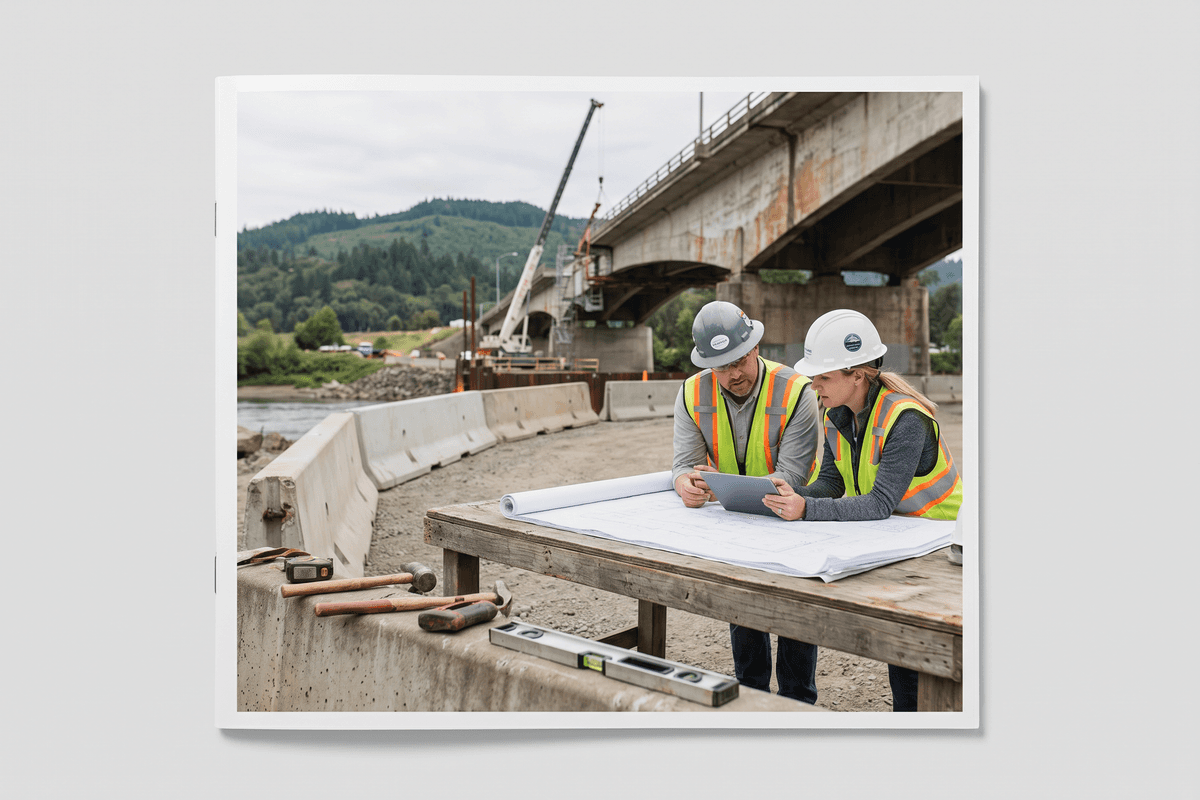



The Canadian engineering landscape is undergoing a profound transition. For decades, the industry's prestige was heavily weighted toward the "ribbon-cutting" phase—the triumphant completion of new, monolithic megaprojects. Today, however, the reality of engineering practice is far more cyclical and complex. Professionals are increasingly tasked with navigating intricate commercial dispute resolutions, engineering the end-of-life renewal of mid-century assets, and fundamentally rewriting design parameters to account for a rapidly destabilizing climate.
This shift from a pure "design-and-build" mindset to a comprehensive Lifecycle Mandate is currently playing out across several distinct fronts in Canada. From the final commercial hurdles of the country's most critical border crossing to the strategic planning for Atlantic Canada's aging suspension bridges, the message is clear: the future of Canadian engineering lies in mastering the entire lifespan of our built environment.
The P3 Reality Check: Resolving the Gordie Howe Delays
Public-Private Partnerships (P3s) have been the delivery vehicle of choice for Canadian megaprojects over the last two decades. But as projects grow in scale and complexity, so too do the commercial frictions inherent in these massive contracts. Recently, contractors and government officials from Canada and the U.S. reached a critical agreement to open the delayed Gordie Howe International Bridge.
While the physical closing of the bridge deck was a millimeter-perfect engineering triumph, the commercial resolution behind the scenes is equally significant for the industry. Megaprojects of this scale—spanning international borders and involving a web of private consortia, crown corporations, and federal agencies—are highly susceptible to schedule creep driven by supply chain shocks, pandemic hangovers, and localized labor shortages.
Implications for Engineering Consultants
The agreement to finally open the delayed Gordie Howe bridge underscores a maturation in how Canadian infrastructure stakeholders handle P3 risk allocation. For engineering consultants and project managers, this signals a shift in required competencies:
- Forensic Scheduling: The ability to accurately untangle overlapping causes of delay to facilitate fair commercial settlements.
- Dynamic Risk Pricing: Moving away from fixed-price, lump-sum models toward more collaborative target-cost or progressive design-build models that don't bankrupt contractors when unforeseeable delays occur.
- Cross-Border Harmonization: Navigating the differing regulatory, environmental, and labor frameworks between jurisdictions to keep bi-national projects moving.
"The Gordie Howe resolution proves that the P3 model, while stressed, can bend without breaking—provided all parties are willing to engage in pragmatic commercial negotiations rather than protracted litigation."
The Renewal Dilemma: Charting the MacKay Bridge's Future
While the Gordie Howe represents the delivery of a new asset, the other end of the infrastructure lifecycle is presenting an equally daunting challenge. Across the country, critical infrastructure built in the 1960s and 1970s is approaching the end of its design life. A prime example is currently unfolding in Atlantic Canada, where Nova Scotia has issued a Request for Proposals (RFP) for a future study on the MacKay Bridge.
The A. Murray MacKay Bridge, a critical suspension bridge spanning Halifax Harbour, opened in 1970. The new RFP seeks comprehensive engineering and consulting services to determine the infrastructure's next phase. This is not a simple maintenance contract; it is a fundamental existential study of a major regional artery.
The Rehab vs. Replace Calculus
For structural engineers and urban planners, studies like the MacKay RFP represent some of the most complex, high-stakes consulting work available today. The core challenge is balancing structural fatigue, evolving traffic demands, and staggering capital costs.
- Advanced Non-Destructive Evaluation (NDE): Firms must deploy cutting-edge sensor arrays and digital twin modeling to accurately assess the fatigue life of main cables, suspender ropes, and orthotropic decks.
- Traffic and Economic Modeling: If the bridge is replaced, how is traffic routed during a multi-year construction phase? What is the regional economic impact of reduced capacity?
- Embodied Carbon Considerations: Increasingly, engineering studies must weigh the massive carbon footprint of pouring a new concrete substructure versus the carbon cost of perpetual, intensive rehabilitation.
| Project Profile | Lifecycle Phase | Primary Engineering Challenge | Commercial / Risk Focus |
|---|---|---|---|
| Gordie Howe Bridge | Delivery / Handover | Executing final commissioning and systems integration across a bi-national span. | Resolving P3 schedule delays; finalizing operations and maintenance (O&M) handover. |
| MacKay Bridge | End-of-Life / Renewal | Determining residual structural fatigue; evaluating rehab vs. replacement feasibility. | Securing funding models for multibillion-dollar replacement; minimizing regional economic disruption. |
The Climate Variable: Engineering for the "New Normal"
Whether delivering a new megaproject or replacing an old one, modern engineering must contend with a variable that mid-century designers rarely considered: a volatile climate. The parameters that define "normal" operating conditions are shifting rapidly, forcing a rewrite of building codes and operational standards.
A stark reminder of this reality comes from the academic sector, where a professor at Waterloo Engineering is warning Canadians to expect poor air quality to become more routine due to the escalating impact of wildfires and climate change. This is not just a public health issue; it is a fundamental mechanical and civil engineering challenge.
Rewiring HVAC and Occupational Health
The routine presence of fine particulate matter (PM2.5) from wildfires necessitates an immediate evolution in how we design and operate the built environment:
- Building Envelope and HVAC Resilience: Mechanical engineers are being forced to specify higher-tier filtration systems (MERV 13 or higher) as standard, rather than premium, upgrades. Furthermore, building automation systems must be designed to dynamically shift into "recirculation modes" based on real-time external air quality sensor data.
- Construction Site Safety: Civil and construction engineers face new operational hurdles. Prolonged periods of hazardous air quality mean more frequent work stoppages, impacting project schedules (and tying back into the P3 delay issues seen on projects like the Gordie Howe). Firms must integrate air quality contingencies into their baseline project schedules and health and safety protocols.
Fueling the Future: NSERC's Role in the Engineering Pipeline
Solving these interconnected challenges—managing complex P3s, executing lifecycle renewals, and adapting to climate volatility—requires a robust pipeline of domestic research and development. The consulting firms that will win the major RFPs of the 2030s are relying on the foundational research being funded today.
To that end, the federal government continues to inject capital into academic engineering hubs. Recently, forty-seven researchers from Waterloo Engineering received more than $2.9 million in combined funding through the Natural Sciences and Engineering Research Council of Canada's (NSERC) Discovery Grants program.
This funding is the lifeblood of Canadian engineering innovation. It supports the graduate students and post-doctoral researchers who are developing the next generation of non-destructive testing algorithms, advanced low-carbon materials, and climate-resilient infrastructure models. For industry leaders, maintaining close ties with institutions like Waterloo is no longer just about talent recruitment; it is a strategic imperative for technology transfer and remaining competitive in a rapidly evolving consulting market.
Conclusion: Embracing Full-Spectrum Engineering
The convergence of these events—the Gordie Howe's commercial resolution, the MacKay Bridge's future study, the stark warnings on climate-driven air quality, and the ongoing investment in academic research—paints a clear picture of the Canadian engineering sector's future.
The industry is moving away from fragmented, siloed disciplines. The successful engineering firms of the next decade will be those that embrace "Full-Spectrum Engineering." They will field teams that can simultaneously negotiate complex P3 risk allocations, deploy digital twins to assess the fatigue of fifty-year-old steel, and design mechanical systems capable of withstanding the climate realities of the 21st century. As Canada's infrastructure demands grow more complex, the definition of what it means to be an engineer is expanding—and the mandate has never been more critical.