
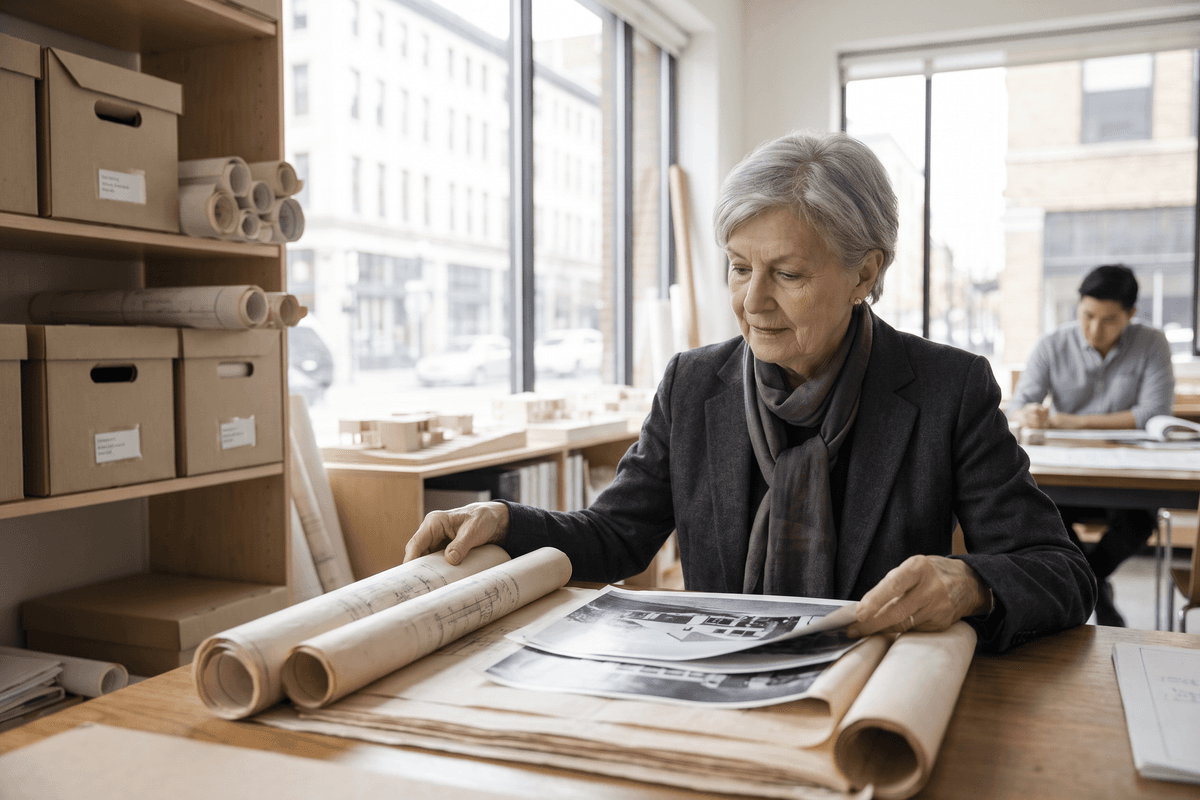



When Phyllis Lambert famously wrote to her father in 1954 to protest the mediocre corporate plans for the Seagram Building in New York, she established an ethos that would transform twentieth-century urbanism: architecture is not merely an investment asset or an envelope of floor area, but a profound public trust. Today, as the Canadian Centre for Architecture (CCA) launches a year-long celebration honouring Lambert’s upcoming 100th birthday, the discipline finds itself reflecting on the extraordinary ripple effects of her century-long life as a "citizen architect," institutional founder, and fearless defender of urban fabric.
Lambert’s centenary arrives at a pivotal juncture for Canadian practice. The architectural profession across the country is engaged in an urgent re-examination of its foundational values—navigating how to preserve the historic physical fabric of our cities while boldly dismantling entrenched canons to reflect contemporary cultural and climate realities. From the monumental technical conservation of Canada's seat of government in Ottawa to grassroots exhibitions elevating historically marginalized voices in Toronto, and international studios reframing human emotional well-being as a core design metric, Lambert’s enduring demand for architectural integrity resonates with fresh urgency.
The Citizen Architect: Institutional Memory as Civic Resistance
Phyllis Lambert’s founding of the Canadian Centre for Architecture in Montreal in 1979 transformed architectural discourse from a closed professional fraternity into a rigorous, internationally respected discipline of public inquiry. By treating archives, research, and exhibitions as active agents of urban debate, the CCA repositioned architecture as a critical lens through which society understands its politics, ecology, and human geography.
Lambert’s career proved that architectural stewardship extends far beyond designing individual buildings:
- Defending the Urban Vernacular: In the 1970s, through initiatives like Heritage Montreal and the defense of the historic Milton-Parc neighbourhood, Lambert pioneered cooperative housing models and demonstrated that historic preservation is fundamentally an instrument of social justice and community stabilization.
- The Archive as a Living Catalyst: The CCA’s permanent collections—housing hundreds of thousands of drawings, master archives of luminaries from Cedric Price to Álvaro Siza, and critical photographic records—established Canada as a global nexus for architectural scholarship.
- Decentering the Monolith: As the CCA celebrates her centenary through international colloquia, exhibitions, and publications, the focus remains firmly on her methodological rigor: interrogating how the built environment shapes human dignity.
Monumental Stewardship: Re-engineering Parliament’s Centre Block
While Lambert taught Canada how to protect the neighborhood fabric of its cities, the federal government is currently executing the most complex, high-stakes heritage intervention in Canadian history. The Senate of Canada’s latest updates on the multi-billion-dollar Centre Block rehabilitation illustrate the immense technical precision required to adapt a century-old symbol of governance for the next century of democratic life.
Led by a joint venture between Centrus (comprising WSP and HOK) and an extensive team of conservators, structural engineers, and heritage specialists, the modernization of the 1920 Modern Gothic landmark balances rigorous historic preservation with aggressive modern performance:
- Seismic Base Isolation: Excavating deep beneath the Peace Tower and bedrock to install hundreds of elastomeric base isolators, isolating the monumental stone structure from ground motion without altering its heritage envelope.
- The Subterranean Parliament Welcome Centre: A multi-level, universally accessible public threshold woven into the topography of Parliament Hill, creating transparent, welcoming civic interfaces while satisfying stringent contemporary security protocols.
- Digital Twin & Stone Stewardship: Utilizing millions of 3D point-cloud scans to map, clean, and restore tens of thousands of individual Nepean sandstone and Tyndall limestone blocks, alongside meticulous conservation of historical wood carvings and plaster murals in the Senate and House of Commons chambers.
"Conserving national heritage at this scale is not an act of freezing a building in time; it is an act of deep technological and spatial negotiation between historical memory and future democratic accessibility."
Expanding the Canon: SAY IT LOUD and the Diversification of Practice
Lambert’s lifelong insistence that architecture belongs to all citizens demands that we continuously interrogate who gets to shape our built environment. Historically, the architectural canon—in Canada as globally—has been framed through a narrow Eurocentric and male lens. That paradigm is undergoing an essential transformation.
At the Paul H. Cocker Gallery, Toronto Metropolitan University’s Department of Architectural Science launched the SAY IT LOUD – Toronto exhibition. Created in partnership with Beyond the Built Environment, the initiative spotlighted the work, research, and leadership of 50 local women and BIPOC designers.
This exhibition represents more than symbolic representation; it documents a structural evolution in the composition of Canadian practice. By showcasing diverse practitioners spanning commercial development, public infrastructure, community housing, and academia, the exhibition establishes a richer, more representative repository of design intelligence that reflects the multicultural reality of Canadian cities.
From Vernacular Craft to Global Practice: The Architecture of Empathy
While institutional stewardship and representation redefine the professional framework, the practice of architecture at the human scale requires its own radical commitment to empathy and sensory joy. Few contemporary Canadian practices demonstrate this evolution as clearly as Omar Gandhi Architects.
As detailed in recent discussions surrounding the studio's expansion across Halifax, Toronto, and Berlin, Omar Gandhi has positioned human happiness, emotional warmth, and vernacular craftsmanship as central architectural imperatives. Moving seamlessly from rugged Atlantic coastal dwellings to dense urban infill and institutional public spaces—such as the revitalized Peggy’s Cove viewing platform—Gandhi’s work illustrates how contextual sensitivity can achieve international resonance without losing its local soul.
The Pillars of Human-Centric Practice
- Climatic & Material Groundedness: Leveraging robust, locally sourced materials (weathering cedar, stone, tactile brick) that age gracefully within harsh Canadian seasonal shifts.
- Emotional Atmosphere: Crafting interior volumes calibrated for light, shadow, and tactile intimacy, treating spatial comfort not as a luxury but as a psychological necessity.
- Decentralized Practice: Operating across regional and international hubs while maintaining an intimate, studio-driven commitment to detailed fabrication and collaborative builder relationships.
Mapping the Paradigms of Contemporary Canadian Practice
The convergence of these distinct milestones reveals how Canadian architecture is maturing across multiple scales of engagement:
| Focus Area | Key Precedents / Initiatives | Primary Architectural Challenge | Professional Implication |
|---|---|---|---|
| Archival & Civic Stewardship | Phyllis Lambert Centenary; Canadian Centre for Architecture (CCA) | Bridging rigorous architectural history with active civic policy and public defense. | Practitioners must act as civic advocates, not merely service providers to capital. |
| Monumental Conservation | Centre Block Rehabilitation, Parliament Hill (Ottawa) | Integrating base isolation, digital twin scans, and security into a 100-year-old heritage icon. | Requires unprecedented multidisciplinary synthesis of heritage craft and advanced engineering. |
| Canon Expansion & Equity | SAY IT LOUD – Toronto (TMU / Paul H. Cocker Gallery) | Correcting systemic underrepresentation of women and BIPOC designers in the historical record. | Diversifies design leadership, project typologies, and community-centred methodologies. |
| Atmospheric & Vernacular Craft | Omar Gandhi Architects (Halifax, Toronto, Berlin) | Balancing rapid studio expansion with intimate material detail and human emotional resonance. | Proves that regional authenticity and joy are potent drivers for global architectural relevance. |
The Next Century of Canadian Practice
Phyllis Lambert’s century-long journey offers a vital lesson to contemporary practitioners: great architecture is not defined by novelty, but by endurance, ethical conviction, and deep care for the communities it touches. Whether restoring the stones of Parliament Hill, celebrating the diverse designers reshaping Toronto's skyline, or designing spaces that elevate everyday human happiness on the Atlantic coast, Canadian architecture is forging a mature, nuanced identity.
As the profession grapples with compounding challenges of climate volatility, housing affordability, and spatial justice, Lambert’s foundational challenge still rings clear across the drafting tables of today: architecture is our most enduring collective statement of what we value as a society. It is our responsibility to build that statement with courage, precision, and an unwavering commitment to the public good.