



In the realm of modern infrastructure, there are projects that test a sector's capacity, and then there are projects that completely redefine its baseline. Moving one million barrels of heavy crude oil per day across the Continental Divide falls unequivocally into the latter category. With plans officially submitted for the new West Coast Oil Pipeline, Canada is signaling a bold pivot toward cementing its status as a global energy superpower. But beneath the geopolitical headlines and economic forecasts lies a staggering technical reality: designing, routing, and building a one-million-barrel-per-day (bbl/d) conduit from Alberta to British Columbia is one of the most formidable multi-disciplinary engineering challenges of the decade.
For Canadian engineering professionals—spanning civil, mechanical, geotechnical, and environmental disciplines—this proposed megaproject is not just a pipeline; it is a mobilization mandate. It will demand next-generation fluid dynamics modeling, extreme-terrain routing, and an unprecedented scale of Engineering, Procurement, and Construction (EPC) coordination.
The Physics of 1M bbl/d: Fluid Dynamics and Metallurgy
Moving 159 million liters of fluid daily is a monumental task, but moving heavy crude—typically in the form of diluted bitumen (dilbit)—introduces severe non-Newtonian fluid dynamics into the equation. The sheer viscosity and density of the product dictate the entire engineering envelope of the project.
Sizing and Hydraulic Design
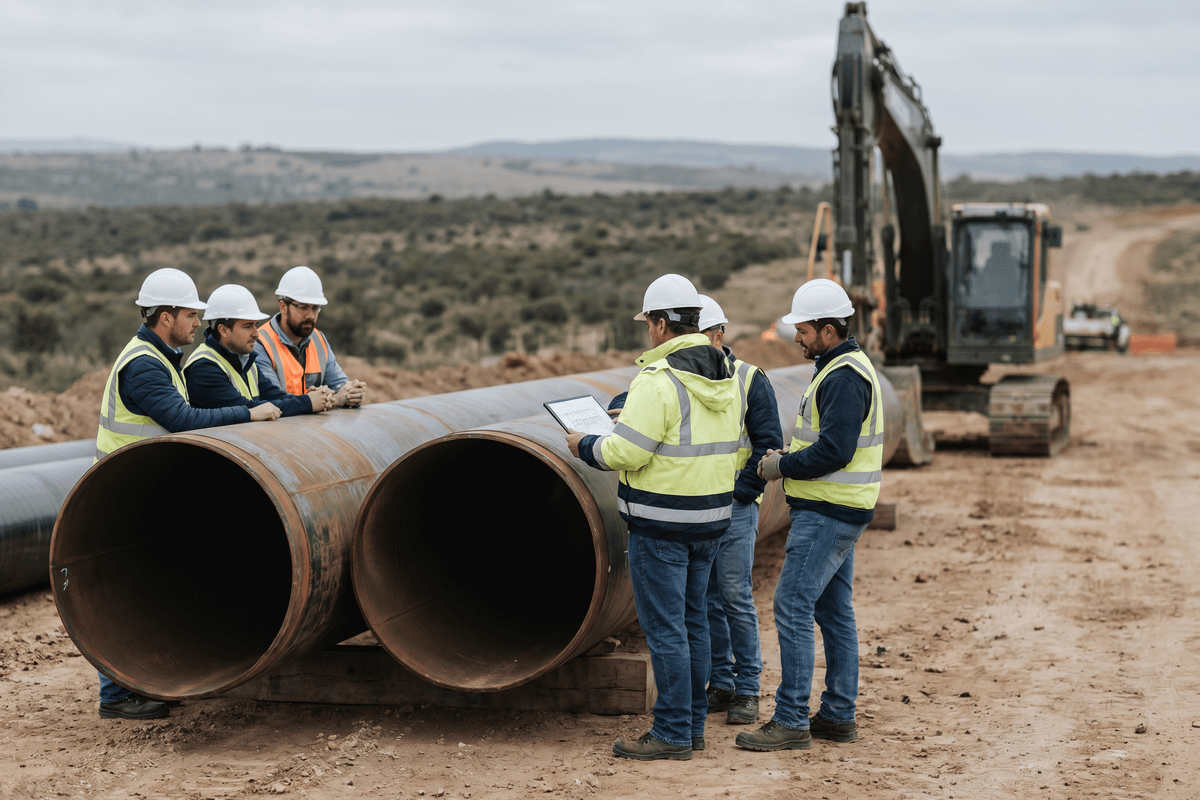
To achieve a throughput of 1 million bbl/d without incurring unmanageable friction losses and prohibitive pumping energy costs, engineers must move beyond standard 36-inch pipe diameters. We are likely looking at a 42-inch to 48-inch diameter mainline. This exponential increase in cross-sectional area reduces fluid velocity and friction, but it radically alters the mechanical stresses on the pipe wall.
"Scaling a pipeline's capacity isn't a linear mathematical exercise. When you push toward 1 million barrels per day of heavy crude, the hoop stresses, thermal expansion coefficients, and pump station horsepower requirements scale exponentially, demanding advanced high-strength steel alloys and massive electrical infrastructure."
Metallurgy and Welding
Operating large-diameter pipes at high pressures requires high-strength low-alloy (HSLA) steel, likely X70 or X80 grades. For mechanical and materials engineers, the challenge lies in the field-welding of these thick-walled, high-grade steels in sub-zero winter conditions across the Rockies. Maintaining weld integrity, preventing hydrogen-induced cracking, and executing automated ultrasonic testing (AUT) on every joint will require a highly specialized workforce and stringent quality assurance protocols.
Navigating the Cordillera: Linear Geotechnical Engineering
Unlike point-source megaprojects like mines or dams, a pipeline is a continuous linear asset that must survive every micro-climate and geological hazard along its hundreds of kilometers of routing. The journey from the Western Canadian Sedimentary Basin to the BC coastline crosses some of the most rugged, geologically active terrain on the continent.
Seismic and Landslide Mitigation
Geotechnical and structural engineers will be tasked with designing a pipeline that can yield without rupturing. Key routing challenges include:
- Seismic Fault Crossings: The pipeline will inevitably cross active fault lines. Engineers must utilize strain-based design (SBD) rather than traditional stress-based design, employing specialized backfill and heavy-wall pipe segments that allow the pipeline to stretch and bend during tectonic shifts.
- Steep Slope Stability: The Rockies and the Coast Mountains present severe landslide and avalanche risks. Mitigating these requires deep soil mixing, retaining structures, and the deployment of real-time slope monitoring networks using LiDAR and satellite InSAR (Interferometric Synthetic Aperture Radar).
- Hydrotechnical Hazards: Mountain rivers are subject to violent seasonal scouring. Engineers will need to design deep trenchless crossings using Horizontal Directional Drilling (HDD) or Direct Pipe installation methods to route the pipeline safely through bedrock beneath river scour zones.
Here is a look at how the engineering parameters of a 1M bbl/d mega-line compare to standard heavy crude infrastructure:
| Engineering Parameter | Standard Crude Pipeline (e.g., 300k-500k bbl/d) | West Coast Mega-Line (1M bbl/d) |
|---|---|---|
| Typical Diameter | 30 to 36 inches | 42 to 48 inches |
| Pump Station Spacing | Every 80-100 km | Every 50-70 km (due to heavy crude viscosity) |
| Design Methodology | Predominantly Stress-Based Design | Extensive Strain-Based Design (SBD) in mountainous terrain |
| River Crossings | Open cut or standard HDD | Deep bedrock HDD and micro-tunneling |
The EPC Supply Chain and Capacity Shock
For Canada's consulting and construction engineering firms, the West Coast Oil Pipeline represents a massive sudden demand on an already stretched talent and supply chain pool. The procurement logistics for a project of this scale are staggering.
Procurement Bottlenecks
Sourcing hundreds of kilometers of 48-inch X70 steel pipe is a global logistical challenge. Furthermore, the massive electric motors and centrifugal pumps required for the pump stations are highly specialized, long-lead items. EPC firms will need to lock in manufacturing slots years in advance, navigating a global supply chain that is currently constrained by competing international energy and water infrastructure projects.
The Talent Mobilization
We are looking at a requirement for thousands of engineering hours before a single shovel hits the ground. Firms will need to rapidly scale up their teams in:
- Regulatory and Environmental Engineering: Navigating the Impact Assessment Act (IAA) and provincial environmental frameworks will require exhaustive baseline studies, indigenous consultation engineering, and robust mitigation designs.
- Electrical Engineering: Designing the high-voltage substations required to power the massive pump stations along remote stretches of the route.
- Construction Management: Coordinating multiple "spreads" (construction zones) simultaneously, managing thousands of tradespeople, and ensuring strict adherence to environmental windows (e.g., halting construction during fish spawning or bird nesting seasons).
Next-Generation Leak Detection and Automation
In the modern regulatory and social climate, "fail-safe" is no longer a buzzword; it is a strict engineering mandate. A 1M bbl/d pipeline moving through pristine British Columbian watersheds leaves zero margin for error.
Environmental and automation engineers will deploy state-of-the-art leak detection systems (LDS). Traditional computational pipeline monitoring (CPM), which relies on mass-balance calculations (what goes in must come out), is no longer sufficient on its own. The West Coast Oil Pipeline will likely require continuous fiber-optic acoustic monitoring. By laying a fiber-optic cable in the trench alongside the pipe, engineers can use distributed acoustic sensing (DAS) and distributed temperature sensing (DTS) to detect the exact acoustic signature of a micro-leak or ground movement, pinpointing issues down to the meter in real-time. Coupled with AI-driven predictive maintenance algorithms, this represents the vanguard of pipeline integrity engineering.
Conclusion: Engineering Canada's Energy Future
The submission of plans for the 1-million-bbl/d West Coast Oil Pipeline is a watershed moment for Canadian infrastructure. It is a declaration of intent to become an energy superpower, but that title will not be won in boardrooms or parliament—it will be won in the drafting rooms, on the steep slopes of the Rockies, and in the welding tents of the EPC contractors.
For Canadian engineering professionals, this project offers a generational opportunity to push the boundaries of large-scale fluid dynamics, linear geohazard mitigation, and environmental protection. As the regulatory and design phases ramp up, the firms that can integrate advanced materials science, autonomous monitoring technologies, and meticulous supply chain management will not only build a pipeline—they will author the new global playbook for mega-scale energy infrastructure.