
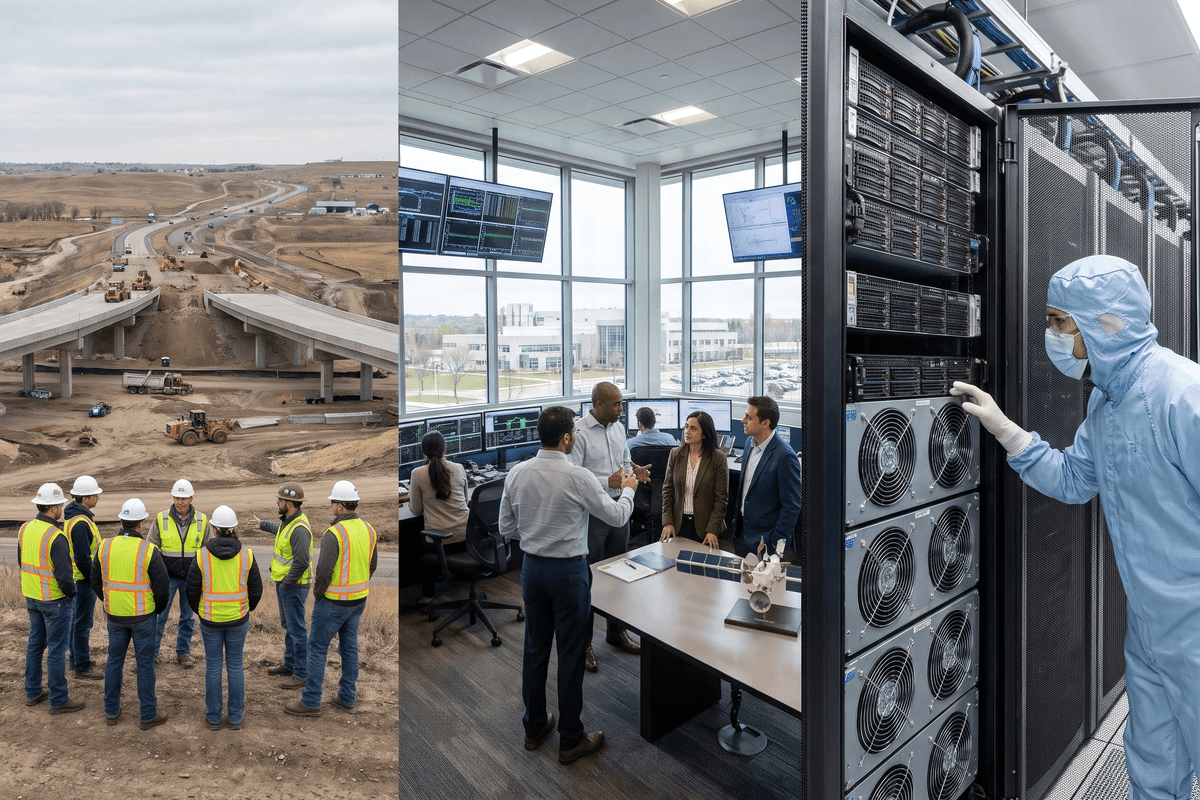

Across the American landscape, the boundaries separating civil infrastructure, federal aerospace manufacturing, and digital industrial power are blurring into a unified test of engineering execution. In the span of days, major project awards spanning Missouri, Texas, and Kentucky have showcased the immense scale and technical diversity required of top-tier engineering, procurement, and construction (EPC) teams. Rather than isolated sector bumps, these awards represent a structural shift toward complex, high-velocity capital deployment where managing live environments, brownfield conversions, and severe supply constraints determines commercial survival.
At the center of this movement is a landmark Midwestern transportation program. The Missouri Highways and Transportation Commission awarded a $583 million design-build contract to a joint venture comprising Jacobs, WSP, and Millstone Weber to reconstruct and expand 44 miles of Interstate 70. Simultaneously, specialized defense and aerospace infrastructure marked a critical milestone as HITT Contracting broke ground on a new greenfield fabrication facility and supporting infrastructure upgrades at NASA's Johnson Space Center (JSC) campus in Houston. Meanwhile, the insatiable power demands of artificial intelligence delivered another mega-award: TeraWulf awarded Fluor an EPC contract for a $4B-plus AI data center complex sited on a former industrial property in Hawesville, Kentucky.
Corridor Modernization: Inside the Jacobs-WSP-Millstone Weber I-70 Strategy
The $583 million Interstate 70 project in Missouri represents one of the largest single transportation undertakings in the state’s history. Encompassing 44 contiguous miles, the scope demands full pavement reconstruction, geometric reconfigurations, bridge replacements, and the addition of a third continuous travel lane in each direction. For the joint venture—uniting the planning and systems engineering prowess of Jacobs, the technical engineering and program management depth of WSP, and the regional heavy civil grading and paving horsepower of Millstone Weber—the mandate hinges on compressing project timelines while maintaining high-volume freight throughput.
Interstate 70 serves as the primary transcontinental artery through the American heartland, carrying tens of thousands of commercial trucks daily between Kansas City and St. Louis. Executing full-depth pavement replacement across 44 miles under live-traffic conditions introduces severe geotechnical, staging, and constructability hurdles:
- Dynamic Maintenance of Traffic (MOT): Phasing construction to guarantee continuous multi-lane travel without bottlenecks, leveraging intelligent transportation systems (ITS) and real-time corridor monitoring to reroute traffic dynamically during structural deck pours and paving operations.
- Pavement Lifecycle Optimization: Designing heavy-duty subbase layers and high-durability concrete mixes capable of withstanding escalating freight axle weights over a 50-year design horizon.
- Accelerated Bridge Construction (ABC): Replacing aging overpasses and water-crossing structures using precast bridge elements and prefabricated superstructure modules to shorten road closure windows from weeks to hours.
"Design-build delivery at this scale is less about raw earthmoving and more about risk management. When dealing with 44 miles of active freight traffic, every hour saved in the staging schedule directly protects both driver safety and program margin."
By packaging 44 miles into a single consolidated design-build contract, the Missouri Department of Transportation (MoDOT) is intentionally bypassing traditional design-bid-build fragmentation. This gives the Jacobs-WSP-Millstone Weber consortium direct control over supply procurement, aggregate batching locations, and equipment allocation, hedging against localized material inflation.
Precision Aerospace Facilities: HITT's Johnson Space Center Expansion
While the I-70 corridor tests heavy civil logistics across dozens of miles, infrastructure at the opposite end of the spectrum is demanding hyper-localized mechanical precision. At NASA’s Johnson Space Center in Houston, Texas, HITT Contracting has broken ground on a modern, greenfield fabrication center tailored for advanced aerospace manufacturing and exploration prototyping.
The Johnson Space Center fabrication center is engineered to support the next era of deep-space exploration, including hardware for the Artemis lunar missions and future Mars architectures. Delivering a greenfield facility within an operational federal research campus introduces severe technical constraints that bridge structural engineering, cleanroom standards, and advanced industrial MEP:
- Vibration Isolation and Foundation Engineering: High-precision CNC milling machines, additive manufacturing systems, and electron-beam welding units require massive, vibration-isolated slab-on-grade foundations to decouple shop floor machinery from ambient environmental acoustic and seismic disturbances.
- Controlled Environment Logistics: Integrating high-bay fabrication zones with ISO-certified cleanrooms, demanding dedicated air handling units (AHUs), positive-pressure differentials, and HEPA-filtration arrays capable of eliminating particulate contamination during spacecraft component assembly.
- Overhead Material Handling: Erecting specialized high-capacity overhead bridge cranes and heavy-payload gantry systems that interface seamlessly with flexible floor layouts, allowing engineers to transition quickly between disparate exploration hardware payloads.
HITT Contracting's task underscores how institutional defense and aerospace clients are upgrading aging legacy footprints to meet the automated manufacturing standards of commercial space partners. The facility must not only manufacture one-off flight components but also function as an agile testing and metrology laboratory.
Industrial Brownfield Transformation: Fluor's $4B-Plus Kentucky AI Fortress
Simultaneously, the convergence of energy infrastructure and artificial intelligence reached a new financial watermark with TeraWulf awarding Fluor an engineering, procurement, and construction (EPC) contract for a multi-building AI data center campus in Hawesville, Kentucky. Valued at north of $4 billion, the project repurposes a legacy industrial site—the historic Hawesville aluminum smelter—into a high-density compute powerhouse.
The Hawesville project highlights a major pivot across U.S. power and digital infrastructure engineering: the brownfield industrial pivot. Building multi-gigawatt compute campuses in suburban tech corridors has collided with utility interconnect backlogs and local community pushback. By targeting a decommissioned industrial smelter site, TeraWulf and Fluor are capitalizing on pre-existing heavy electrical interconnects, high-voltage transmission rights-of-way, and robust cooling water access along the Ohio River.
Key Technical Challenges in AI Industrial Conversions
- High-Density Thermal Engineering: Standard air-cooled data halls are inadequate for next-generation GPU clusters operating above 100 kW per rack. Fluor’s engineering scope will involve direct-to-chip liquid cooling loops, high-efficiency plate-and-frame heat exchangers, and closed-loop evaporative cooling towers.
- Substation and Medium-Voltage Distribution: Overhauling historical industrial substation infrastructure to feed highly dynamic, non-linear compute loads without inducing phase imbalances or harmonic distortions into the regional bulk transmission grid.
- Environmental Remediation and Foundation Retrofits: Navigating subsurface industrial contaminants from decades of aluminum smelting operations while engineering massive pile-supported slabs capable of bearing extreme transformer and server chassis weights.
For an EPC heavyweight like Fluor, this contract confirms that digital infrastructure has fully graduated into the domain of heavy industrial engineering. Designing and constructing multi-building hyperscale complexes requires the exact supply-chain procurement and megaproject risk management traditionally reserved for petrochemical refineries and nuclear power stations.
Cross-Sector Project Comparison
These three concurrent awards illustrate how capital allocation and project delivery strategies vary significantly based on sector constraints, regulatory oversight, and technical complexity.
| Project Scope | Contract Value | Key Partners | Primary Delivery Model | Primary Engineering Focus |
|---|---|---|---|---|
| Missouri I-70 Reconstruction (44 Miles) | $583 Million | Jacobs, WSP, Millstone Weber | Design-Build | Live-traffic corridor staging, heavy civil paving, accelerated bridge construction (ABC) |
| NASA JSC Fabrication Facility (Texas) | Confidential / Federal | HITT Contracting, NASA | Construction Management / Greenfield GC | Vibration-isolated foundations, cleanroom HVAC, high-bay aerospace manufacturing integration |
| TeraWulf AI Data Center (Kentucky) | $4+ Billion | Fluor, TeraWulf | Full-Wrap EPC | Brownfield industrial conversion, high-density direct liquid cooling, high-voltage grid interconnects |
Strategic Implications for Engineering Leadership
For engineering executives, program directors, and lead systems engineers navigating this market, the operational implications are clear:
1. The Return of the Mega-Consortium
As contract packages cross the half-billion-dollar mark—exemplified by MoDOT’s $583M award to Jacobs, WSP, and Millstone Weber—pure-play engineering firms can no longer operate in isolation from general contractors. The joint venture model allows firms to balance balance-sheet risk, share performance bonding liabilities, and integrate design directly into the contractor's equipment and materials pipeline.
2. Brownfields Are the New Greenfields for Power-Hungry Compute
Fluor’s Kentucky award proves that the fastest path to gigawatt-scale power interconnects lies in decommissioned heavy industrial assets. Engineering firms must develop internal multidisciplinary capabilities that fuse environmental site remediation, power substation rehabilitation, and advanced mechanical systems engineering. The ability to evaluate legacy industrial infrastructure quickly will be a primary competitive differentiator.
3. Specialized Controlled Environments Demand Agile Manufacturing Layouts
HITT Contracting’s work at NASA JSC illustrates that modern manufacturing facilities must balance stringent ISO environmental controls with high reconfigurability. As aerospace, semiconductor, and clean-tech manufacturing expand domestically, structural engineers and MEP leads must design flexible, vibration-mitigated spaces that accommodate continuous technological churn over a multi-decade operational lifespan.
The Forward Outlook
The convergence of the $583 million I-70 corridor contract, HITT's specialized NASA ground-breaking, and Fluor's $4B+ AI campus marks a definitive transition in U.S. engineering delivery. The market is rewarding organizations capable of deploying sophisticated systems engineering across disparate operational landscapes—from active, high-speed freight corridors to ultra-clean aerospace assembly bays and power-dense computing campuses.
As state transportation agencies double down on collaborative design-build to modernize crumbling interstate networks, and as AI and aerospace developers demand unprecedented velocity from their EPC partners, the engineering industry's baseline has elevated. The engineering leaders who thrive in this cycle will be those who bridge the gap between heavy civil logistics, high-voltage electrical realities, and precision manufacturing tolerances—delivering critical infrastructure that is resilient, scalable, and built for long-term operational performance.